
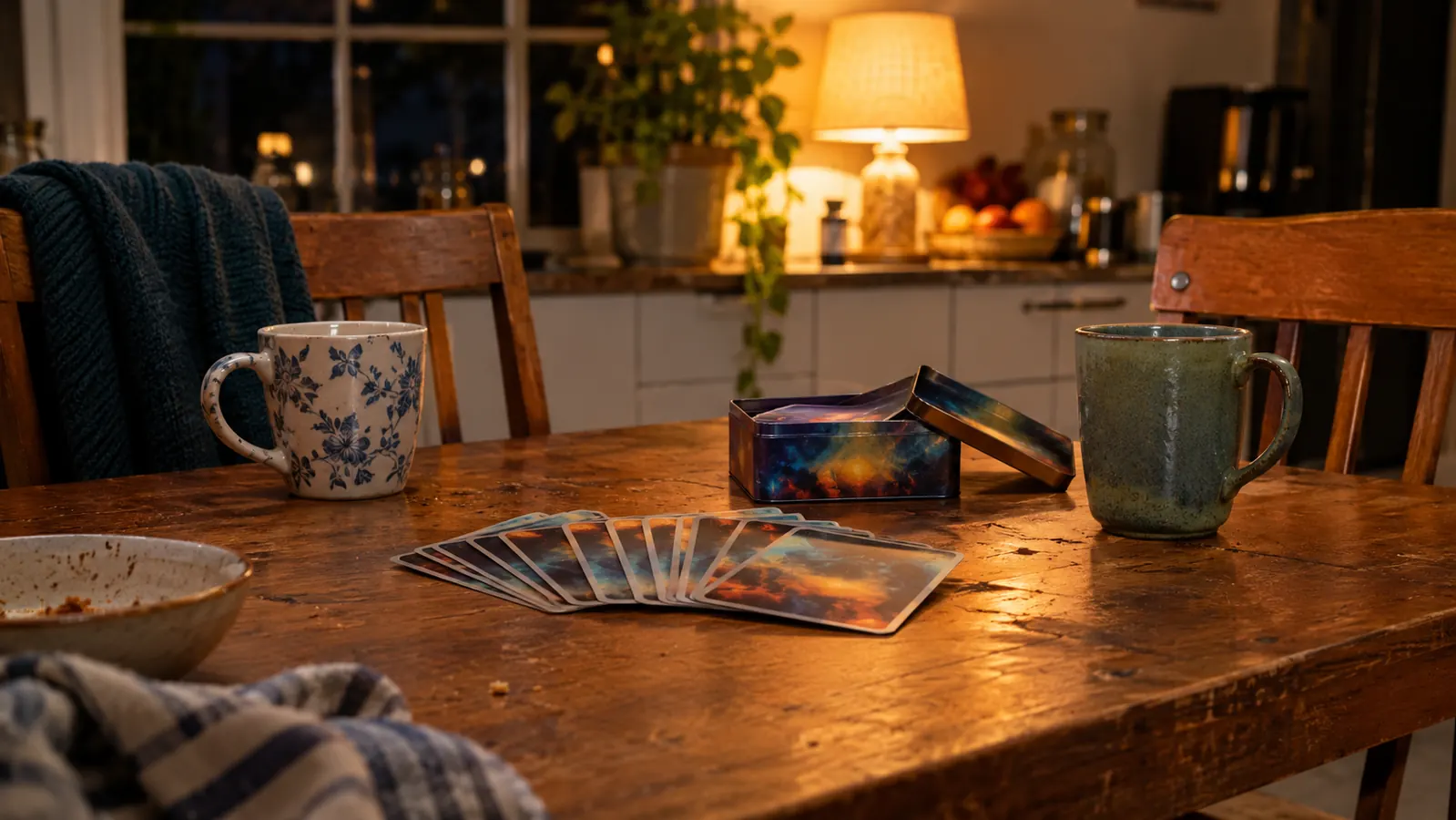
I bought Let's Get Deep on a Tuesday and then let it sit in the hall closet for three weeks. That is the honest version of how this started. I am 38, I spend my workdays with middle schoolers, and by 8:30 at night I have roughly four sentences left in me. Handing my husband a deck of question cards felt like assigning homework to both of us.
Let's Get Deep is a question card game for couples from WHAT DO YOU MEME? (Relatable). You sort the cards into four piles, Ice Breaker, Deep, Deeper, and Activity, and you work your way up. The tin is small, 8.27 by 4.33 inches, and it holds cards and nothing else. No timer, no buzzer, no score pad. It is rated for ages 17 and up, it says so plainly on the packaging, and it means it. Two or more players, though in practice it is two. Mark is 41, an HVAC technician, and a man who would rather discuss refrigerant lines than feelings. We have been married eleven years. He is the reason I can actually tell you whether this works, because he is the hardest possible audience for it.
The Quick Verdict
The most useful conversation deck I have found for two people who already share a mortgage, and the one most likely to get a quiet partner to actually answer. It has no winner, the Deeper pile is not a joke, and by game fifteen you will recognize cards. Buy it for the middle of a marriage, not the start of one.
Amazon Check Today's Price →If your kitchen table has gone quiet, start here
Four piles, one small tin, no screens. This is the simplest thing I have found for getting a real conversation out of a Tuesday night.
Amazon Check Today's Price on Amazon →How This Actually Ended Up on My Kitchen Table
The first night, I made a mistake. I dumped the whole tin on the table and started reading whatever came up, which meant we went from how was your day to a Deeper card in about ninety seconds. Mark answered the first one with three words and looked at the clock. If you take one thing from this review, take that. The piles are ordered on purpose, and skipping ahead is how you kill the game on night one. Before this we had tried a shared notes app where we were supposed to answer one question a day. It lasted nine days and then sat unopened for four months. We also tried a deck of conversation starters we picked up at a bookstore in Clintonville, and it went straight at the heavy material with no warm-up, which meant Mark shut down by card three. The difference here is not that the questions are better. It is that the deck makes you climb before it asks you to jump.
The second attempt went better. We started at Ice Breaker, which sounds like a waste of time with someone you have known for fifteen years, and it is not. The early cards are low stakes enough that you answer without editing yourself first, and that gets a rhythm going. By the time we reached the Deep pile we had been talking for forty minutes and neither of us had looked at a phone. I remember one Ice Breaker card about the first meal we ever cooked together, a disastrous chicken thing in a rental kitchen in 2014 that set off the smoke alarm twice, and Mark laughed out loud. He does not laugh out loud in November. That is what bought me the rest of the night. He did not say the word feelings once. He also did not leave, and he did not check his phone, which is the actual metric in this house.
We have played it maybe fifteen times since, mostly at the kitchen table between 8:30 and 10 at night. Our kids are nine and six, so the window is short and the deck fits inside it. A couple of times we took it onto the back porch in summer when the kids were down and the mosquitoes were winning, and the tin sat on the side table with two glasses of iced tea sweating rings onto the wood. It has never run past an hour and a half. Most nights it runs closer to fifty minutes and ends because one of us is yawning, not because we are finished. Nobody has ever won. That last part matters more than you would expect, and I will come back to it.

What the Four Piles Are Actually Like
The Ice Breaker pile is the one people skip and should not. The questions are light, occasionally silly, and they do the job of getting two tired adults to stop performing tiredness at each other. We have had genuinely new answers out of this pile. Small ones, mostly, like what he actually thought of the first apartment we rented on Weber Road, where the radiator knocked all night and I found it charming and he did not. Eleven years and he never said a word about it. That is the thing about a card. It asks a question in the abstract and your partner answers in the specific, because the specific has been sitting there the whole time waiting for a doorway. Ice Breaker is that doorway, and it costs you about eight minutes.
The Deep pile is the workhorse. This is where the game earns its reputation, and it is also where you find out whether your partner wants to be at the table. Some of these questions are the ones you have been meaning to ask for years and never found a doorway into. Mark answered one about a year he would redo, and I learned more in four minutes than I had in the previous six months of car rides to soccer practice. He said he would redo the year he turned down the job that would have moved us to Dayton, and that he had been turning it over in the truck on long service calls ever since, and had never once brought it up at home. I have known this man since we were twenty six. I did not know that. I had to set the card down and look at the wood grain for a minute.
The Deeper pile is the one that gets talked about in other reviews, and it earns the warning label. These are direct questions, some of them about the relationship itself, and a couple of them land hard if you are in a rough stretch. I have dealt around exactly two cards in fifteen games, and I remember both. One asked something about regret that I was not going to answer on a Wednesday. The other was about what we would each do differently, and we were both tired, and I knew at ten at night it would go badly. That is not a knock on the deck. It is the difference between a game that is safe and a game that is useful, and useful has edges.
On a typical night we get through somewhere between twenty and thirty cards, which sounds like a lot until you see how short most of them are. The tin holds hundreds, so you will not run dry in a month. What happens instead is subtler: you start to notice the deck has a personality. It leans toward memory and toward the future in roughly equal measure, and it is more interested in small honest answers than in big declarations. Nobody has to make a speech. That suits a house where one person talks to a room of twelve year olds all day and the other one climbs into attic spaces with a gauge and comes home quiet.
Mark answered one about a year he would redo, and I learned more in four minutes than I had in the previous six months of car rides to soccer practice.
What Nobody Tells You Before You Buy
Nobody tells you the game has no ending. There is no score, no winner, no final card that closes the night. You stop when you are tired, or when the oldest kid thumps down the hall for water, and you put the rubber band back around the pile. For some couples that is freeing. For competitive people it is quietly maddening, and if your partner needs a scoreboard to stay engaged, this will lose them somewhere around the Deep pile and not come back. Mark is competitive in exactly one place, which is a truck engine, so we were fine. My sister and her husband would not be. He would be asking who was ahead by card six.
Nobody tells you the tin runs out of novelty. Fifteen games in, we are recognizing cards before we flip them. WHAT DO YOU MEME? (Relatable) says on the listing that the content has been refreshed, and I believe it, but a finite deck is still finite. Around game twelve I answered a question I remembered answering on the porch in July, and I gave a different answer, which was interesting but not the same as a new question. Ours gets pulled out every few weeks now instead of every week, which honestly might be the correct dose for anything played at a kitchen table. The game tins that get used to death in January are the ones on the shelf by March.
Nobody tells you the Activity cards break the rhythm. They are mixed in with the conversation cards, and they ask you to do something rather than answer something, and after twenty minutes of real talk, getting up to perform a bit feels like a record scratch. The first time one came up we were so far into a Deep conversation that we laughed and slid it under the tin. We started setting them aside and doing them first, before the talking starts, which fixed it entirely. That is the kind of thing you figure out on your own in month two and wish the insert had mentioned.
One more thing about the physical object, because it matters more than you would think. The tin measures 8.27 by 4.33 inches, paper cards inside, and it takes up about the footprint of a paperback. It goes in a tote bag for a weekend away without bending a card, and it goes back on the shelf in the hall closet without an argument about where it lives. We have had game boxes that split at the corners within a season. This one is still square after a year and a half, and the cards have not started to curl, which says something about how often it has been handled.

Where It Falls Apart
The mature content label on the WHAT DO YOU MEME? (Relatable) tin is not decorative. The deck is rated 17 and up and the Deeper pile goes places a family game night cannot follow. That is fine if you know it. It does mean you cannot leave this on the coffee table with a nine year old in the house. Ours lives on a high shelf in the hall closet, which is also where it sat for three weeks before I worked up the nerve to open it. My daughter is at the age where she reads everything in the house out loud, cereal boxes included. A tin of questions about the marriage sitting on the coffee table would have been a fifteen minute conversation I did not want to have on a school night.
The game assumes two willing people. This is the limitation nobody prints on the packaging. If one partner is answering in monosyllables and checking the clock, no deck of cards fixes that, and pushing harder makes it worse. There was a night in February when I pulled it out and Mark said, not unkindly, that he had been in a crawl space since eight in the morning. I put it away. We watched half a hockey game. The deck was there the next week and it worked the next week. Treat it as an invitation instead of a summons and it holds up. Treat it as a summons and you will get three word answers and a man who suddenly needs to check the furnace.
It also does not scale. Two is right. Three works if the third person is a very close friend and everyone is being honest. Four is a dinner party, and this is not a dinner party game. There are no teams, no rounds, no points to keep. It is a conversation with a structure, and structure gets worse as the group gets bigger. We tried it once with my sister and her husband on a Saturday and it lasted about eleven minutes before somebody started talking over the pile about a kitchen renovation.
What I Liked
- Gets a quiet partner talking without turning it into a confrontation
- Four ordered piles, so you can start light and stop whenever you want
- Small tin, 8.27 by 4.33 inches, that lives in a drawer or a closet shelf
- Ice Breaker cards still produce new answers after eleven years together
- No timer, no scoring, no winner, nothing to manage or referee
Where It Falls Short
- Finite deck, and by game fifteen you recognize cards
- Deeper pile can land badly if the relationship is in a rough patch
- Activity cards interrupt the conversation and work better played first
- No score and no ending, which loses competitive players
- Rated 17 and up, and the mature content is real
Who This Is For
This is for the couple whose conversation has collapsed into logistics. If your evenings are who is doing drop off and whether the gutters need doing before the frost, this deck is a way back in that does not require either of you to announce that you want to talk more. That framing is the whole thing. Mark would have resisted a conversation about our communication. He did not resist a card game, and he did not resist it because the first eight cards asked him nothing he could get wrong.
It is also good for a couple in a fine place who just wants a better Tuesday. Not every marriage needs repair. Some need a reason to sit at the table for an hour with no screen in the room, and this is a small, reusable one that fits in a drawer and requires no setup, no charging, and no explaining. WHAT DO YOU MEME? (Relatable) built it to do exactly that, and it does.
Who Should Skip It
Skip it if you want a party game. This is not one. If you are looking for something to bring out with another couple or with your sister and her husband, it will go flat, because the questions are built for two people who share a mortgage, not four people being polite to each other over a cheese board. Skip it too if you need a winner, and skip it if anyone at the table cannot handle a direct question about the relationship on a random Wednesday.
And skip it if you are in the middle of something genuinely bad. The Deeper pile is not therapy and it does not pretend to be. It is a deck of cards with a good ear for the question you have been avoiding. That is useful when things are steady. It is not useful when they are not, and no game should be asked to carry that weight for you.
The deck that earned its spot in the closet
Four piles, no screens, one hour at the kitchen table after the kids are down. If your evenings have gone quiet, this is the smallest thing I have found that changes that.
Amazon Check Today's Price on Amazon →