
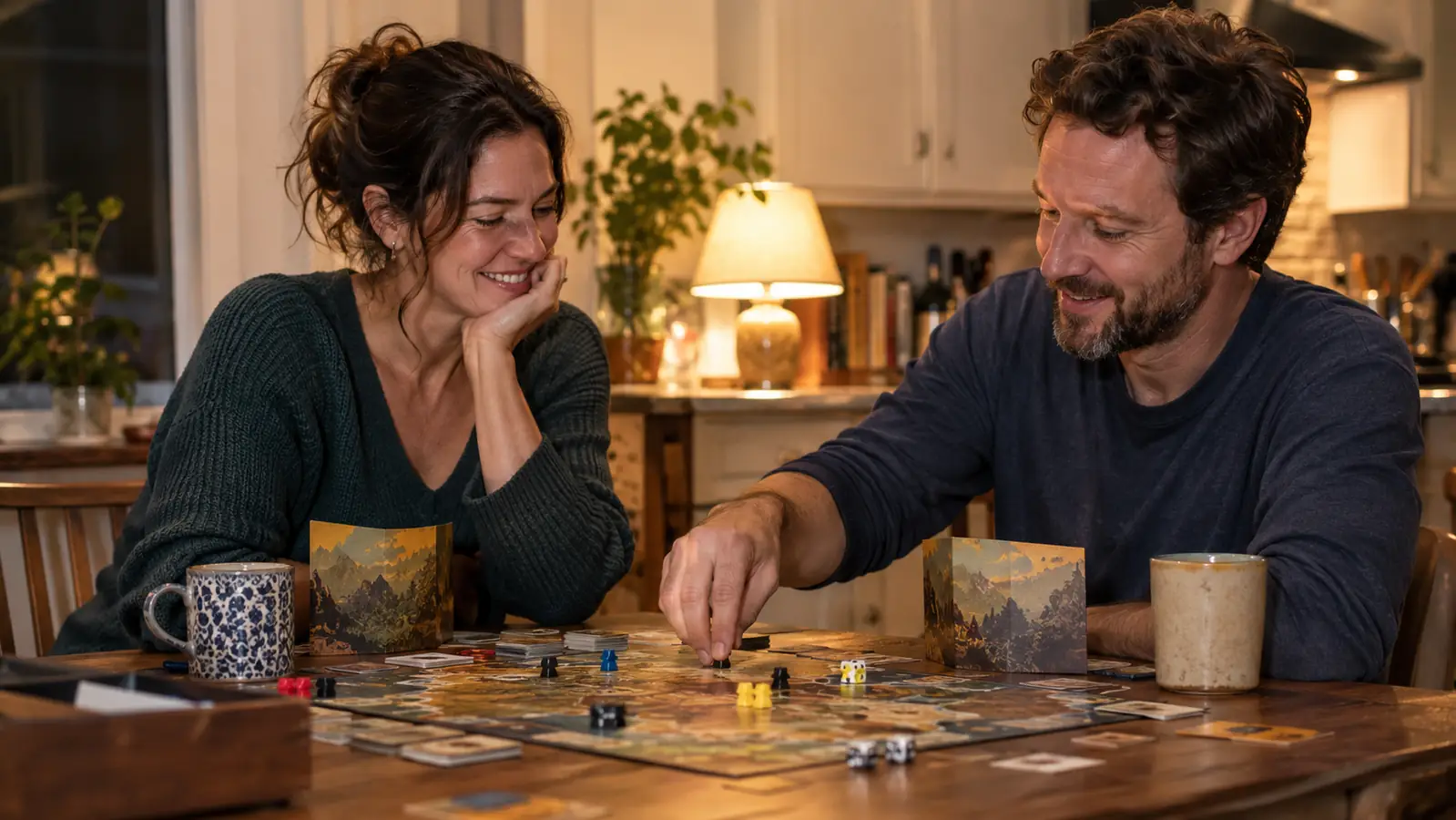
Sky Team is the first cooperative game that has survived more than a week on our kitchen table. I am Tessa, a middle-school librarian in Columbus, Ohio, and my husband Mark is an HVAC technician who groans whenever I bring home something that looks like a relationship exercise. Sky Team, from Scorpion Masqué, is not that. It is a two-player game about landing a plane, and the talking happens because the dice demand it, not because a card asked us to share a feeling. We have played it after the kids go down, roughly 8:30 to 10 PM, for several weeks now. Some nights we land. Some nights we crash on the runway and immediately set up again.
That is the short version: Sky Team earns its table time. The longer version includes a rulebook that took us two reads, a few scenarios that felt unfair on the first try, and one recurring argument about who gets to call the final approach. None of that stopped us. It is the rare couples game that works because it is a good game first.
The Quick Verdict
A tight two-player cooperative game that turns conversation into a shared job. Best for couples who like a puzzle, not a prompt deck.
Amazon Check Today's Price →Land the first airport together tonight
Sky Team is a two-player cooperative game from Scorpion Masqué with 20 airport scenarios and optional challenge modules. If you want a game that gives you something concrete to talk about, start here.
Amazon Check Today's Price on Amazon →How I've Used It
Mark and I are not hobby gamers with a wall of shelves. We have a few party games, a deck of cards, and a shelf of books that are mostly mine. He is the skeptic. The first night I opened Sky Team, he read the box, saw the line about working together to land the plane, and said, 'So we are doing homework with dice.' I set up the first airport anyway.
Setup is part of why it works for us. The control panel goes in the middle. We each take a player aid screen. The eight dice go in reach. The altitude track sits where both of us can see it. There is nothing to charge and no screen between us. That last part matters more than I expected. By 8:30, after homework and dishes and the third glass of water for the 6-year-old, I do not want another screen. I want something I can touch and talk about. Sky Team is that.
The first game took us 25 minutes including the rulebook. The second took 12. By the end of the week we could reset in under a minute. The control panel sits between us. Each of us has a player aid screen. The eight dice are the main random element. We talk, we place dice, we adjust the airplane axis disc, and we watch the altitude track. The components are cardboard, which makes the whole thing feel like a game you can actually use rather than protect.
Three weeks in, we have played the first eight airports, repeated four of them, and added the kerosene leak module once. We have not won every game. Our record is 11 wins and 7 losses, which is the right ratio for us. A game that lets you win every time stops being interesting by the second night. Mark still calls it 'the airport game'. He does not call it a relationship game. That is a win in this house.
What Comes in the Box and How a Turn Actually Works
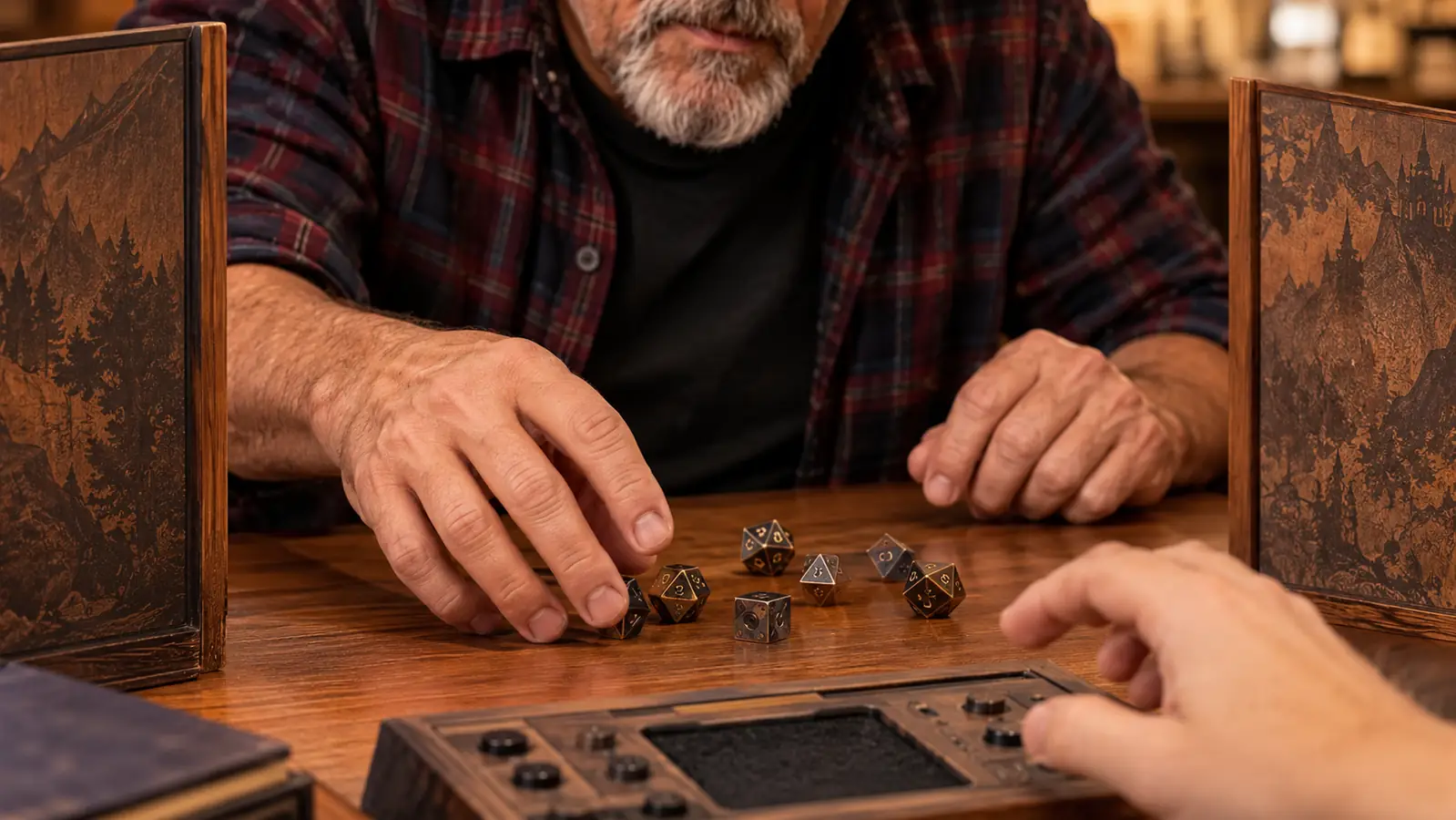
The box contains one control panel, one airplane axis disc, eight dice, two player aid screens, and an altitude track. The player screens hide your dice from your co-pilot. The box is travel sized, though we have only played at home. Scorpion Masqué keeps the footprint small enough that it lives on the shelf with our cards instead of in a closet.
A turn is a conversation with a deadline. You and your co-pilot each roll dice behind your screens. Then you talk in the narrow language the game allows. You can say what you need, what you can offer, and what you cannot do. You place dice on the control panel to clear air traffic, adjust speed, and level the wings. The airplane axis disc and altitude track show whether you are still flying or already in trouble.
The important part is that you cannot show your dice. You can only describe them. That sounds small. In practice it turns every turn into a tiny negotiation. Mark knows I have a die that can fix our speed. I know he has a die that can level the wings. Neither of us can do both. So we decide what to leave alone for one more turn. Sometimes that decision is fine. Sometimes it is the reason we end up in the grass beside the runway.
The first two games were slow because we kept reading the player aids. The player aids are dense but useful. After that, the rhythm clicked: roll, talk, place, resolve. The game does not need a timer. The pressure comes from the dice you did not get and the altitude track moving down. If you have played a lot of cooperative games, you will recognize the feeling. If you have not, it takes one night to learn.
The rulebook deserves a fair warning. Our first read felt like assembling furniture without the picture. The player aids carry most of the detail, so the game makes more sense once you set it up and play a practice round. We watched no videos. We just played the first airport with the rulebook open and got a few rules wrong. The second game fixed that. If you learn best by doing, budget one clumsy night and you will be fine.
The Communication Puzzle That Makes It Work
This is where Sky Team separates itself from a lot of cooperative games. In many co-op games, one person can run the whole table. Here, the hidden dice make that impossible. You cannot quarterback a hand you cannot see. Mark cannot solve my side of the control panel for me because he does not know what I rolled. I cannot solve his. We have to ask.
The questions are specific. 'Can you take the speed down one?' 'Do you have a die for the axis?' 'If I clear the traffic, can you hold the altitude?' That is a different kind of talk than 'How was your day?' It is not therapy. It is a shared task, and the task gives us something to be curious about in each other. We have had more useful conversations over a bad landing than over a dinner where neither of us knew where to start.
The downside is real. If one player is tired or distracted, the communication breaks and the plane goes down. The game is not forgiving of a partner who checks a phone between turns. It also rewards a certain kind of bossy player a little too much. We had to make a house rule: no reaching across the table to point at a spot on the control panel unless you ask first. That rule saved us an argument.
Mark is the reason I trust this game as a couples pick. He does not like being asked to be vulnerable on command. He does like being useful. Sky Team gives him a job. He can see a problem, call it out, and solve it with me. That is his love language, or at least his comfort zone. By the third night he was the one saying, 'Let's try the next airport.' I did not have to sell him on togetherness. The game did it.

The 20 Airports and the Optional Modules
Sky Team comes with 20 airport scenarios. Each airport has its own layout and special rules. That is the main reason the game has stayed out. The first airport is a teaching tool. The later ones add more rules on top of the same eight dice, so the game feels different without adding a second box. We have not played all 20. We are trying not to rush them, because the discovery is half the fun.
The optional challenge modules are the second reason. The box lists kerosene leaks, ice on the tarmac, and a rookie intern who needs extra guidance. We tried the kerosene leak module after we had won the first few airports. It added a new thing to track and a new way to lose. We have not tried the rookie intern yet. Mark says it sounds like bringing our actual children to game night. I think he is right.
The Game of the Year 2024 label on the box is not why we bought it, but it explains why the game keeps showing up on lists. The design is tight. The rules are not bloated. The 20 scenarios give you a lot of game in a small box. The travel sized format means you could take it on a trip, though the pieces are small enough that I would use a bag for the dice.
The first airport is gentle enough that we won on our second try. The fourth airport took us five attempts. That swing is not a flaw. It is the reason we keep coming back. Some scenarios add special rules that change how you use the same control panel. All of them use the same small set of components, which means you are never relearning a new game. You are just relearning the same game under pressure.
One caution: the title says ages 12 and up, and that feels right. Our 9-year-old could sit and watch, but the planning is too much for him to play well. This is a game for two adults or two older kids who can talk through a plan without getting their feelings hurt. The age field on some retail listings is messy. Trust the box title.
What I Liked
- Two-player cooperative game where hidden dice force real conversation
- 20 airport scenarios plus optional modules give a lot of replay
- Small box, quick reset, and easy to play on a weeknight
- Rules are tight once you get past the first read
Where It Falls Short
- The rulebook takes a couple of reads
- Some scenarios can feel punishing on the first attempt
- Only for exactly two players
- A tired or distracted partner can sink a run
- Not a good fit for groups or for people who want a party game
The hidden dice do the work. Mark cannot solve my side of the control panel because he cannot see what I rolled. We have to ask, and that is the whole game.
Who This Is For
If you and your partner already like cooperative games, this is an easy yes. If one of you is the skeptic, this is a good gateway because it does not ask you to talk about your feelings. It asks you to land a plane. That is a lower bar and a better time. We have recommended it to two couples in our neighborhood, and one of them has already borrowed it for a weekend.
It is also a good pick for long-distance couples who each have a copy and can play over video, though the hidden dice are harder to manage. For gift buyers, this is a safe pick for a couple with a small table and a 30-minute window after the kids are down. It is not just for couples, either. Two friends who want a cooperative puzzle will get their money's worth.
One more thing for gift buyers: this is a complete game in one box. You do not need an expansion to get the full experience. The 20 airports and the optional modules are already inside. That makes it a clean gift for a couple who has a small apartment, a small table, or a small window of time. It also travels well if you keep the dice in a bag.
Who Should Skip It
Skip it if you want a party game for four or more. Sky Team is exactly two players. Skip it if you hate rules overhead or if one partner refuses to engage with a puzzle. Skip it if you need a game that lets you switch off and not talk. This one asks for attention.
Also skip it if a competitive game is the way you two connect. Sky Team is cooperative all the way. There is no hidden traitor, no winner, and no score to beat except the airport. Some couples find that relaxing. Some find it flat. Know which couple you are. And if you are looking for a game to play with the kids, wait until they are older. The box says 12 and up for a reason.
If your game night needs a shared job, start with Sky Team
The version from Scorpion Masqué is a two-player cooperative game with 20 airports and optional challenge modules. It is small enough for a kitchen table and deep enough to keep for weeks.
Amazon Check Today's Price on Amazon →