

The short answer depends on the couple. If you want a structured, laugh-then-get-quiet night at the kitchen table, Let's Get Deep, the question card game for couples from WHAT DO YOU MEME? (Relatable), is the one I reach for. If you want a small deck that slips into a weekend bag and asks a few sharp questions without any setup, We're Not Really Strangers is the better fit. I am Tessa, 38, a middle-school librarian in Columbus, Ohio, married to Mark for 11 years. Mark, 41, is an HVAC technician and a quiet man who groans at the phrase "relationship game." We play after our kids, 9 and 6, go to bed, usually from 8:30 to 10. So I care about a game that starts fast, does not feel like homework, and gives us something to talk about besides the dishwasher.
Here is the short version for people who are already scrolling. Let's Get Deep wins on structure, replay value, and the way it walks a couple from easy questions into the ones you avoid. We're Not Really Strangers wins on speed, portability, and a quieter, less game-show feel. Neither is a therapy session in a box. Both are card games. The right one is the one you will actually put on the table on a Tuesday when you are tired and the dishes are still in the sink.
| Let's Get Deep | We're Not Really Strangers | |
|---|---|---|
| Structure | Four piles: Ice Breaker, Deep, Deeper, and Activity | Three levels plus wildcard questions |
| Number of players | 2 or more | Built for two |
| Age guidance | 17 and up, with mature content | Written for adults |
| Setup | Sort cards into four piles before the first question | Open the deck and draw |
| Content style | Escalating prompts plus activity cards | Reflective prompts with fewer activities |
| Replay value | Four levels and activities give a couple several different nights | Short, direct deck can start to feel familiar |
| Portability | Comes in a tin, 8.27 by 4.33 inches | A single deck with no pile sorting |
| Best setting | Kitchen table with an hour to spare | Travel, long distance, or a 15-minute check-in |
| Gift factor | Tin and mature content make a clear couples gift | Minimal look suits a low-key gift |
| Emotional temperature | Starts light, then gets direct | Starts reflective and stays even |
Where Let's Get Deep Wins
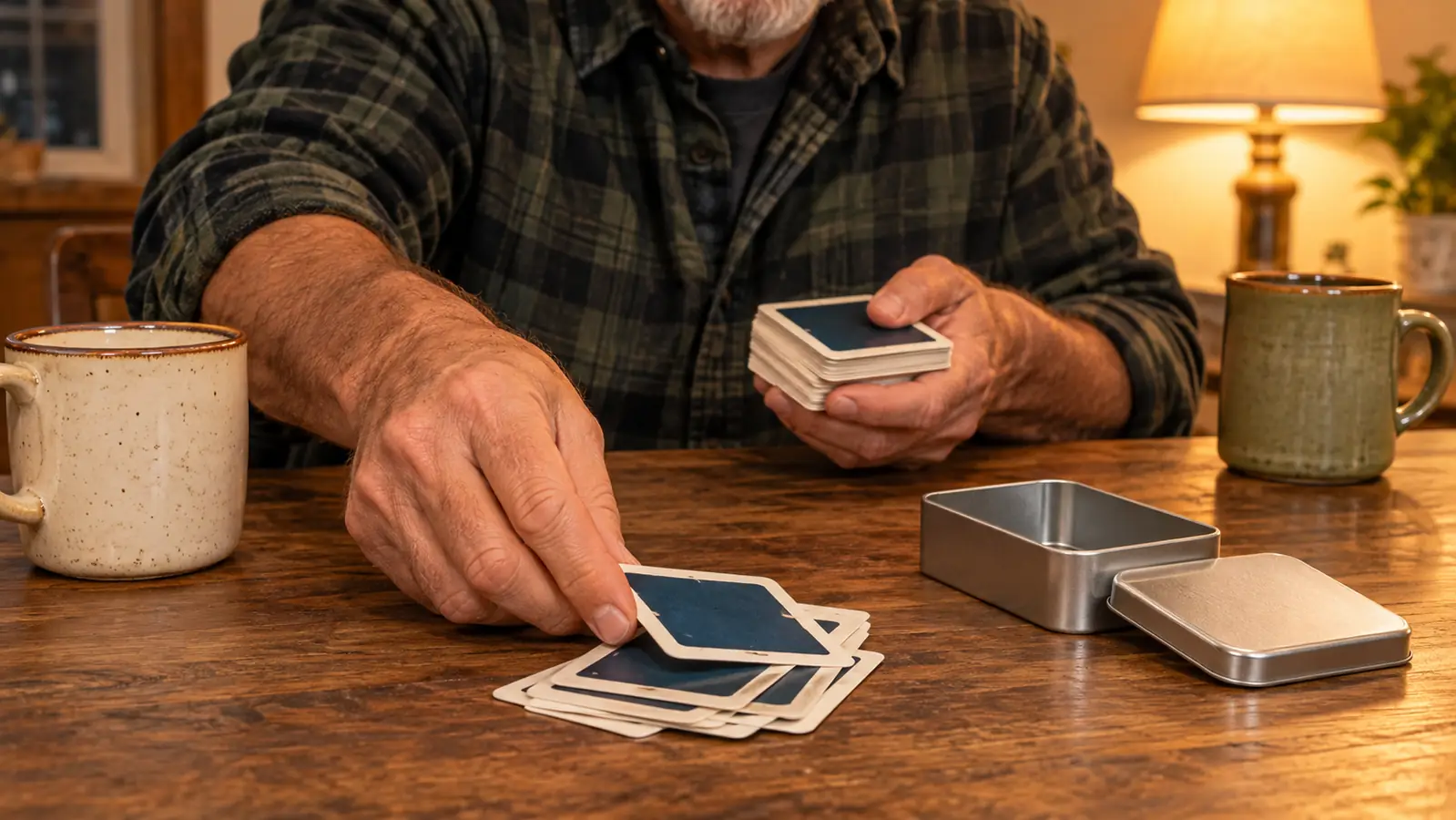
The first thing Let's Get Deep does better is remove the blank-page problem. You sort the cards into four piles: Ice Breaker, Deep, Deeper, and Activity. That structure matters. When Mark and I sit down at 8:30, I do not want to invent a meaningful conversation. I want a card in front of me. The Ice Breaker pile gets us talking about small things. The Deep pile moves us toward memories and opinions. The Deeper pile is where the night changes. The Activity pile gives us something to do with our hands, which helps Mark, a man who would rather fix a furnace than answer a feelings question. The first night we played, I sorted the four piles while Mark rinsed the mugs, and it took me a little over three minutes, which is the only setup cost in the whole box. I stack them back into the tin in order when we finish so the next night starts faster. The paper stock is thin enough that a tipped mug would ruin a pile, so the drinks live at the far end of the table now. That sounds fussy. It is just the small adjustment you make for something you want to keep using.
The second win is replay value. A lot of couple decks have one good night in them. You go through the cards, you learn a few things, and then the deck sits in a drawer. Let's Get Deep, from WHAT DO YOU MEME? (Relatable), has enough range that we have played it on a porch in July and at the kitchen table in February and gotten different conversations. The 17 and up age guidance and mature content are real. This is not a family game, and you should not play it with your kids in the room. That is part of why it works. It gives the two of you a lane that is just yours. The tin also matters more than it should. Cards get lost. A tin keeps the deck together, and the 8.27 by 4.33 inch size slides onto a shelf.
The Deeper pile is where the night changes. Mark answered one about the last time he felt proud of us, and I had to put my mug down.
Where We're Not Really Strangers Wins
We're Not Really Strangers wins on the nights when you have 15 minutes and no patience for sorting. The deck I have uses three levels plus wildcard questions, and you can open it and draw. There is no pile system, no activity cards, no setup. For a couple who travels, or for long-distance couples who want a prompt before bed, that matters. It is also quieter. The questions are reflective and direct, but they do not build like a game show. If Let's Get Deep is a dinner with three courses, We're Not Really Strangers is a short, honest walk around the block.
It also wins for the couple where one person is allergic to anything called a game. Mark is that person. He will answer a question. He will not always want to play a game with rules and piles. We're Not Really Strangers asks you to sit down and talk, and that lower production feel can get a reluctant partner to the table. I would not say it is deeper than Let's Get Deep. I would say it is less performed. You are not moving through levels toward a finish. You are just talking. For some couples, that is the difference between a deck that gets used and a deck that gets dusted. Here is the specific night it won. Mark came home at 7:40 after a no-heat call on the north side of Columbus, ate standing up, and told me he had maybe twenty minutes in him. The tin stayed on the shelf. I pulled the small deck out of the drawer by the couch and we did four questions before he fell asleep on the cushion. No piles, no activity card, no negotiation about whether we were playing a game. That is a real use case, and it is why I would not tell anyone to throw this deck away just because the other one has more in the box.
Want the Structured Kitchen-Table Night? Start With Let's Get Deep
Four piles, one tin, and a clear path from easy questions to the ones you have been circling. If you want a game that gives your evening a shape, this is the one I would put on the table.
Amazon Check Today's Price on Amazon →How We Actually Played It
We played on a Friday after the kids went down. I made tea, Mark made a face at the tin, and we started with Ice Breaker. The first ten minutes were ordinary. Work, the kids, a joke about the neighbor's leaf blower. Then we moved to Deep. The questions got more specific. We talked about a trip we took before the kids were born. We talked about what we want the next five years to look like. At one point Mark answered a question about when he feels most like himself, and I learned something I had not known in 11 years of marriage. That is the actual product. Not the cards. The hour you would not have had otherwise.
The Activity cards were the surprise. I expected them to be filler. They gave us a break from eye contact, which sounds strange, but sitting across from someone and answering direct questions for an hour can be intense. The activity gave us a way to reset. We laughed. We got a little uncomfortable. We finished before 10, which is our real bedtime now. The next morning we talked about one of the Deeper questions over coffee, which is the test I use for any of these decks. Did it follow us out of the room? Let's Get Deep did.
The parts I did not love are worth saying. The mature content is not a warning label for show. Some cards are direct about intimacy, and that is fine if you are ready for it and awkward if you are not. The four-pile sorting takes a minute. If you have a partner who wants to open a box and start, We're Not Really Strangers has the edge. The cards in Let's Get Deep, from WHAT DO YOU MEME? (Relatable), are paper, so you should not leave them on a porch overnight. That is not a flaw. It is just a card game, and it behaves like one. One card in the Deeper pile landed badly. I will not quote it, because the deck is better met cold, but it was a question about a choice from years ago, and Mark answered it flatly and then got up to check the thermostat. We skipped the rest of that pile and went to Activity. The night did not fall apart. We just learned that a deck built for 17 and up can still hit a nerve, and that you are allowed to deal past a card. Knowing that going in helped on every night after.

The Honest Tradeoffs
The tradeoff is time. Let's Get Deep wants an evening. If you have 20 minutes and a partner who is already half asleep, the four piles can feel like a commitment. We're Not Really Strangers fits into the gap between dinner and bed. The other tradeoff is tone. Let's Get Deep has a game-night energy. It is playful, then direct, then playful again. We're Not Really Strangers stays even. If you want laughter and a little performance, the structured deck is better. If you want a calm, honest check-in, the smaller deck is better. The time cost is real in a way that is easy to underestimate. Our window is 8:30 to 10, and once you subtract the ten minutes it takes to get both kids actually settled, we are down to about 75 minutes. Sorting, drawing, and clearing the Ice Breaker pile eats 25 of those. That leaves an hour for Deep and Deeper if we move, and less if one question opens something up, which is the point. The smaller deck fits that same window with room to spare, and on a school night in November that difference decides whether we play at all.
There is also the question of who the deck is for. If you are buying a gift for an engaged couple, Let's Get Deep looks like a gift. The tin, the four piles, the 17 and up label, the fact that it is made for couples but works with 2 or more players. It says I thought about this. We're Not Really Strangers says I thought about this too, but in a quieter way. For a long-distance couple, the smaller deck is easier to pack. For a couple who has been together for years and has stopped asking new questions, the structured deck gives you a reason to sit down. That is not a small thing. We have handed the tin to two sets of friends now, one engaged for a year and one married the summer before us, and both wrote back about a question rather than about the box, which is the only review I trust.
What I Liked
- Four named piles give the night a shape
- Tin keeps the paper cards together
- Works with 2 or more players
- The 17 and up mature content is clearly labeled
- Activity cards break up the intensity
Where It Falls Short
- You have to sort the cards before you start
- Mature content may be too direct for some couples
- It wants a full evening, not a five-minute check-in
- Paper cards need reasonable care
Who Should Buy Which
Buy Let's Get Deep if you want a planned night, if you have an hour after the kids are asleep, and if you want a deck that moves from light to direct without you having to steer. Buy it if your partner is willing to play a game, even a reluctant one, and if you like the idea of activity cards breaking up the heavy questions. It is also the better gift for an anniversary or a wedding shower because the tin and the 17 and up label make the intent clear. Do not buy it for a first date or a family game night. It is not that.
Buy We're Not Really Strangers if you want a deck for travel, long distance, or short check-ins. Buy it if your partner will answer a question but will not sort cards into piles. Buy it if you want a quieter, less produced conversation and you do not need activities. I would still keep both. We do. The structured deck is for the nights we plan. The smaller deck is for the nights we do not. If I had to choose one for the average couple with a kitchen table and a bedtime, I would choose Let's Get Deep. It gives you more to do with the hour, and the hour is the thing you are short of.
Put the Four Piles on Your Table
If you want the version that turns a tired Tuesday into a real conversation, start with Let's Get Deep. The tin, the four piles, and the 17 and up content are all part of the deal.
Amazon Check Today's Price on Amazon →