
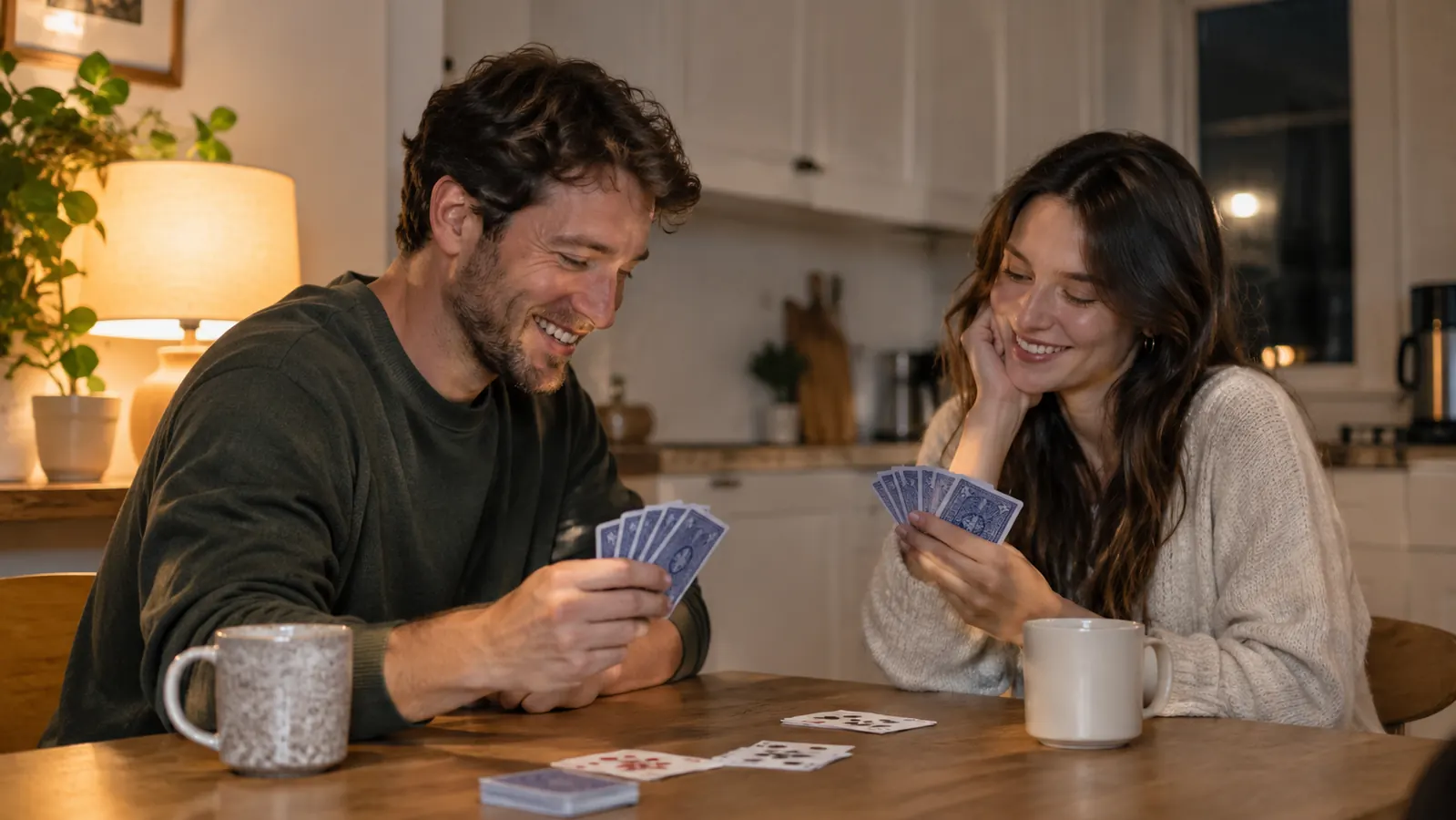
By 9 PM the kitchen is finally quiet. The dishes are done, the nine-year-old is asleep, and the six-year-old has been down for an hour. Mark comes in from the garage still smelling like cold metal, sits down at the table, and we both reach for our phones. Not because we have anything to look at. Because two tired people do not have a better idea at nine o'clock at night.
That is the version of the evening I got tired of. An hour would pass and neither of us would have said anything that counted. What we needed was not a deep conversation about our feelings. We needed something to do with our hands that gave us something to talk about. For us that turned out to be Fox in the Forest, a two-player trick-taking card game from Renegade Game Studios. It plays in about 30 minutes, it lives in a small box, and it asks just enough of you that work drops out of your head. Here is the version of the evening that actually works.
Thirty minutes, two players, and neither of you on a phone
Fox in the Forest is a compact trick-taking game for exactly two players, ages 10 and up, with a full game running about half an hour.
Amazon Check Today's Price on Amazon →Step 1: Clear the table before you sit down
The thing that decides whether a weeknight game happens is almost never the game. It is whether the table is usable. Ours collects mail, a laptop, somebody's water bottle, and whatever the kids abandoned at dinner. If I have to move four things before I can deal a card, the game does not happen. So the first step is boring and it is the whole trick: clear the table, wipe it down, and put the pile somewhere that is not the table.
I learned that the hard way last February. We had a good run going on Tuesday nights and then a week of parent-teacher conferences knocked it sideways. The mail piled up, a stack of graded papers took over the near end of the table, and for eleven days we did not play once. Not because we had stopped wanting to. Because there was nowhere to put the cards down. Eleven days is how a habit dies, quietly, over a pile of paper that would have taken four minutes to move.
Then fix the light. We turn the overhead off and leave one lamp on in the corner and the little one over the stove. That is not decoration. Overhead light at nine at night makes a kitchen feel like a room you are supposed to be working in. One lamp makes it feel like a room you are allowed to sit in.
Last part of this step, and Mark will tell you I am serious about it: both phones go on the counter in the other room. Not face down on the table. In the other room. A phone face down on the table is still a phone on the table, and one of us will check it inside of ten minutes.
Step 2: Learn the trick-taking part with the rulebook open
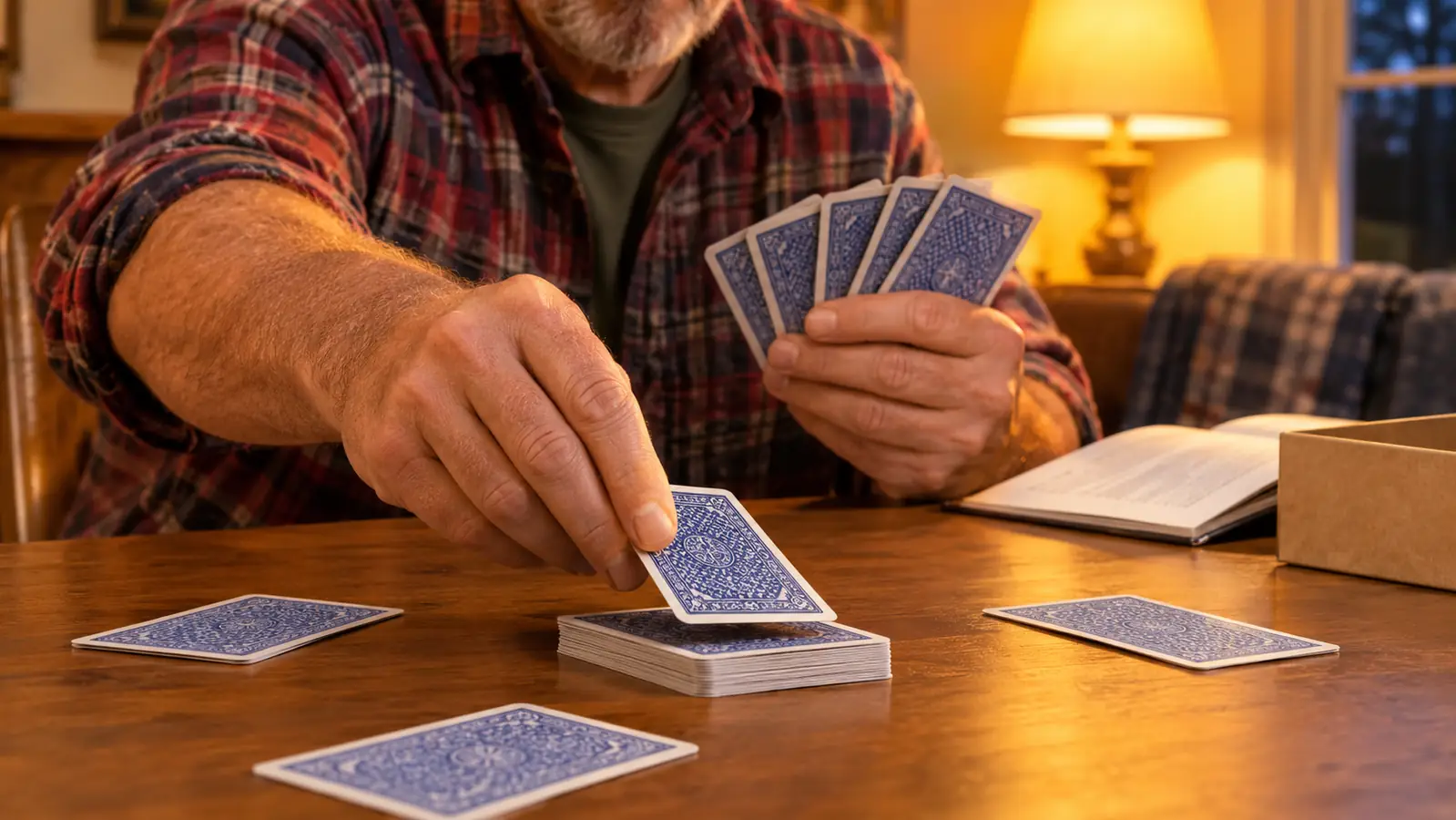
If you have never played a trick-taking game, the name sounds heavier than the thing is. Each player plays one card. Whoever plays the higher card takes those two cards and leads the next round. That is the engine, and you already understand it. Most of the rulebook is about the exceptions stacked on top of that engine, and there are fewer of them than the page count suggests. The fairy tale theme carries through the whole deck, which matters more than I expected, because it gives the cards personalities instead of just numbers.
What surprised me is that the scoring works against the obvious instinct. Taking every trick is not the same as winning. You are rewarded for reading the hand and for knowing when to hold back, which means a quiet, patient player does well. Mark is a quiet, patient player. It is the first game in years that I have watched him enjoy without being talked into it first.
My first attempt at teaching it was a small disaster, and it is worth telling you so you skip it. I read the whole rulebook to myself at the counter while Mark waited at the table, then summarized it to him in one long sentence. He nodded, we dealt, and two hands in we discovered we had been playing the same rule two different ways. We started over. If instead you read it out loud, a paragraph at a time, with the rulebook open on the table between you, you both hear the same rule at the same moment. Renegade Game Studios prints a short one, so it takes about four minutes.
The night we learned it, Mark took a hand without saying a word, then talked for twenty minutes about a job he had never mentioned before.
Step 3: Play the first game badly, on purpose
The first game will be a mess. You will forget the exceptions, you will lose track of who leads, and one of you will take a trick you did not want. Do not stop to fix it. Call the first game a practice round before you deal the first card, so neither of you is competing for anything except getting to the end.
Keep score anyway, but keep it out loud and keep it simple. A running count of games won, not a spreadsheet. The goal of the first night is to get through about 30 minutes without opening the rulebook more than twice. If you manage that, you have learned the game. You will play better on Thursday than you did on Tuesday, and I do not need to know you to say that.
Our first game took forty-two minutes, and I know that because I looked at the stove clock when we finished and could not believe it. We had planned on half an hour. Two rules trips and one argument about who led the last trick ate the extra twelve minutes. The second game took thirty-one. The third took twenty-six. That is the whole learning curve, and it fits in one evening, which is why I tell people not to judge the game on night one.
Expect one of you to be skeptical. Mark's exact words were that he did not need a game to talk to his wife. That lasted until the first hand went sideways and he had to decide whether to take a trick he did not want. Skepticism does not survive a genuinely good decision.
Step 4: Cap it at two games so it stays a wind-down
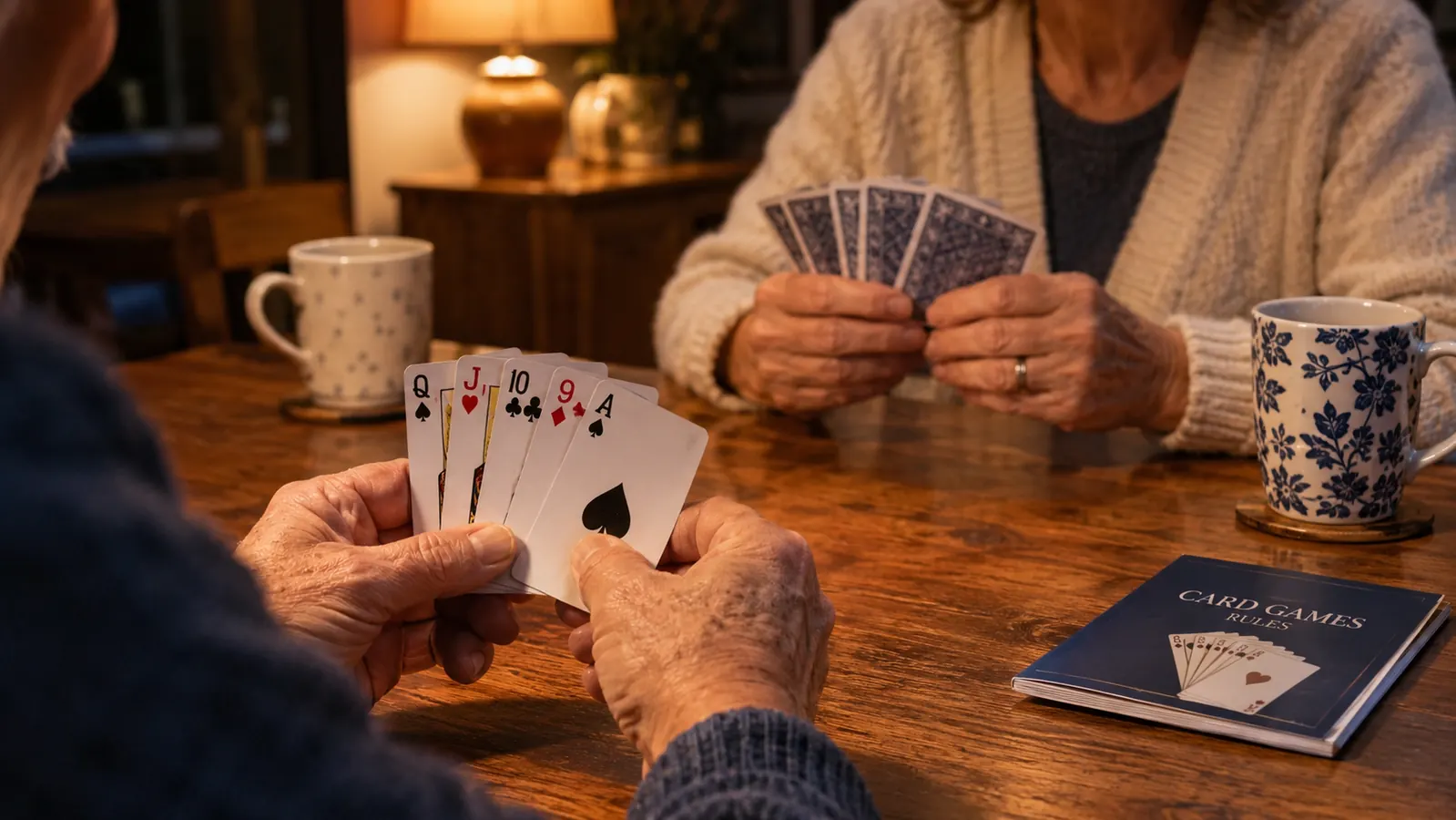
A single game runs about 30 minutes. That matters more than it sounds, because it means the evening has a shape. Two games is an hour. Two games plus setup and putting it away is a little over an hour, and that fits between bedtime and the point where we would both be useless the next morning. Three games is a different evening, and a different evening is how a weeknight habit turns into a weekend thing that never happens.
So we cap it at two, and most nights we play one. Setting the cap ahead of time takes the negotiation out of it. If we finish a second game and it is 9:50, we stop. If we finish and it is 9:15, we still stop, because the next thing is not a third game. The next thing is step five.
This is also where the small box earns its place. It weighs next to nothing, about the heft of a paperback, so it goes in a tote bag without a second thought. At home it sits on the shelf next to the cookbooks, and the rulebook folds inside it. There is no board to unfold and nothing to sort. You take the box down, you deal, and you are playing inside of two minutes, which is the only setup time a tired person will tolerate. We took it to a rented cabin in July for the same reason, and it was the only thing we packed that got used every night.
Step 5: End with ten minutes of talking, and no tidying
Here is the part that took me a while to notice. The game is not the point. The game is the thing that makes the talking possible. When the last hand is over, we put the cards back in the box and then we sit there. Ten minutes, usually. It comes out sideways: a kid at school, a job that is bothering one of us, a thing a sibling said in a group text. Those conversations do not happen when we sit down and ask each other how our days were. They happen because we already have something in common to talk about.
I can date the moment I understood this. It was a Thursday in October, the last hand had gone badly for me, and I was still annoyed about it when Mark said something about a callback he had been putting off for two weeks. Not a big thing. But he had not mentioned it at dinner, and he did not mention it the next morning either. He mentioned it because we were sitting there with cards in our hands and nowhere else to be. That was the whole point of the exercise, and I nearly missed it by getting up to load the dishwasher.
Which is why I do not get up and start wiping the counters. Tidying is how I avoid conversations. If I stand up, the night is over and we both go look at screens. Ten minutes of sitting is the whole return on the evening, and it costs nothing but the discipline to stay in the chair.
That is the five steps. Clear the table, learn it out loud, play the first one badly, cap it at two, and stay in your chair afterwards. None of it is complicated. All of it is the difference between a game on a shelf and a habit you actually keep.
What Else Helps
Play at a table, not on the couch. Couches swallow cards, and they also encourage the half-watching mode where one person is playing and the other is scrolling. A flat surface changes how present you are. In warm months we take it out to the back porch with a candle and a mug of something, and those are the best games of the month, including the ones where I lose badly.
Keep the box somewhere visible. Ours is with the cookbooks because that shelf sits at eye level when you are standing in the kitchen deciding what to do with your evening. A game in a closet is a game you own. A game on the shelf is a game you play. And if the two of you turn out to be competitive about it, there is a companion game in the same line from Renegade Game Studios worth a look once you have worn this one out.
Finally, do not save it for occasions. The reason this works is that it is small and frequent. One game on a random Wednesday does more for a marriage than one elaborate date night in March. Set the bar low enough that you clear it on a night when you are tired, because nearly every night is a tired night, and a ritual you only honor when you have energy is not a ritual at all.
One small box on the shelf, one half hour, two people off their phones
Fox in the Forest from Renegade Game Studios is a two-player trick-taking game for ages 10 and up. About 30 minutes a game, and small enough to come on every trip.
Amazon Check Today's Price on Amazon →