
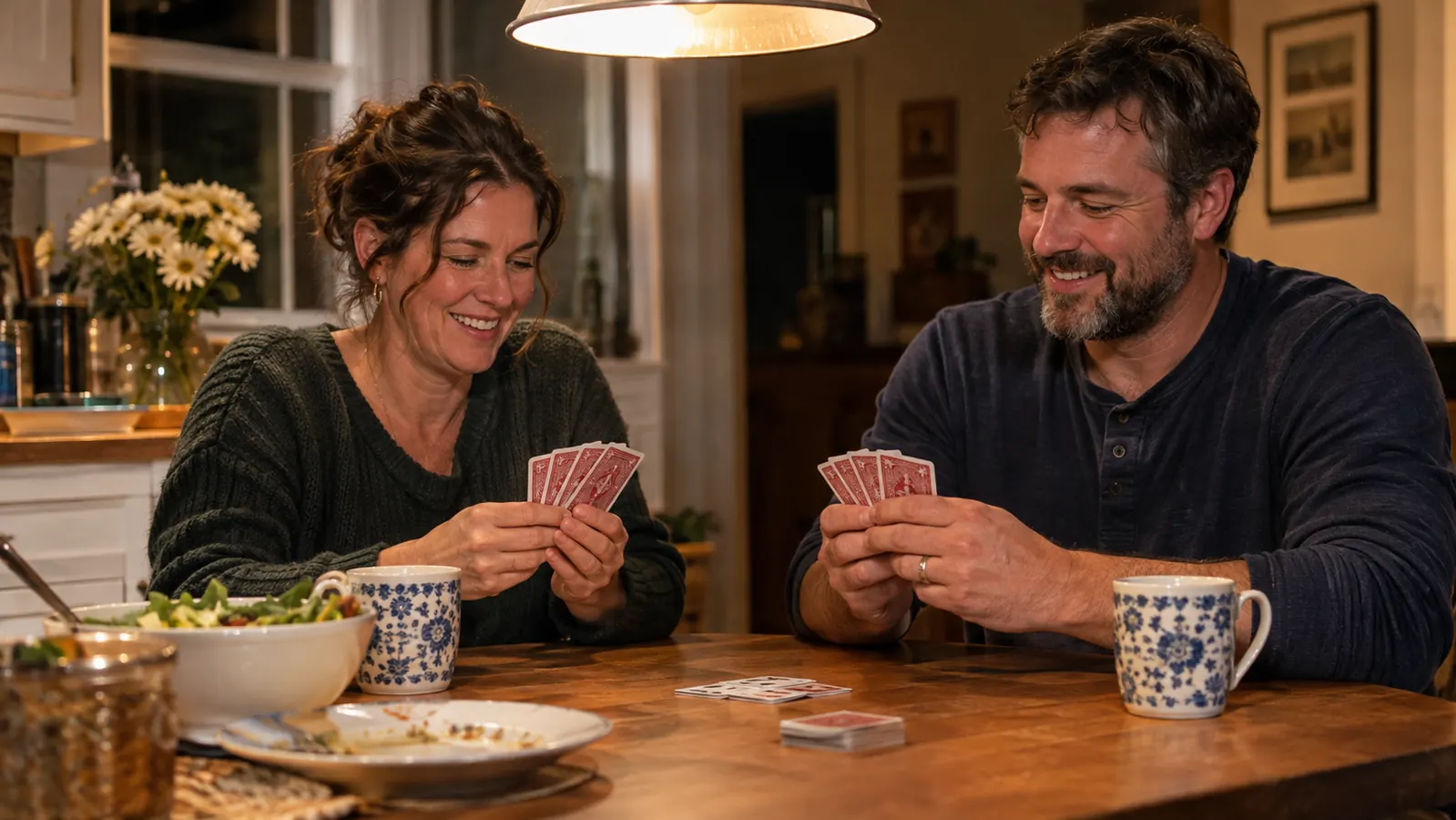
Mark does not play games. He will tell you this while standing in the kitchen holding a card, because I have handed him one. Eleven years of marriage and he has politely turned down every couples game, conversation deck, and feelings prompt that has crossed our table. So when I set the small box from Renegade Game Studios between our mugs on a Tuesday night, he looked at it the way he looks at a furnace that is making a noise. Then he sat down. Fox in the Forest is a two-player trick-taking card game, thirty minutes, age ten and up, and I had been told it was the one that works on skeptics.
We played four hands. He asked for a fifth. I want to be careful here, because a card game is not a marriage counselor and I am not going to pretend otherwise. What it is, is thirty minutes at the kitchen table after the kids are down, with something in the middle of the table to look at besides each other. That turned out to be worth more than I expected. Here are ten reasons it works for couples, roughly in the order I noticed them.
The Game My Skeptical Husband Asked to Play Twice
Two players, thirty minutes, one small box. If your partner groans at the words couples game, this is the one to put on the table instead of another deck of prompts.
Amazon Check Today's Price on Amazon →10 Reasons It Works on a Weeknight
Thirty minutes fits the gap between bedtime and your own bedtime
Our kids are nine and six. Lights out lands around 8:30, Mark is up at 5:40 for work, so the real window is roughly 8:30 to 10. A ninety-minute campaign game is not happening in that window, and neither is a long setup with tokens everywhere. Fox in the Forest lists thirty minutes as the estimated playing time, and that matched what we saw, including the first night when we were still checking the rules. We get two or three hands in and still get to bed at a reasonable hour. That math is the whole reason it gets played instead of sitting on the shelf.
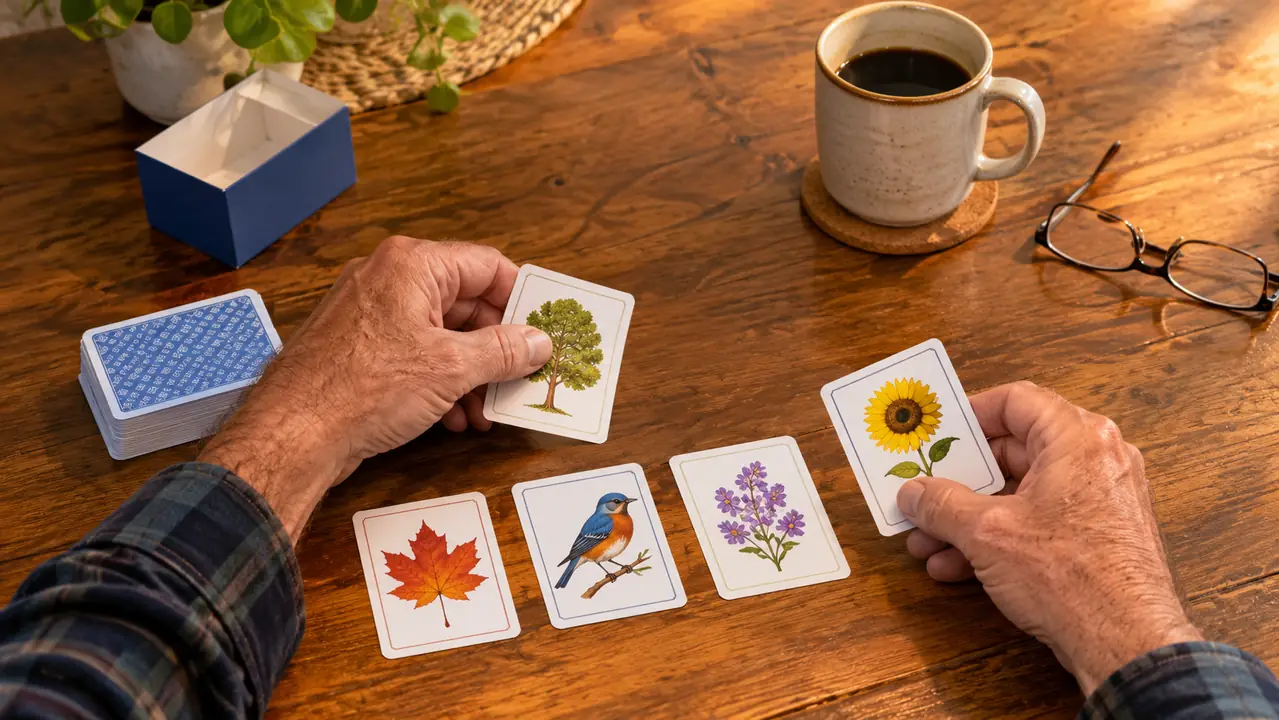
Two players means nobody has to organize four
Every group game night we have attempted required two other adults, a sitter negotiation, and three weeks of text messages that ended with somebody's kid being sick. Two players is whoever happens to be standing in the kitchen. There is no fourth chair problem, no team picking, no couple paired off with the wrong couple. If Mark is tired we play one hand. If he is not, we play five. The game scales to the energy in the room instead of demanding a quorum and a calendar invite.
The rules are short enough for a skeptic to learn in one sitting
Mark's actual objection to games is homework. He does not want to spend the first hour of a Tuesday reading a rulebook while I explain it badly. We learned this one in about ten minutes, partly because it is a trick-taking game and trick-taking is muscle memory for anyone who grew up playing euchre in Ohio. You follow suit, you win tricks, you count what you took. The unfamiliar part is small, and the familiar part carries you through the first hand while you pick up the rest. No rulebook wall, no abandoned first attempt.
It leans on a card game he already knows how to play
There is a fairy tale theme on the cards and some art worth looking at, and I like that fine. What got Mark to the table was the structure underneath, which is the same structure as the card games his uncles played on folding tables. He did not have to learn a new vocabulary to feel competent, and competence is what keeps a quiet man in his chair. Renegade Game Studios built the theme on top of mechanics he already trusted. That ordering matters more than any theme for a forty-one-year-old HVAC technician who has been handed a lot of games built around answering personal questions.
The scoring keeps the quieter player in it
Our house has one talker and one listener, and the talker is me. In games where volume wins, Mark fades out by the second round and I do not notice until he is refilling his water glass. The listing for Fox in the Forest describes trick-taking mechanics designed so neither player gains an unfair advantage, and the practical version of that is what I felt. The hand you were dealt is the argument. You cannot out-charm it. He won three of our first five games, which he has mentioned more than once since.
It gives you a topic that is not the gutters or the school calendar
By year eleven, most of our conversation is logistics. The gutters, the field trip form, whether the nine-year-old needs new cleats. None of that is bad, it is just not the whole thing. A game puts a shared object in the middle of the table and the talking happens sideways, over the cards, in the pauses while somebody decides what to play. We ended up on a work thing he had not brought up in weeks, and I do not think either of us could have started that conversation cold on a couch.
The box is light enough that it actually leaves the house
The listing puts the whole thing at 0.16 kg, and the box is small, with portable named as a feature. That sounds like a spec sheet detail until you count the shelf of games you never carry anywhere. This one goes in my work bag, which means it goes to the porch in July, to a rental cabin for a weekend, and to the waiting room at the tire place. The version of a game that gets played is the one already in the bag when a forty-minute wait shows up unannounced.
It is a game, not an assignment about your feelings
We have tried the conversation card decks. They work for some couples. In our house they landed like homework, and Mark's shoulders went up the moment I opened the box. This has no prompts. Nobody asks you to name a time you felt unheard. You are just playing cards, and the closeness is a side effect rather than the stated purpose on the front of the box. That difference is the reason he says yes to this one and no to the decks, and I have stopped arguing with him about it.
Ten and up means it stays in the house for years
The manufacturer's recommended age is ten years and up. Our oldest is nine, so she is a year away and I am content to wait rather than bend the rule. That also means the box has a long life ahead of it, first as a two-player thing after bedtime and later as something the kids can join one at a time. The material is cardstock in a small box, so it does not need careful storage or a shelf of its own. It lives in the drawer with the pens and the takeout menus.
It is a low-risk gift for a couple you do not know well
I buy a lot of gifts for other people's weddings and housewarmings, and a feelings deck assumes a great deal about where a couple is. This assumes almost nothing. Two players, thirty minutes, no group required, no scoring pad to keep track of. If they never play it, it takes up a corner of a drawer. If they do, it is one of the few gifts that gets used on a Tuesday instead of a special occasion. That is the version of a gift I want to be giving now.
What I'd Skip
It is a two-player game, and it does not turn into a four-player game when friends come over, so if your game night is a group, this is not the box you want. The fairy tale art is not for everyone, and Mark still calls it the fox game. Renegade Game Studios lists no warranty, so treat the cards reasonably and keep a rubber band handy. And the honest limit: if what a couple actually needs is a hard conversation about money, or a counselor, thirty minutes of trick-taking is not that. It is a good Tuesday night. It is not a repair job, and I would not want anyone buying it thinking otherwise.
He asked for a fifth hand. In eleven years I have never seen him ask for a second hand of anything.
One Tuesday Night Is the Whole Test
Two chairs, thirty minutes, kids already asleep. If it does not land for your house, you have lost an evening to a card game, which is a decent way to lose an evening.
Amazon Check Today's Price on Amazon →