
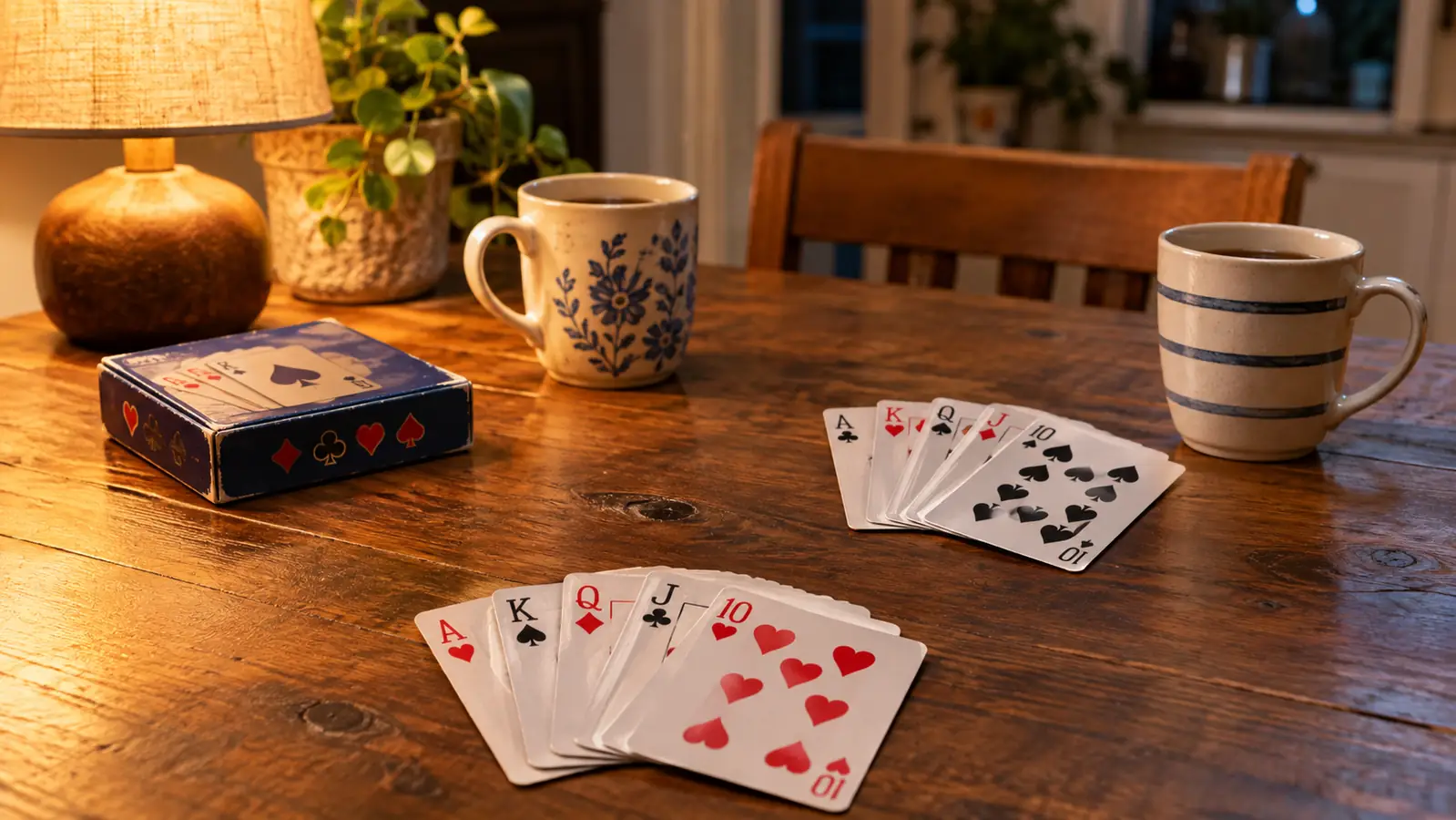
Our kitchen table gets roughly ninety minutes of adult use per night. The kids go down at 8:30, the dishwasher starts, and Mark settles into his chair with his phone face up on the table like he is expecting a page. I bought Fox in the Forest from Renegade Game Studios for exactly that ninety minutes. Two players, thirty minutes a session, a box small enough to live in the cabinet above the coffee maker. I have been married to a man who says the words "relationship game" the way other people say "root canal" for eleven years, and I needed something that did not announce itself as a feelings exercise.
Here is what I know about my husband after eleven years. He will not play a game that asks him to describe his childhood on a card. He will absolutely play a game with a score, a hand of cards, and a way to win. So when I set Fox in the Forest on the table, I did not call it a couples game. I said it was a trick-taking card game and that I would deal. He picked up his hand without looking up from the phone. That is the whole story of how this thing got a real test instead of a polite one.
The Quick Verdict
A genuinely clever two-player card game that survived five weeks of weeknight use with a skeptic. Buy it for the play, not for the conversation prompts.
Amazon Check Today's Price →The thirty-minute game my skeptic now suggests himself
Two players, one small box, no rulebook lecture. Fox in the Forest from Renegade Game Studios is the version of date night that fits between bedtime and ten o'clock.
Amazon Check Today's Price on Amazon →How I've Used It
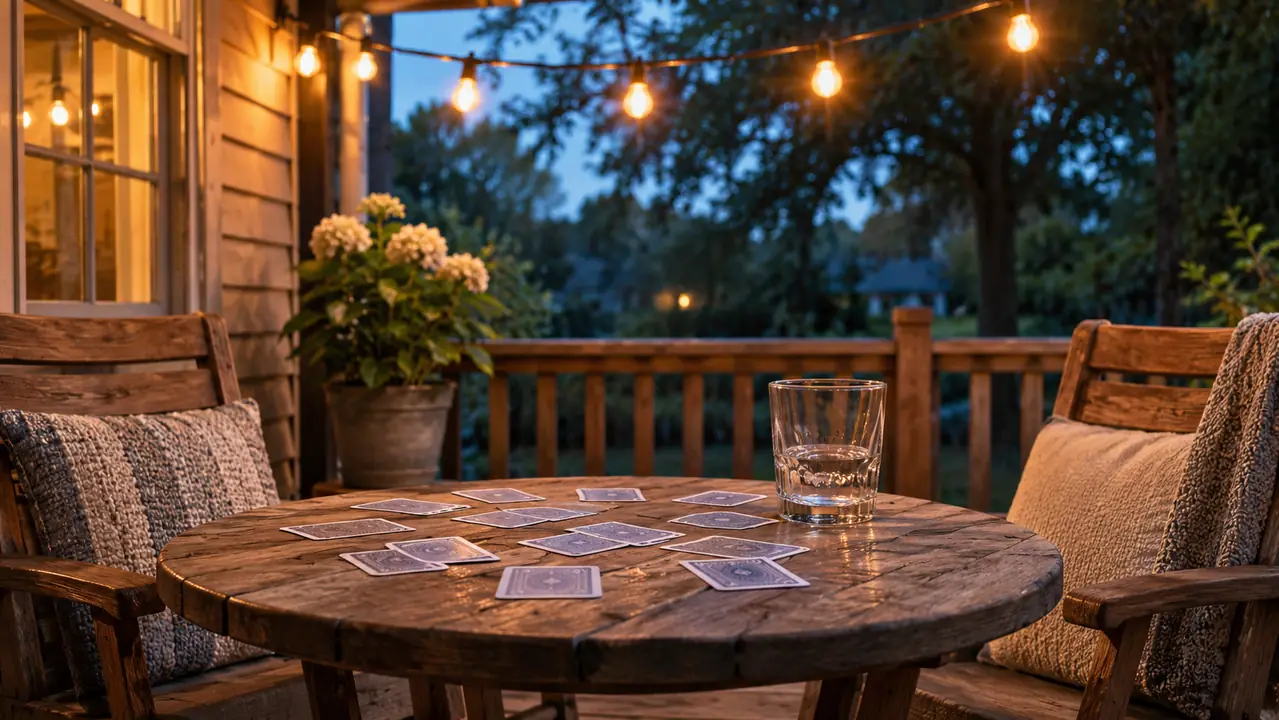
We have played somewhere between twelve and fifteen times since the box arrived, which is a real number and not a marketing number. Almost all of those sessions were at the kitchen table between 8:40 and 9:30 at night, after the nine-year-old and the six-year-old were down and the last round of water requests had been handled. Two of them were out on the back porch in September, with the box sitting on the railing and a wine glass doing double duty as a card weight when the wind picked up.
That is the honest test for anything in this house. Not "did we enjoy it on vacation," but "did we reach for it on a Tuesday when we were both tired and one of us had a work call at seven the next morning." Fox in the Forest got reached for. It also got packed into my tote bag for a weekend at my sister's, where the box took up less room than my phone charger and weighed less than the paperback I brought and never opened.
Set up is close to nothing. You shuffle, you deal, you play. There is no board, nothing to punch out, no fifteen-minute teach at the top of the evening. The first night we played, Mark had the rules read before I finished my tea, which never happens. I want to be clear that this is not a knock on the depth. It is a knock on the assumption that a card game for two has to be either a five-minute filler or a two-hour commitment, with nothing in between for a Wednesday night.
What a Round Actually Looks Like
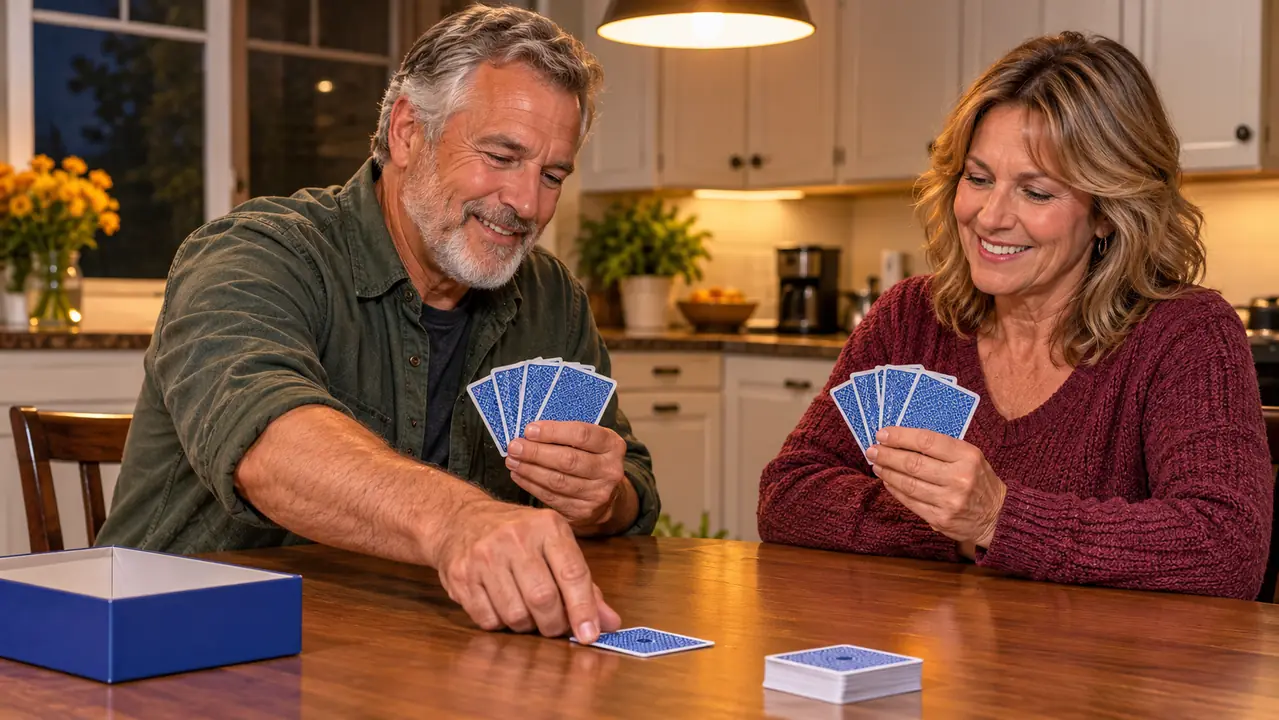
If you have played a trick-taking game before, you will recognize the bones of it. One player leads a card, the other follows, and the better card takes the trick. Fox in the Forest lives on that frame, so the first hand is familiar enough that nobody has to be taught from zero. Mark learned euchre at a family reunion in his twenties and he was comfortable inside two hands. I have played with people who take three hands to relax into a new game, and I think they would be fine here too.
Then it bends. Winning tricks is not the same as winning the round. The person who takes the most is often not the person who finishes ahead, and that single shift changes how you play every card in your hand. You find yourself holding back. You find yourself trying to lose a trick in a very specific way, which is a strange and enjoyable thing to attempt while somebody across the table is trying to force you to win it. It is a two-player game about restraint, which is not a sentence I expected to write about a card game with a fairy tale on the box.
The cards carry a fairy tale theme and the art does the work of making a small deck feel like more than a small deck. There are characters on the cards and numbers under them, and a logic connecting the two, and after three or four rounds you stop checking the rules and start reading the table instead. That is the moment a card game either earns its shelf space or does not. Fox in the Forest earned it around round five, on a night when I lost badly and immediately wanted another round to fix it.
Twelve to fifteen plays in five weeks, nearly all of them on a Tuesday or Wednesday between 8:40 and 9:30 at night. That is the only review metric I actually trust.
How It Held Up Over Five Weeks
Some games are wonderful on night one and dead by night five. The pattern I have watched with two-player card games goes like this: the first few rounds are interesting because everything is new, then one player finds a line of play that beats the other consistently, and the box goes back into the cabinet and stays there. That has not happened here. Mark has won more rounds than I have. I have won more of the close ones. Neither of us has found a repeating answer, and we are both the type to look for one.
Part of that is the two-player build. With two people at the table there is no negotiating, no table politics, no ganging up on whoever is winning. It is just the two of you and the cards, and the luck and the reading of the other person stay in a rough balance. Renegade Game Studios designed this specifically for two rather than scaling a party game down, and you can feel that in how tight the rounds are. There is no dead seat. There is no hand where one player is waiting out the other.
The physical thing has held up too. The cards are cardstock, the box is small, and after five weeks of shuffling and one weekend in a tote bag there is no fraying at the corners and no splitting along the edges. It weighs almost nothing, which is why it ended up in the bag in the first place. For a game that lives in a kitchen drawer and travels twice a year, that matters more than any design flourish.
How We Play It Now
We have settled into a rhythm that I did not plan. We play two rounds instead of a full session most nights. Two rounds takes us to about twenty minutes, which leaves room for one of us to talk about the day before the evening closes out. On weekends we play the full thirty-minute session and the loser makes the coffee in the morning. That rule was Mark's idea, which tells you something about how seriously he is taking it.
The other thing that changed is who suggests it. For the first two weeks it was me, every time. Around week three he started saying "deal those" while I was still loading the dishwasher, which I took as the actual verdict. A game that only one person in a marriage wants to play is a chore with extra steps. This one crossed over, and it crossed over faster than I expected.
The Skeptic's Verdict
I asked Mark for one sentence I could use in this review. He said, "It's a real game, not a therapy exercise." From him, that is a five-star quote. He has since been the one to suggest it twice, once on a night when I was fully prepared to put on a show and call it a date. He also beat me three rounds in a row that night, which he would want mentioned in print, so there it is.
The larger point deserves saying plainly. If your partner is the kind of person who shuts down at the phrase "let's connect," this is a way in that never uses that phrase. You are not talking about your feelings. You are playing cards. The talking happens anyway, in the gaps between tricks and while somebody reshuffles, and it happens more easily because nobody is on the spot. That is the actual mechanism at work here, and it worked better on my husband than any prompt deck I have ever put on this table.
Where It Frays
Two things, and then a smaller one. First, this is a two-player game and only a two-player game. There is no version of it that works with four people at a table unless you buy two copies and split into pairs, and even then you have a different experience on your hands. If your game nights are group nights, this is not the box you pull out, and no amount of enthusiasm on my part changes that.
Second, the box says ten and up and I would honor that in my house. My nine-year-old is a strong reader and I would not sit her down with this yet. Not because of the content, which is a fairy tale, but because the strategic layer asks you to hold two competing ideas in your head at once and stay patient while you do it. Some kids get there earlier. Mine will not, and I would rather wait a year than turn the game into homework.
The smaller thing is timing. Thirty minutes is accurate for a full session once you know what you are doing, but the first two or three rounds run long while somebody keeps checking the rules. Budget forty minutes for night one and do not start at 9:40, because you will finish at 10:30 and be annoyed about it. After that it settles down fast and the thirty-minute figure holds.
What I Liked
- Playable and interesting inside a genuine thirty minutes
- Built for two, so neither seat carries an advantage
- Small, light box that survives a tote bag and a porch railing
- Teaches in one hand without a rulebook lecture
- Real strategic layer that had not gone stale after five weeks
Where It Falls Short
- Strictly two players, with no group option at all
- The strategic layer suits twelve and up better than the box's stated ten
- First night runs closer to forty minutes
- No manufacturer warranty on the game itself
Who This Is For
Couples with a ninety-minute window and no interest in filling it with a screen. That is the core of it. If you are dating, engaged, married, or doing long distance and you see each other in short blocks rather than whole weekends, this fits those blocks better than almost anything else I have put on my table. It also works as a gift, and I say that as someone who has given and received a lot of games over the years. This one has a low embarrassment factor for a partner who is wary of the whole category.
It is also good for the couple where one person loves games and the other tolerates them. The tolerant one can learn this inside a hand. The enthusiastic one gets something with enough depth to keep playing for a month. That gap is usually exactly where two-player games fall apart, and Fox in the Forest sits in it comfortably.
Who Should Skip It
Skip it if you need a game for a group, if you want something that generates conversation prompts rather than conversation, or if the person across the table genuinely does not enjoy card games at all. No box fixes that last one, and I would not pretend otherwise to sell you something. This is a card game. It is a very good card game, but it is a card game.
Skip it too if you are after a big-box evening with a board and pieces and an hour of atmosphere. Fox in the Forest is a small deck in a small box and it is proud of that fact. If the ritual of a sprawling game is the point for you, this will feel like a snack when you wanted dinner. For our kitchen table at 8:45 on a Wednesday, a snack was exactly right.
A small box that earned its spot in the kitchen drawer
Two players, thirty minutes, and a skeptic who now deals the cards himself. Fox in the Forest from Renegade Game Studios is worth a look if your evenings come in short blocks.
Amazon Check Today's Price on Amazon →