
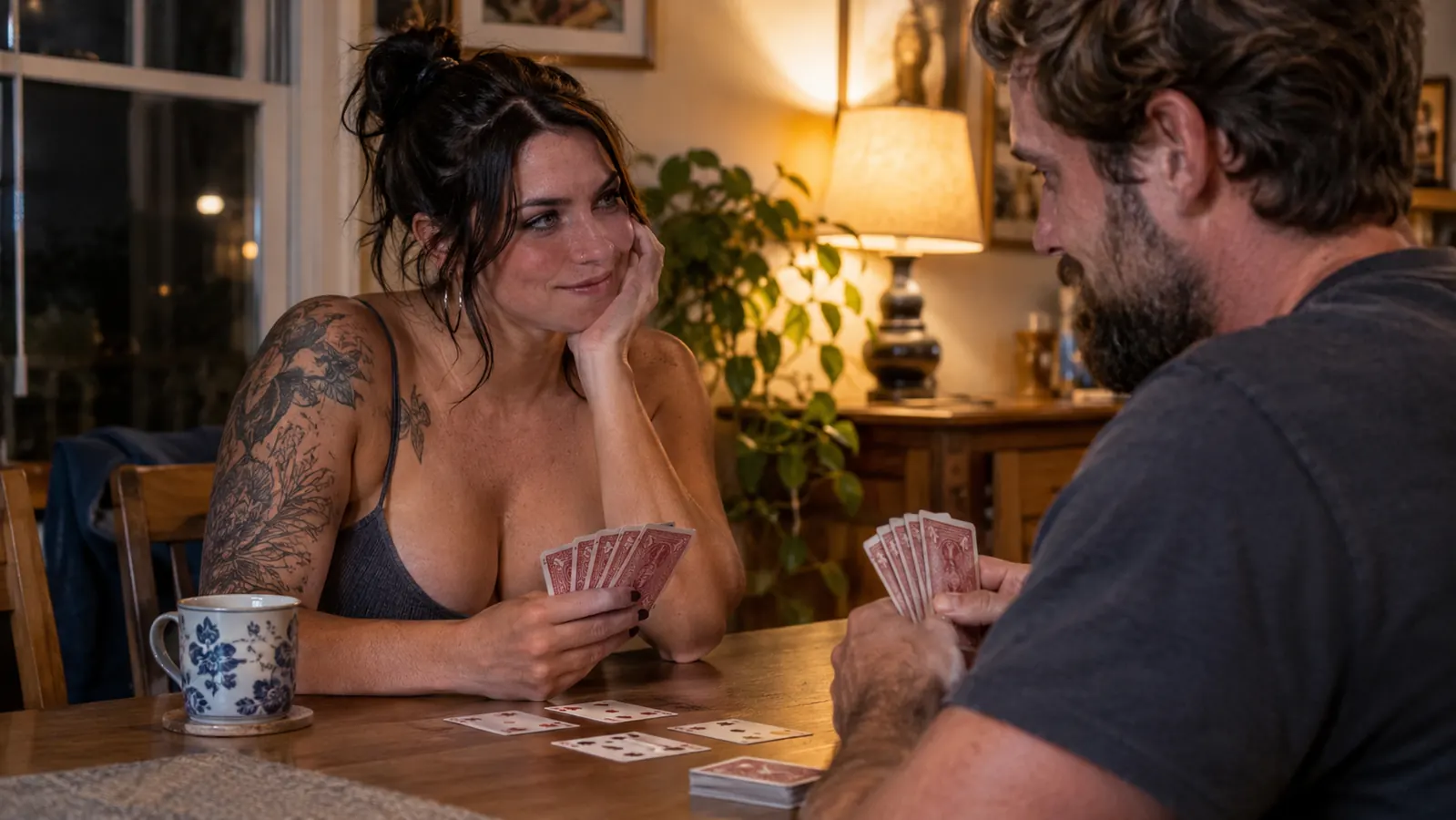
Mark is suspicious of any game that arrives with a reputation for bringing couples closer together. He is an HVAC technician, he spends his days in crawl spaces and attics, and he would rather re-grout the shower than sit through an evening a website has described as meaningful connection. So when I set a small card game on the kitchen table at 8:40 on a Tuesday, he looked at the box the way he looks at a service call that turns out to be a clogged filter.
Here is the short answer, since that is probably why you clicked. There are two versions of this game, both from Renegade Game Studios. The original, Fox in the Forest, is a competitive trick-taking card game for exactly two players, listed at 30 minutes and ages 10 and up. Fox in the Forest Duet is the cooperative version of the same idea. Instead of trying to beat each other, the two of you are trying to beat the game together. For most couples, especially couples where one person hates losing, I would point you at the Duet. If you both genuinely enjoy a little friendly friction across the table, the original is the better buy. Neither one asks you to read a rulebook the length of a short story, and both fit in a kitchen drawer.
| Fox in the Forest | Fox in the Forest Duet | |
|---|---|---|
| Players | Exactly 2 | Exactly 2 |
| Style | Competitive trick-taking. One of you wins and one of you does not. | Cooperative trick-taking. You win or lose as a pair. |
| Session length | Listed at 30 minutes, and that listing is honest | The same weeknight-sized sitting |
| Who gets blamed | The person who lost, and everybody at the table knows it | Nobody. The deck is the villain. |
| Teaching a reluctant partner | A few hands, and they have to lose a couple of those hands first | Easier sell, because nobody has to lose to anybody |
| Head-to-head tension | Real. The entire point is outplaying the person sitting across from you. | None between you. The pressure is on the team. |
| Replay pull | Strong. A loss makes you want the rematch tonight. | Strong, but you replay to solve it, not to get even. |
| Ages on the box | 10 and up | Same family-friendly tier |
| Portability | Small box, cardstock cards, listed as portable | Also a small box that lives in a drawer |
| Best for | Two people who like a real contest and can laugh about it afterward | Couples where one of you hates losing, or hates games in general |
How We Ended Up With Both
I bought the original first. It was on the shelf at the game store on High Street, it was small, and the box said 30 minutes, which is the exact length of the window between bedtime and the point where one of us falls asleep on the couch. I brought it home and did not announce it as a couples activity. I just put it on the table and dealt.
Mark won the first game. He shrugged and said, and I quote, that was fine. From a man who once described a Florida vacation as acceptable, that is a five star review. We played four more hands that night, and he won three of them, which did not hurt his opinion of the game.
The Duet came into the house about a year later, after a colleague at the school library mentioned that Renegade Game Studios had made a second version. I had assumed the original was a one-note purchase. It turns out the same design was rebuilt so that the thing that made Mark quiet after a loss, which was the losing, is simply gone.
Where Fox in the Forest Wins
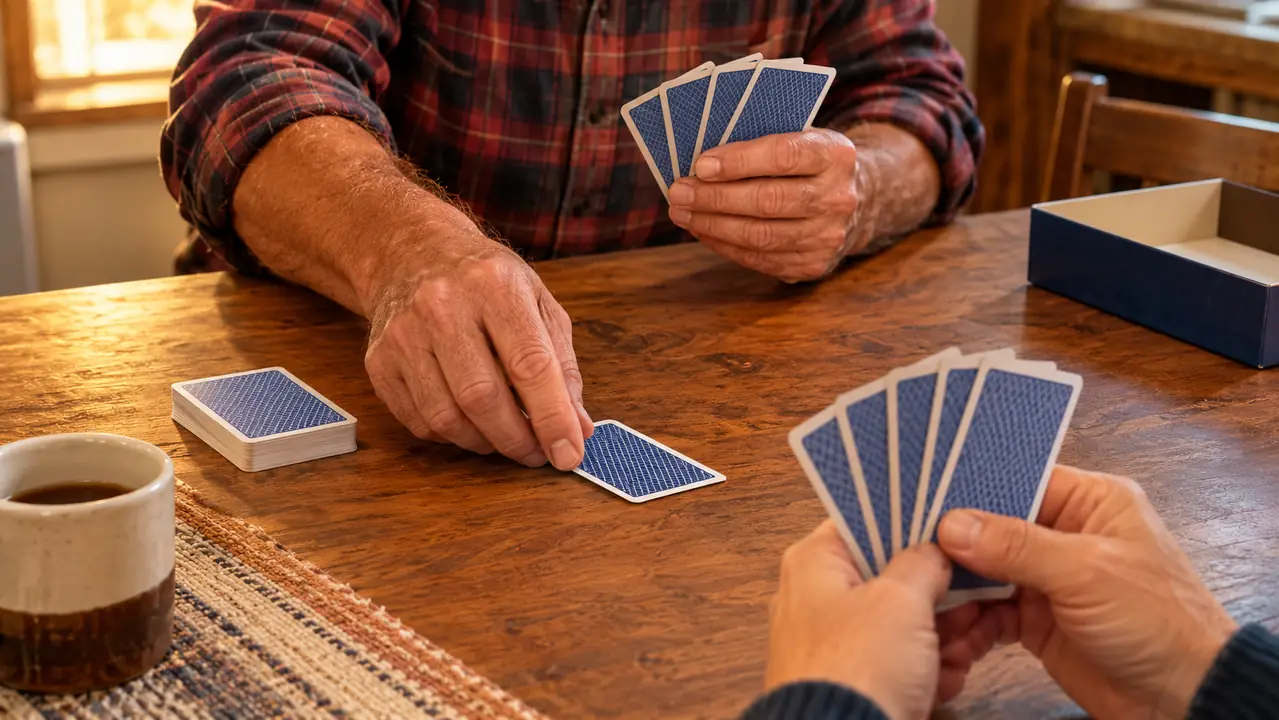
The case for the original is straightforward. It gives the two of you something to be on opposite sides of, in a way that costs nothing. You are not arguing about the electric bill or whose mother is coming for Thanksgiving. You are trying to take a round your husband wants, and he is trying to stop you, and both of you are grinning. On a Tuesday in February that is worth more than it sounds.
It also gives you a scoreboard, and a scoreboard gives the week a shape. Losing to Mark on Tuesday and beating him on Wednesday is a small, harmless thing. It is also the reason we have played the original maybe forty times and the Duet maybe fifteen. Competition makes you want a rematch. Cooperation makes you want to have already done it. I keep a running tally on the inside of the box lid in pencil, the way my grandmother did with dominoes. As of this writing it reads 21 to 19 in his favor. The last entry is a Thursday in January when he took four straight while I was distracted by the dishwasher, and I still think about that Thursday.
And it travels. The box is small, the game is listed at 0.16 kg, the cards are cardstock, and the whole thing slides into the outside pocket of a backpack. The box says 30 minutes because 30 minutes is honestly what it takes. We have finished games in 20 and dragged a few out to 40, usually because one of us is pretending to think.
Where Duet Wins
Cooperative games solve a problem nobody warns you about before you get married, which is scorekeeping. If one of you wins most of the time in a head to head game, the other one starts keeping a quiet ledger. Not a dramatic ledger. Just a small internal tally that makes a loss feel like more than a loss. The Duet deletes the ledger. You either both solve it or you both do not, and the only party you can be annoyed at is the deck. The first time we played it, on a Sunday afternoon in March, we lost with two cards still sitting in the deck. Mark said, out loud, to a stack of cards, we should have held the five. Then he shuffled and dealt again without being asked. That does not happen after a competitive loss in our house, not once in eleven years.
The second thing the Duet does better, and I did not expect this, is that it makes you talk. In a competitive trick-taking game, table talk is basically trash talk. There is nothing to discuss, because your cards are yours and mine are mine. In the cooperative version you are comparing notes about what each of you is holding and what the two of you can afford to spend, which means for half an hour you are genuinely talking to each other about a shared problem instead of about logistics.
The third thing is the sell. If your partner is the skeptic in the house, we play this together against the game is a very different sentence than I am going to beat you. Mark agreed to the Duet without the eyebrow. He has never agreed to anything without the eyebrow.
He shrugged and said, that was fine. From a man who once called a Florida vacation acceptable, that is a five star review.
The one with a scoreboard, if you both like a rematch
Fox in the Forest is the competitive version. Exactly two players, about 30 minutes a game, ages 10 and up, and small enough to live in a kitchen drawer. Start here if neither of you needs to be protected from a loss.
Amazon Check Today's Price on Amazon →What a Weeknight Actually Looks Like
Ours goes like this. The nine year old is finally down at 8:30, the six year old has been out for an hour, and the kitchen table still has crumbs on it from dinner. I make tea I will not finish. Mark sits down with the air of a man doing someone a favor. Twenty minutes later he is holding his cards like a poker player and asking whether I am sure I want to play that one.
There is no setup beyond opening the box. No board, no tokens to punch out, no app, no fifteen minute teach. I timed it once, out of curiosity, because I am the sort of person who times things. Seventy-five seconds from the drawer to the first hand dealt, and fifty of those were me moving a stack of mail off the table. That matters more than any discussion of the mechanics. A game that takes ten minutes to set up does not get played on a Tuesday. A game that takes forty seconds does, and that is most of the reason this one has stayed on our table for years.
The kids are the limiting factor, and I will be honest about it. Both Renegade Game Studios versions sit in the same family-friendly age tier, with the original listing 10 and up, which means our nine year old could probably sit in with help and our six year old cannot. This is an after bedtime game in our house, and it is a couple game, not a family game. If you want something to play with the children at the table, this is the wrong shelf entirely.
In the warm months we take it out to the small back porch, which has two chairs and a table the size of a serving tray. That is where the Duet earns its keep. On the porch there is no scoreboard energy. There are cicadas, a card that does not go the way we planned, and two people quietly working out what to do next. It is the closest thing to a shared hobby we have that does not require a babysitter.

The Learning Curve, Honestly
If either of you has played euchre, hearts, or spades at a family reunion, you already understand the shape of this. Cards get played, one card takes the round, and you are steering which rounds you win. The original asks you to think about whether winning a particular round is even good for you, which is the part that takes a few hands to click. Mark lost his first three games to that exact confusion, then won six in a row and became unbearable about it.
The Duet is the gentler teach, because nobody has to lose while they are learning. That is not a small thing. The first hour with a new game is where most couples quietly decide a game is not for them, and the cooperative version gets you past that hour without bruising anybody. We taught it to my sister and her husband on a visit in October. Three rounds, one trip to the rulebook, and the trip was over what happens when a round ends and neither of you has the card you were counting on. That is a good ratio for a game with real decisions in it.
Where Neither One Wins
Neither version is a heavy strategy game, and I would not pretend otherwise. If one of you plays chess, or spends evenings in a competitive online game, this will feel light. It is a 30 minute card game in a small box. It will not carry a whole evening on its own, and it was never designed to.
Neither version is a conversation game either. There are no question cards, no prompts, no deck built to make you talk about your childhood. The talking that happens is a side effect of playing together, not the product itself. If what you actually want is a structured way to have a deeper conversation on a Tuesday night, this is not that, and I would point you at a different shelf.
Who Should Buy Which
Buy the original if you both like winning and neither of you sulks. Buy it if you have a competitive streak that stays friendly, if you enjoy the specific pleasure of not knowing what the person you married is holding, and if the word rematch is a good word in your house. It is also the better pick for a couple who already plays cards together and wants something new to be competitive about.
Buy the Duet if one of you hates losing, if one of you is skeptical of games in general, or if the two of you spend most evenings parallel scrolling and want something to do with your hands that does not involve a screen. It is also the better gift, because you are not handing someone a small box that says I would like to beat you.
Buy both if you play often. I know that sounds like the answer of a woman who owns both, and it is, but they genuinely scratch different itches. The original is for the nights you want a contest. The Duet is for the nights you want company. We keep both in the same drawer and choose by mood, and I have never once regretted the second purchase.
Start with the competitive one. Add the cooperative one if you need it.
Both are made by Renegade Game Studios, both play in about 30 minutes with exactly two people, and both are small enough to disappear into a drawer between game nights. The original is the one with a winner, and the one I would still put on the table first.
Amazon Check Today's Price on Amazon →