
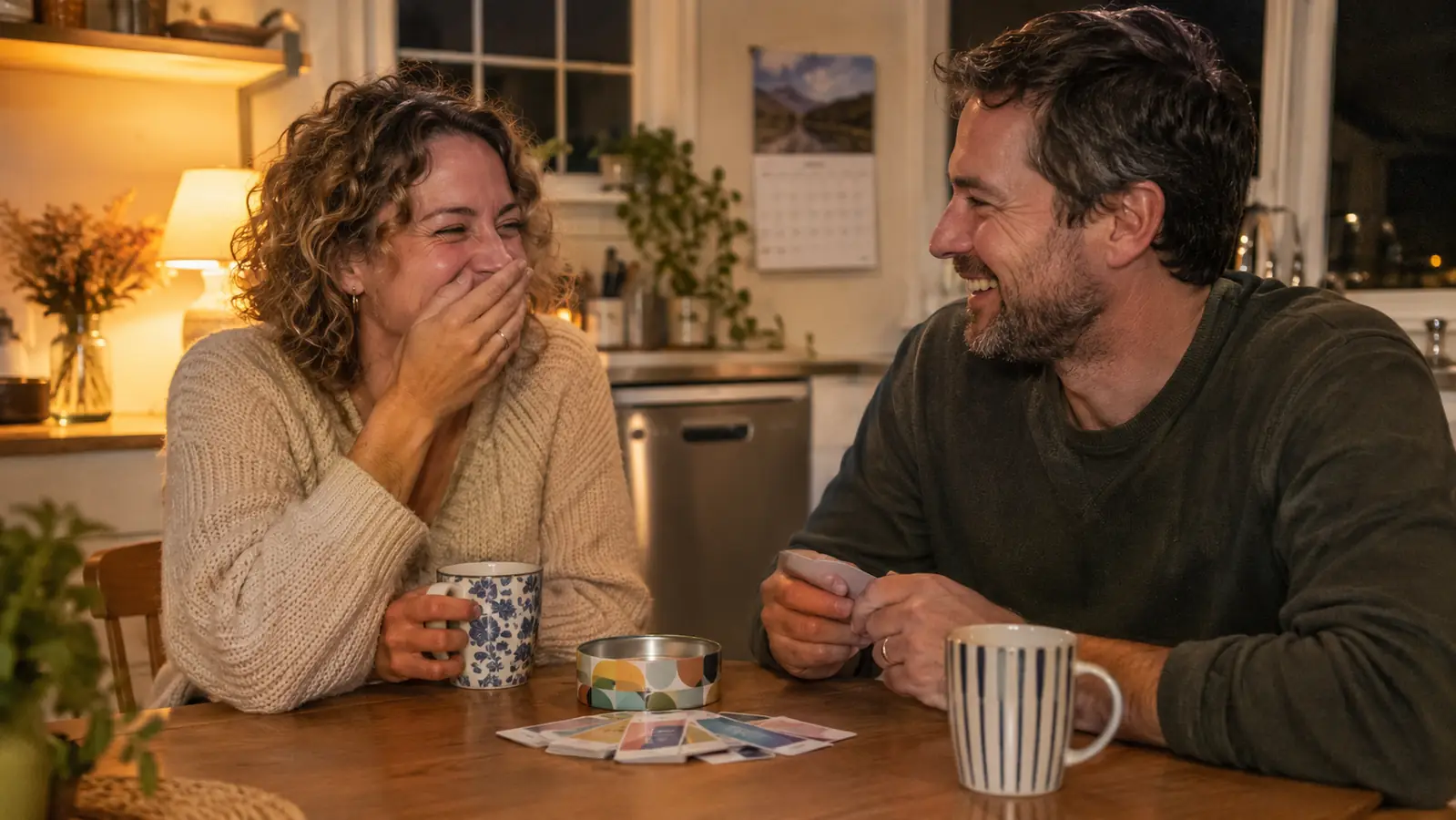
Mark and I have been married eleven years, and somewhere around year eight we ran out of new things to say to each other. Not in a bad way. In a Tuesday way. He comes home from a day of crawlspaces and thermostat wiring, I come home from a day of shushing seventh graders in a middle school library, and by 8:30 we are sitting at the kitchen table with two cups of tea and nothing to say that is not a logistics update about the kids. I bought Let's Get Deep, a question card game for couples from WHAT DO YOU MEME? (Relatable), mostly because I wanted a box on the table that was not my phone.
Here is what we had already tried. We tried the standing Friday night date, which cost us a sitter and two hours of driving for ninety minutes of eating too fast. We tried the how-was-your-day check-in, which for an HVAC technician in February is a weather report. We tried a couples question list I printed off a blog, and Mark answered every prompt in six words or fewer while making direct eye contact with the salt shaker. He is not a man who volunteers feelings. He is a man who fixes things. When I set the tin on the table the first time he looked at it the way he looks at a furnace quote, which is to say politely and with his arms crossed. So my bar for a relationship game was never is it fun. It was will Mark still be playing this in twenty minutes without looking at the clock. These five steps are what got us there, and they matter more than the cards themselves.
The tin that kept my quiet husband at the table past 10 PM
Let's Get Deep sorts into 4 piles (Ice Breaker, Deep, Deeper, Activity), plays with 2 or more people, and comes in a tin that survives a shelf. Ages 17 and up, and it means it.
Amazon Check Today's Price on Amazon →Step 1: Put the phones somewhere that requires standing up
The first change had nothing to do with the cards. At 8:25 I set a small ceramic bowl in the middle of the table and both phones go in it. Mine and his. Face down, silenced, and far enough from either chair that checking one means standing up and announcing yourself. The bowl came from a thrift store on High Street and it has a chip in the rim. It has done more for our marriage than the candle holders we registered for.
Before the bowl, one of us was always halfway out of the conversation. Mark would be answering a question while a notification lit up the tablecloth, and I could watch the answer leave his head before it got to me. The bowl fixes that for free. It also works on me, which is the part I did not expect. I am the one who reaches for it, usually to check on a school email that has never once been urgent. The first week I must have stood up to fetch my phone nine or ten times out of pure habit before I remembered the rule, and Mark found that funnier than anything in the deck.
Wait until the kids are actually down before you start. Ours are 9 and 6, and the 6-year-old has a gift for needing water at exactly the moment a conversation turns interesting. 8:30 is our real starting time. Anything earlier is a rehearsal, and rehearsals are why people decide a game does not work. If your house runs later than ours, start later. The cards do not care what time it is. The people holding them do.
Step 2: Sort all four piles, then start at the shallow end on purpose
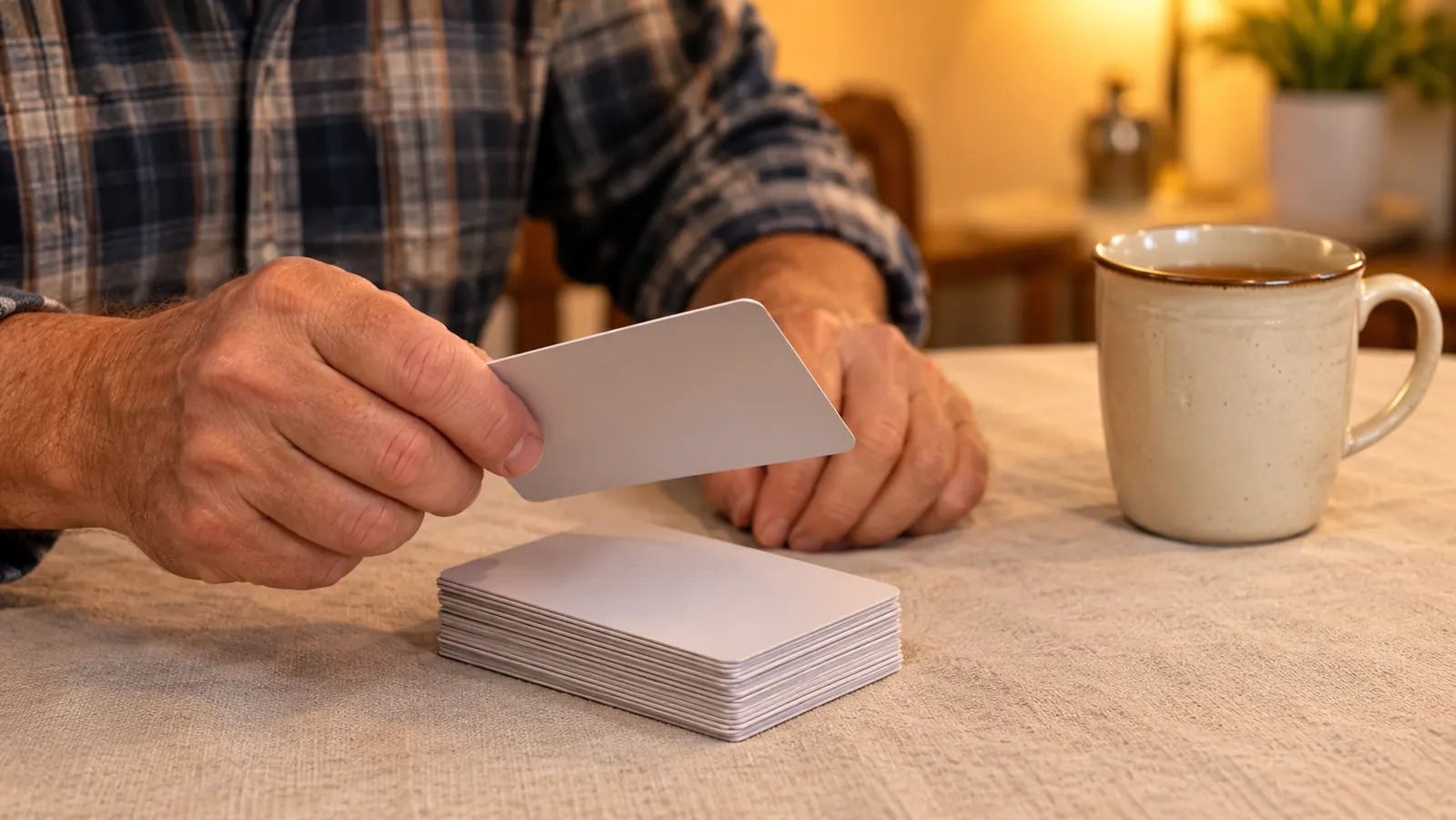
Let's Get Deep splits into four piles: Ice Breaker, Deep, Deeper, and Activity. The instinct is to go straight to Deeper because that is where the good stuff supposedly lives. Do not do that on a weeknight. You do not get a better conversation by going heavier faster, you get a tired one. Sorting takes about four minutes the first time and about ninety seconds after that, because the cards come out of the tin in order and go back in order if you are the kind of person who does that. I am. Mark is not, which is why we now sort together at the start of the night instead of arguing about it at the end.
Start with three Ice Breaker cards. They are low stakes on purpose, and their job is not to produce revelation. Their job is to get both of you speaking in full sentences again after a day of being interrupted. Mark's first answer was about a sandwich he had in 2003. I am not exaggerating. It took ninety seconds, and something came loose, because he was laughing and I was laughing and neither of us was performing. Three cards is the number that works for us. Five and he starts to feel like he is being warmed up for something.
Then move to Deep and stay there as long as it is working. That is where most of our good nights actually happen. Deeper is not a higher level of the same thing, it is a heavier one, and the deck is built so you can decide when to carry that weight. The tin from WHAT DO YOU MEME? (Relatable) keeps the piles separate, which sounds like a small thing until you have shuffled four categories together by accident and pulled a heavy card five minutes in. We did that exactly once, in the first month, and spent ten minutes trying to re-sort from memory. Now the piles stay in a row across the table and nobody touches the row.
Step 3: Answer the card first, then read it out loud
Our table rule is that the person holding the card answers it themselves before reading it to the other one. Otherwise you are interviewing your spouse, and nobody relaxes under a spotlight. Going first is unfair and it is also the whole game. Once one of you has said something real, the other one is answering a person instead of a question. It also kills the thing I used to do, which was pick a card I already knew the answer to because I wanted a particular answer. That is not a conversation. That is a quiz with a target score.
Second half of the rule: answer with a detail. Fine, or yeah I guess, stops a conversation dead. When Mark gives me three words, I ask one follow-up question, and then I let it go. That follow-up is what turns an answer into a story. He told me once, on a Deep card about being proud of something, about a school bus he fixed when he was nineteen, and I had never heard it in eleven years of marriage. What made that work was not the card. It was me asking where the bus ran and him remembering the route number.
The follow-up is also the only place I let myself push. One question, then drop it. Two questions starts to feel like a deposition, and a man who fixes things will absolutely fix the conversation by ending it. The card is doing the asking. I do not need to pile on. If an answer is short and the follow-up lands flat, that is information about the night, not about the marriage. Some nights the man has spent eight hours in an attic and he has about four sentences left in him. Those are the nights you pull an Activity card and let it be silly.

Step 4: Keep the Activity pile where you can reach it
The Activity cards are the pressure release valve and the box has a whole pile of them. When a Deeper card lands and the room goes quiet in the wrong way, pull an Activity card and do the ridiculous thing it says. The first time we did this we ended up standing in the kitchen doing something absurd at 9:15 at night with the dishwasher running, and it reset the whole mood in about two minutes. Mark, who does not perform, performed. I nearly dropped my tea.
Heavy cards work better when they are not stacked back to back. You need a break in the weather, especially on a Wednesday, especially in February. Alternating a Deep card with an Activity card is the difference between a conversation and a session. I can usually tell within ten minutes which kind of night it is going to be, and I set the order accordingly before we start. That is not cheating. That is reading the room, which is most of what makes this work.
One practical note: the game is labeled 17 and up and it means it. This is not a box to leave sitting out when the 9-year-old wanders out for water at 9:10. Ours lives on the top shelf of the hall closet, behind a stack of old picture books. The tin helps here too, since paper cards in a loose stack get bent and a bent deck is a deck you stop reaching for. It measures 8.27 by 4.33 inches, roughly the size of a hardback novel, so it disappears onto a shelf without any production.
Step 5: Pull one Deeper card near the end, then stop while it is still fun
This is the step I got wrong for the first two months. We would keep pulling Deeper cards because it was going well, and then we would hit one that was too big for a Tuesday, and the whole night would collapse into a heavy conversation neither of us had the energy to finish properly. The second time it happened I remember looking at the clock and thinking we had turned a perfectly nice evening into homework.
Now we pull one Deeper card near the end, both answer it, and put the deck away. Sometimes that is 9:40. Sometimes it is 9:20 and we are both yawning. There is a real cost to overrunning, and it is not the argument. It is that the next week you remember the game as exhausting, and you do not take the tin off the shelf. A game you stop playing is worse than a game you never bought.
The deck from WHAT DO YOU MEME? (Relatable) waits. Nothing is lost by stopping early, and nothing is gained by pushing through to eleven o'clock on a night when the six-year-old will be up at 6:15. We have been at this for the better part of a year now, and the Wednesday that ended at 9:25 with both of us laughing about a sandwich from 2003 is the one I remember, not the one where we pushed through to 11.
He told me about the school bus he fixed when he was nineteen. Eleven years of marriage, and that came out of a card at 9:20 on a Wednesday.
What Else Helps
Two things, and neither of them is another game. The first is a named night. Ours is Wednesday, because Friday belongs to the kids' activities and Saturday we are both done in. A specific day does more work than any amount of good intentions, because good intentions are always waiting for a better week and Wednesday just shows up. We put it on the wall calendar in pencil, which sounds too small a thing to matter and is not. On the weeks it gets erased for a school concert, we move it to Thursday rather than skip it, because skipping once is how a thing becomes a thing you used to do.
The second is a pot of tea between us. It sounds like nothing. But two mugs on a table give your hands somewhere to go during the pause after a hard question, and that pause is where the good answers actually come from. In warm months we take the tin out to the small back porch and play in the last of the light, which turns out to be a completely different conversation than the one we have under the kitchen lamp. Same cards. Different room. Different night. The porch version runs shorter, usually, and that is fine too.
A deck that fits in a drawer and gets used on a Wednesday
4 piles, 2 or more players, ages 17 and up, paper cards in a tin. Rated 4.5 by more than 6,300 people, most of whom were probably also tired on a weeknight.
Amazon Check Today's Price on Amazon →