
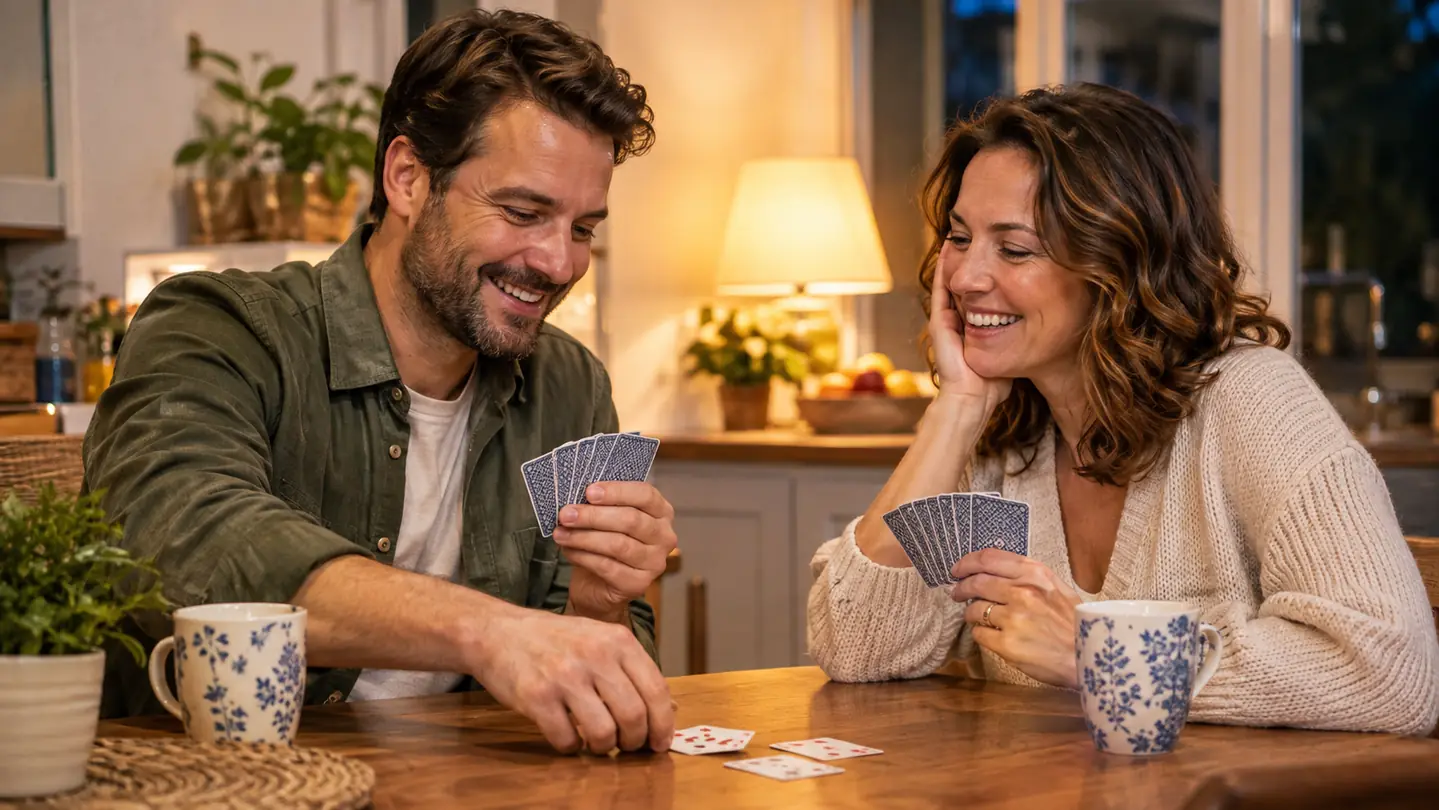
Mark does not trust games that promise to bring couples closer. He is 41, an HVAC technician, and his idea of a good evening is a quiet chair and a ballgame he is not really watching. So when I set a small card game on the kitchen table at 8:40 on a Tuesday, after the kids were down, he looked at the box the way he looks at a service call that sounds like a bigger job than the homeowner described. The game was Fox in the Forest, from Renegade Game Studios. Two players. Thirty minutes. A fairy-tale theme. I had read that it was a trick-taking game, which meant nothing to him and not much more to me. Ten minutes later he was leaning forward and asking whether I had to follow suit. That is the honest review in one sentence: it got my skeptical husband to lean forward.
That matters because Mark is the hard case. I am the one who brings home games. He is the one who asks, politely, whether we could just watch something. A game has to earn its place on our table. Fox in the Forest earned a second hand, then a third. It did not earn a standing ovation. This review is for couples who are deciding whether a small two-player card game is worth a spot in their weeknight, and for gift buyers who do not want to hand someone a box that gets opened once and then buried in a closet.
The Quick Verdict
A clever, compact two-player trick-taking game that fits a weeknight, if you both like cards and can tolerate a ten-minute learning curve.
Amazon Check Today's Price →The game that got my card-skeptical husband to deal again
Fox in the Forest is a small-box, two-player trick-taking game from Renegade Game Studios. It plays in about 30 minutes, sets up in seconds, and lives on a kitchen table without taking over the room.
Amazon Check Today's Price on Amazon →What Nobody Tells You Before the First Hand
The first thing nobody tells you is that Fox in the Forest is not a conversation deck. It is a card game. There are no prompt cards asking you to describe your childhood or name three things you appreciate about your partner. The connection happens sideways. You are both looking at the same small puzzle, and the talk comes out of the plays. If you are shopping for a deck of questions, this is the wrong box. If you want a screen-free activity that gives you something to do together with your hands and your attention, it is the right box.
The second thing is that the rules take a round to settle. The box says ages 10 and up, two players, about 30 minutes. That is accurate. What it does not say is that the first ten minutes involve a lot of looking at the rulebook, asking what counts as a trick, and figuring out why you would ever want to lose one. Trick-taking has its own vocabulary. If neither of you has played a game like this, expect the first hand to be slow. The second hand is where it clicks.
The third thing is that it is quiet. This is not a loud party game. There is no timer, no buzzer, no frantic shouting. The appeal is in the small decisions, the cards you hold, the cards you let go, the read on your partner. For a couple who spends the evening on separate screens, that quiet is the point. For a couple who wants a game that produces big laughter and stories, this may feel too low-key.
The fourth thing is that the box is smaller than the product photos make it look. That is not a complaint. It is a warning for people who expect a board game box. This is a deck and a rulebook in a small package. The cards are cardstock, the box is compact, and the whole game weighs about as much as a paperback. If you are buying it as a gift, it will look modest in the wrapping. The experience is bigger than the package, but the package is small.
How the Two-Player Trick Taking Actually Works
I am not going to pretend this is a full rules teach. The rulebook does that better than I can, and it is short. The shape of it is simple enough. You and one other person play cards into the middle. Some cards win the trick, some do not. You are trying to manage what you take and what you give away. The strategy is in the timing. A card that is strong now may be the wrong card two tricks later. You watch what has been played. You make a guess about what is left.
What makes it work for two players is that every card matters. With more players, a trick-taking game can feel like a crowd. With two, you can see the shape of the hand more clearly. You are not waiting for a turn in a circle. You are in a back-and-forth. The listing calls it a balanced two-player experience, and that matches what I felt. Neither of us ran away with the first few hands. Mark won one, I won one, and the third was close enough that we played a fourth.
The fairy-tale theme is light. It is there in the art and the names, but it is not a storytelling game. You are not building a narrative. You are playing cards. That is fine with me. A theme that stays out of the way is better than a theme that promises an experience the game does not deliver. If you want a game where the story is the point, look elsewhere. If you want a clean card game with a pleasant look, this is it. Renegade Game Studios kept the mood cozy without turning it into a role-playing session.
Where It Surprised Me
The biggest surprise was Mark. He is not a sore loser, but he is also not a person who asks for a rematch. After the third hand he wanted to know if we could play again the next night. That is the whole review, really. A game that gets a skeptical partner to ask for another round has done something. It did not make him sentimental. It did not turn him into a game hobbyist. It gave him a small, fair contest that he could understand in one sitting, and he liked that.
The second surprise was the footprint. The small box from Renegade Game Studios fits on a corner of the kitchen table. We played after the kids went down, roughly 8:30 to 10, and we did not have to clear the table or move the mail. On a warm night we took it to the back porch. It travels well because there is almost nothing to it. A deck, a small box, a rulebook. No board, no pieces to lose under the couch.
It did not ask us to talk about our feelings. It gave us something to think about together, and the talking happened on its own.
The third surprise was the balance. I expected one of us to run away with it. That is what happens in a lot of two-player games when one person understands the rhythm faster. Here the hands felt close. The listing says the mechanics are designed so neither player gains an unfair advantage, and I believe it. That does not mean the better player never wins. It means the game does not hand one person a win in the first five minutes. For couples, that is a real feature. A game that makes one person feel stupid is not a game you play twice.
The Parts That Wear Thin
The first thin part is the vocabulary. Trick-taking, follow suit, trump, lead. If you did not grow up playing cards, those words are a wall. The rulebook is not long, but it is not a tutorial. You will read a paragraph, play a hand, read it again, and find out what you misunderstood. That is normal for this kind of game. It is still friction. A couple who wants to sit down and play immediately will feel it.
The second thin part is luck. You draw cards. Sometimes you draw a hand that does not give you many choices. Skill shows up over several hands, not one. If you play a single round and one person gets a bad draw, the result can feel random. The fix is simple: play two out of three, or play for 30 minutes and let the hands even out. If you need every loss to be a moral failing or a strategic triumph, this will annoy you.
The third thin part is the theme. I like the fairy-tale art. It is pleasant. But I could not tell you a single story from the game. It is a card game with a mood, not a narrative. If you are buying this because the cover makes you think of a cozy story-driven evening, adjust your expectations. The cozy part is the pace and the size. The story part is not there.
The fourth thin part is the competitive frame. This is not a cooperative game. You are trying to win. Some couples want a game where they work together against the board. This is not that. It is gentle competition, but it is still competition. If one of you hates losing, or if the two of you have a history of turning small games into arguments, a cooperative game is a safer choice. Fox in the Forest is not going to fix that dynamic.
What I Liked
- Sets up in seconds and fits a small kitchen table.
- Plays in about 30 minutes, which matches the box.
- Designed for exactly two players, so no one sits out.
- Compact and portable, easy to take to a porch or a trip.
- Cardstock cards and a small box hold up to regular play.
- Balanced hands keep a weeknight match close.
- A screen-free activity that does not require a big time commitment.
Where It Falls Short
- Trick-taking vocabulary takes a round to learn.
- A single hand can be decided by the draw.
- The fairy-tale theme is mostly decoration.
- Competitive, not cooperative, so it will not suit every couple.
- Only for two players, which rules out family game night with the kids.
- No conversation prompts, despite what some gift guides imply.
- A player who dislikes card games will not be converted.
Who This Is For
This is for couples who already like cards, or who are willing to learn a small card game together. It is for the pair who wants a 30-minute screen-free activity after dinner, not a whole evening. It is for the couple who has tried a conversation deck and felt cornered by the questions, and who would rather talk while doing something with their hands. It is for a marriage where one person is the game buyer and the other person is the skeptic. It is also a good gift for an engaged couple or a long-distance couple who see each other on weekends and want something small to do together.
It is a good fit for parents who have a narrow window after bedtime. Our window is roughly 8:30 to 10. That is not enough time for a big board game with a long setup. It is enough time for one round of Fox in the Forest, a little talk, and bed. The game does not demand that you finish a campaign or remember where you left off. You can play one hand and stop. That is the season of life we are in, and the game respects it.
For gift buyers, the size is actually a point in its favor. It fits in a stocking, a care package, or a bag for a weekend trip. It does not require the recipient to clear a shelf. The risks are the same as any game gift. If they do not like card games, the theme will not save it. If they already have a full shelf of two-player games, this may not be new. But if they are a couple who likes a quick game after dinner, it is a safe, useful gift. I would rather give this than another mug.
Who Should Skip It
Skip it if you are looking for a conversation deck. The title and the cozy art might make it look like a relationship game, but there are no prompts. It is a card game. If your goal is to ask each other deeper questions, buy a question deck instead, or use this as a side activity and bring the questions yourself. Skip it if you need a cooperative game. Skip it if you have more than two people at the table and you want everyone involved.
Skip it if you or your partner hates trick-taking games. This is not a trick-taking game with a twist that makes it palatable to people who hate the genre. It is a trick-taking game. The theme is gentle, but the mechanics are the mechanics. If one of you groans at the words follow suit, this will not be the box that changes your mind. Skip it if the kids are under 10 and you want to include them. The box says 10 and up, and that feels right. Our 9-year-old could probably follow the cards with help, but it would not be a relaxing game night.
How I've Used It
The way we use it is simple. We keep it on the shelf near the kitchen table. After the kids are down, one of us gets it out. We play one round. If the round is close, we play another. If one of us is tired, we stop. The game does not punish stopping. There is no campaign, no legacy element, no setup that makes you feel like you have to finish. That is a small thing, but it is the difference between a game that gets played and a game that gets admired.
On a warm night we take it to the back porch. The small box fits in one hand. The cards do not blow around if you use a mug as a paperweight. We have also taken it to a coffee shop on a Saturday morning, which is the closest thing we get to a date. It is not a replacement for a real conversation. It is a way to be together without a screen, and for us that is worth something. It also gives us a shared language. Mark will now say, about a work problem, that he was trying to decide whether to take the trick. That is a small inside joke, and it came from a small box.
A small box that earns its shelf space
If you want a two-player card game that plays in about 30 minutes and does not require a rulebook marathon, Fox in the Forest from Renegade Game Studios is worth a look. It is not a conversation deck. It is a card game for couples who like a little competition with their quiet.
Amazon Check Today's Price on Amazon →