

Mark and I have been married for eleven years, and for most of them I was the one dragging games to the kitchen table. He is an HVAC technician who spends his days solving other people's problems, so when I bring home something labeled a cooperative couples game, his face does a thing. I know that face. It says, I love you, but I would rather rewatch a documentary about concrete. Sky Team from Scorpion Masqué is one of the few games that got past the face. Not because it is soft or cute. Because it gives two people a shared problem and then makes them talk to each other about it. That is rarer than it should be.
The pitch is simple. Two players are co-pilots trying to land a plane. You roll eight dice, place them on a control panel, and manage your speed, your wings, and the air traffic around you. The game comes with an altitude track, two player aid screens, an airplane axis disc, and twenty airport scenarios. Each airport changes the layout and the special rules. There are optional modules with names like kerosene leaks, ice on the tarmac, and a rookie intern who needs extra guidance. The box says ages 12 and up, two players, and it notes Game of the Year 2024. It is also travel sized, which matters more than I expected.
The Quick Verdict
A tense, talky two-player cooperative game that earns its table time, provided you want to communicate under pressure and not just chat.
Amazon Check Today's Price →If you want a game that makes you talk, start here
Sky Team gives two players one job and no room to coast. It is the cooperative game I reach for when Mark is willing to play but does not want a rulebook lecture.
Amazon Check Sky Team on Amazon →How I've Used It
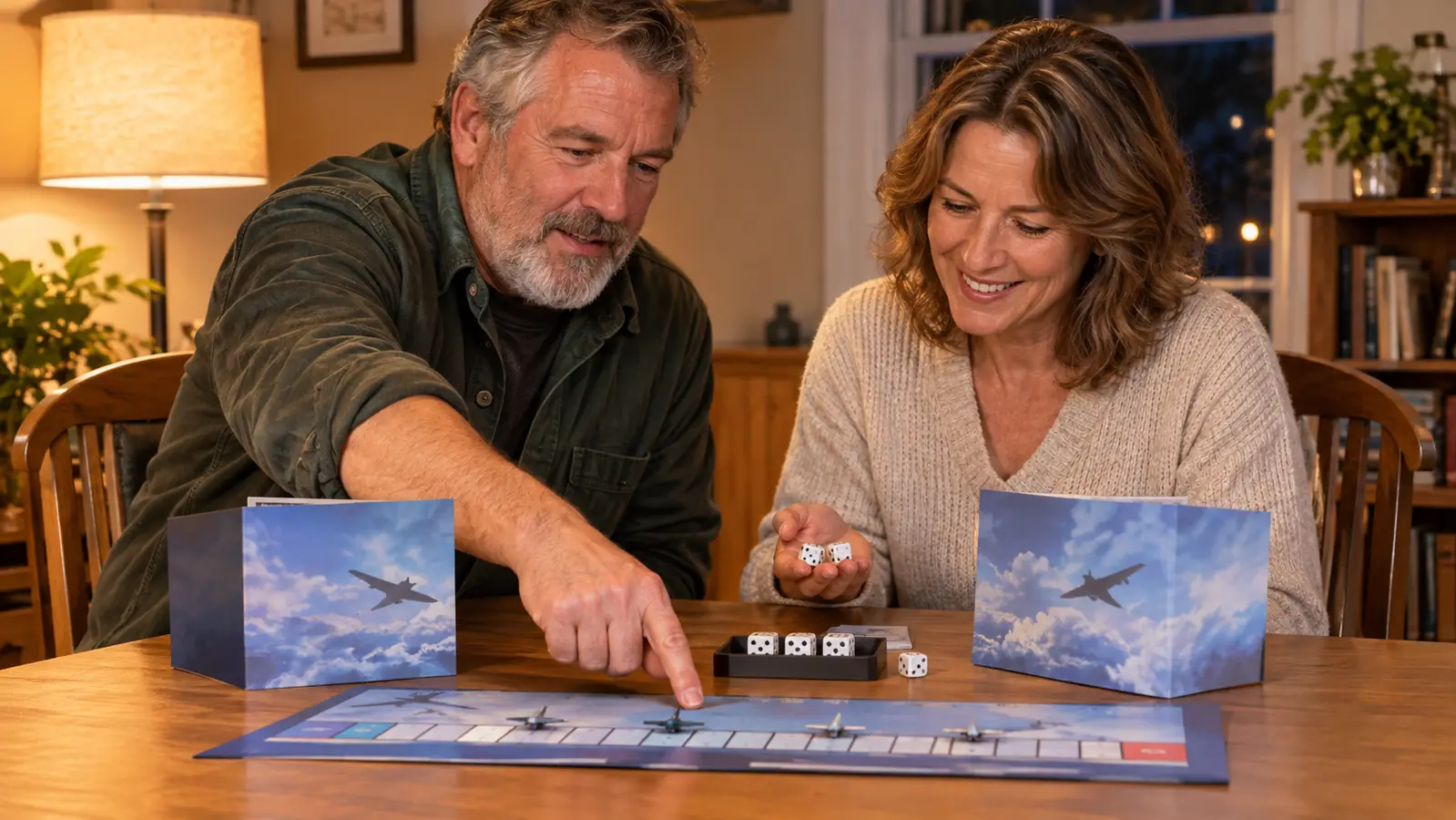
We play after the kids are down, usually between 8:30 and 10 on a weeknight. That window matters. It is long enough for two or three landings, short enough that a game has to be easy to set up and easy to put away. Sky Team fits. The box is small, the components come out fast, and the player screens keep your dice and plans hidden from each other. That hidden information is the engine. You cannot see what your partner rolled. You have to ask.
Mark is the skeptic, so I watched him closely the first night. He read the player aid. He asked two questions. Then he started telling me his speed and asking whether I could cover the wings. About ten minutes in, he said, this is actually good. From him, that is a review I trust more than a thousand star ratings. We lost that first landing. We lost the second one too. The third one we won with one die left and a lot of talking.
Since then we have kept it on the shelf by the table, which is the highest honor in our house. It is not the game we play when we want to laugh at nonsense. It is the game we play when we want to feel like a team. The difference sounds small. It is not. A game that makes two tired people coordinate at the end of a long day has to be doing something right.
One thing I did not expect: the game gives us something to talk about afterward that is not the kids, the schedule, or the leaky faucet. We replay the landing. We argue about one die. We laugh about the time we forgot the altitude track existed. That sounds small. It is the whole point of a weeknight game.
We have also played it on the back porch in warm months, which is a different experience. Outside, the game feels less like a puzzle and more like a small mission. The dice are harder to keep on the table when the wind picks up. That is not a knock on the design. It is just a note for anyone who thinks a porch table is a stable surface.
What the Box Actually Asks You to Do
Sky Team is not a storytelling game. There is no long campaign, no role-play, no card that asks you to describe your first date. It is a puzzle with a radio. You and your partner each roll dice, and your dice are hidden behind the player aid screens. On a turn you place a die on the control panel to adjust your speed, level the wings, or handle the air traffic in front of you. You have to announce enough for your partner to plan, but not so much that you slow the whole thing down. The altitude track tells you how much room you have left. The airplane axis disc tips the plane and gives you another thing to manage. The twenty airports give you different landing conditions, which is what keeps the box from feeling solved after three nights.
The communication is the game. Not the dice. The dice are just the excuse. If you and your partner are the kind of people who say, I will take the left side, you can cover the middle, you will feel at home. If one of you tends to go quiet and hope the other one figures it out, Sky Team will expose that habit in a way that is either useful or annoying, depending on the night.
The optional modules are where the box gets meaner. Kerosene leaks add a problem you have to manage. Ice on the tarmac changes what you can do. The rookie intern needs extra guidance, which means more talk and less margin. We have not touched every module. We do not need to. The base game already gives us enough tension for a Tuesday. But I like knowing the box can grow when we want it to.
The Part Nobody Warns You About: It Is Quietly Stressful
Here is what the friendly shelf copy does not tell you. Sky Team can make a quiet couple feel very loud. Not in a fighting way. In a wait, why did you put that there way. The first few games, Mark and I both assumed the other person could see what we were seeing. They cannot. The screens are there for a reason. If you do not narrate your plan, your partner is guessing. Guessing is how planes go off the runway.
That is the honest tradeoff. The game is not relaxing. It is satisfying. There is a difference. A good landing feels like the moment after you parallel park on a busy street and nobody honks. You exhale. You look at each other. You say, okay, one more. A bad landing feels like a small argument that you both know is not really an argument. The game gives you a shared language for that moment, which is why it works for us. It also means it is not the right game for a couple who wants a low-stakes hang.
The stress is not constant. There are quiet turns where you are just placing a die and tracking altitude. The pressure comes in spikes. You realize the altitude is lower than you thought. You realize your partner has been waiting on a number you cannot give. You realize the approach is not going to be clean. Those spikes are the point. If you dislike that feeling, you will dislike the game. No amount of pretty airport names will fix that.
Where Sky Team Surprised Me
I expected the theme to be thin. A plane landing is a setting, not a story, and cooperative games often use a setting as wallpaper. The Scorpion Masqué design does not. The control panel is not decoration. It is the thing you are all talking about. The altitude track is not a scoreboard. It is the clock in your stomach. The airplane axis disc is not a prop. It is the reason you have to say, I am tilting left, can you take the other side. Every component has a job, which is not something I can say about every game on our shelf.
The airport scenarios also did more than I expected. I thought they would be small tweaks. Some are. Others change the rhythm enough that you have to relearn how to talk to each other. That is the closest thing this box has to replay value without a campaign. You are not unlocking a story. You are learning a new airport and a new set of bad habits to avoid.
The two-player limit is a feature, not a flaw. I love a big table game, but big table games turn into a host performance. Sky Team is a conversation. It needs two people. It does not need a moderator, a rulebook referee, or someone scrolling a phone between turns. That narrowness is why it gets played.
One more surprise: the game is easy to teach. I have explained it to two other couples, and both times the first landing was underway in under ten minutes. The player aids do the heavy lifting. You do not need to memorize a rulebook. You need to be willing to say your plan out loud and then adjust it when your partner tells you something you did not expect.
The Honest Tradeoffs
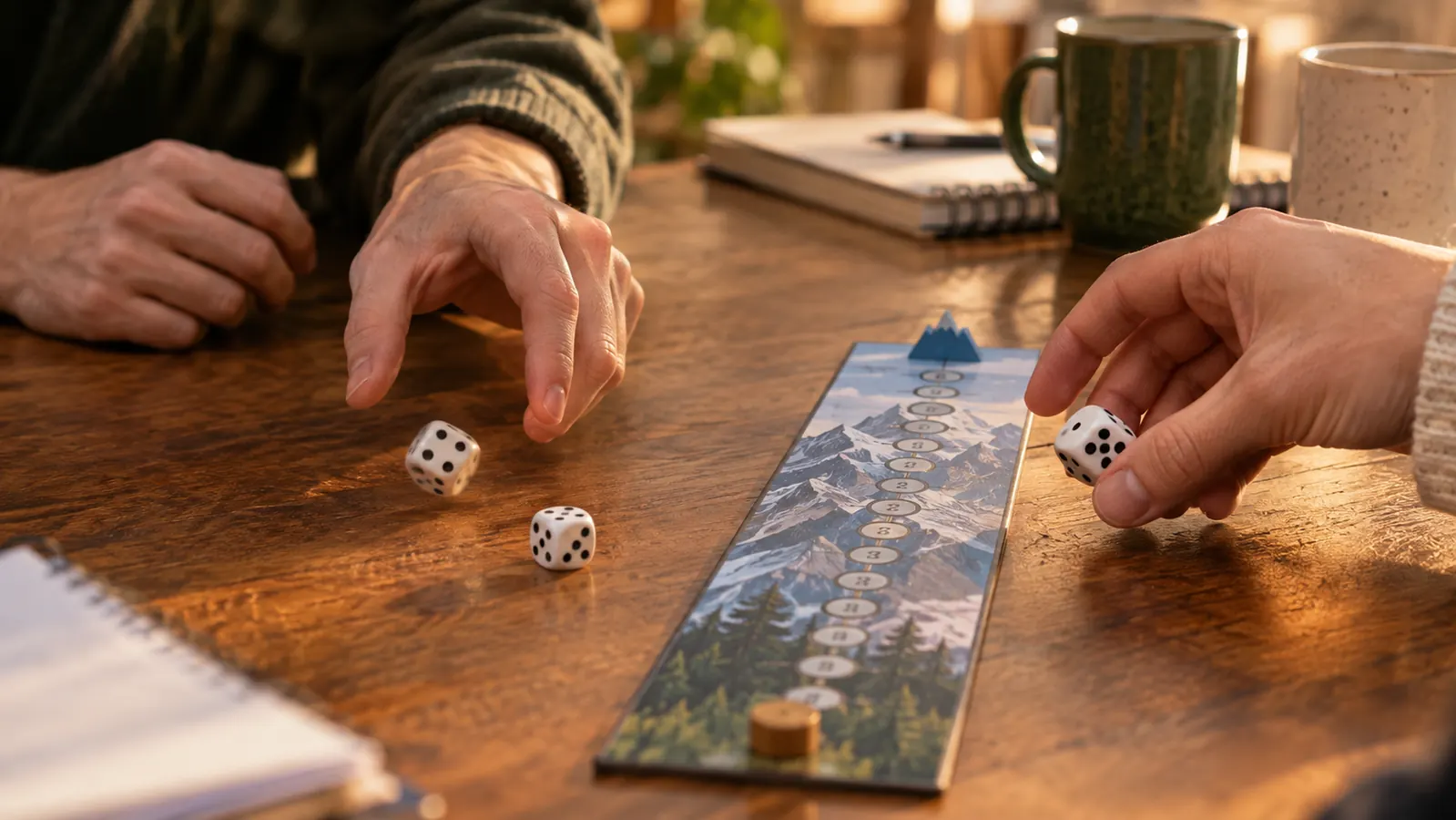
First, the learning curve is not zero. The player aids are good, and the first airport is gentle, but you are still managing dice, speed, wings, altitude, and air traffic at once. Our first game had a lot of pointing and a little bit of sighing. That is normal. The second game was smoother. The third game was fun. If you judge a game by the first ten minutes, give this one a full night before you decide.
Second, losing is common. Sky Team is cooperative, which some people hear as easy. It is not. You will crash. You will crash in ways that feel preventable. You will replay the last two turns in your head and find the exact moment you should have said something different. That is part of the appeal for us. It is not part of the appeal for everyone. A couple who needs a win on the first try should know that going in.
Third, it is not a relationship cure. I say that with love. It is a game. It will not teach you to communicate about money, in-laws, or who forgot to schedule the dentist. It will teach you to say what you need in a small, contained situation where the stakes are cardboard. That can be a useful rehearsal. It is not therapy, and it is not a substitute for a conversation. If you are looking for a deck of cards that asks, what is your earliest memory of feeling safe, this is not that. Buy a conversation card deck for that. Buy this when you want to play.
None of these tradeoffs are surprises after two or three plays. They are the shape of the game. The question is whether that shape fits your table. A couple who wants a gentle chat will find the pressure annoying. A couple who wants a puzzle they can solve together will find the pressure motivating. That is not a flaw in either direction. It is a filter.
Fourth, the box is small, and that has a downside. Travel sized is great for a weekend away. It also means the components are small enough that a dropped die can vanish under the stove. We keep a small tray on the table now. That is not a flaw in the game. It is a flaw in our kitchen.
Fifth, the game asks for a certain kind of attention. You cannot half-watch a show and play Sky Team. You have to be in it. For us, that is a feature. After a day of splitting attention between work, kids, and a phone, a game that demands focus feels like a small reset. For a couple who wants to unwind with a screens-off but brain-off activity, it may feel like homework.
Sixth, the theme will not carry everyone. If you do not care about planes, the landing frame may feel like a thin excuse for dice. For me, the frame works because it explains why every die matters. For Mark, it works because he likes systems. For a couple who wants narrative and characters, this is the wrong box.
What I Liked
- Two players only, so every turn matters
- Communication is the core mechanic, not a side note
- Twenty airport scenarios and optional modules add variety
- Travel sized box that sets up fast on a weeknight
- Real tension without a long campaign or rulebook study
- A cooperative game that got my skeptical husband to ask for another round
Where It Falls Short
- First game is a little bumpy while you learn the flow
- You will lose often, and some losses sting
- The tension can feel stressful, not relaxing
- Travel sized box means a dropped die can disappear
- Not a conversation card deck and not a therapy tool
- Two players only, so it will not save a group game night
The communication is the game. The dice are just the excuse.
Who This Is For
Sky Team is a Scorpion Masqué game for couples who already like games or are willing to try one that asks for actual talking. It is for the pair who has tried a conversation card deck and found it a little too direct, and for the pair who wants something to do with their hands while they talk. It is for long-distance couples who want a shared activity over video, though you will each need a copy. It is for gift buyers looking for a two-person game that does not require a group. It is for the partner who says, I will play if you teach me, and the other partner who is tired of teaching alone. And it is for anyone who likes the idea of a cooperative puzzle with a theme that is not zombies, farming, or a dungeon.
Who Should Skip It
Skip it if you want a game that lets you relax. Skip it if one of you hates talking during games and prefers to play quietly. Skip it if you need a game for four or more people. Skip it if you are looking for a guided relationship exercise with prompts and feelings. Skip it if a first loss makes you want to put the box away instead of try again. And skip it if small pieces on a kitchen table are a dealbreaker. None of those are moral failures. They are just fit.
If you want the version of game night where you actually talk, this is it
Sky Team is a two-player cooperative game that earns its place on the shelf by making communication the whole point. It is tense, it is small, and it is the one Mark asks for.
Amazon Check Sky Team on Amazon →