

The short answer, if you are standing in an aisle trying to choose: Sky Team is the better couples game for most people. Codenames Duet is the better game for a narrower couple, the two of you who already love words and will happily spend an hour afterward working out why a one-word clue landed the way it did.
I am Tessa, a middle-school librarian in Columbus, Ohio, married to Mark for eleven years. Mark is 41, works HVAC, and regards the phrase relationship game roughly the way he regards a Sunday service call. Our game nights run about 8:30 to 10 at the kitchen table, after our nine-year-old and six-year-old are finally asleep. That window is why this comparison is not academic. Whatever we keep has to earn ninety minutes on a Tuesday. Sky Team, from Scorpion Masqué, earned it. Codenames Duet earned a place on the shelf too, just a smaller one.
The reason I rank Sky Team first is not that it is a more clever design. It is that Sky Team makes two people pay close attention to each other in a way that does not feel like an exercise. Nobody is asked to share a feeling or answer a prompt. You are asked to place a die and trust that your partner will understand what you meant, then to adjust when they don't. That is closer to a marriage than most games get.
What Each Game Actually Asks of You
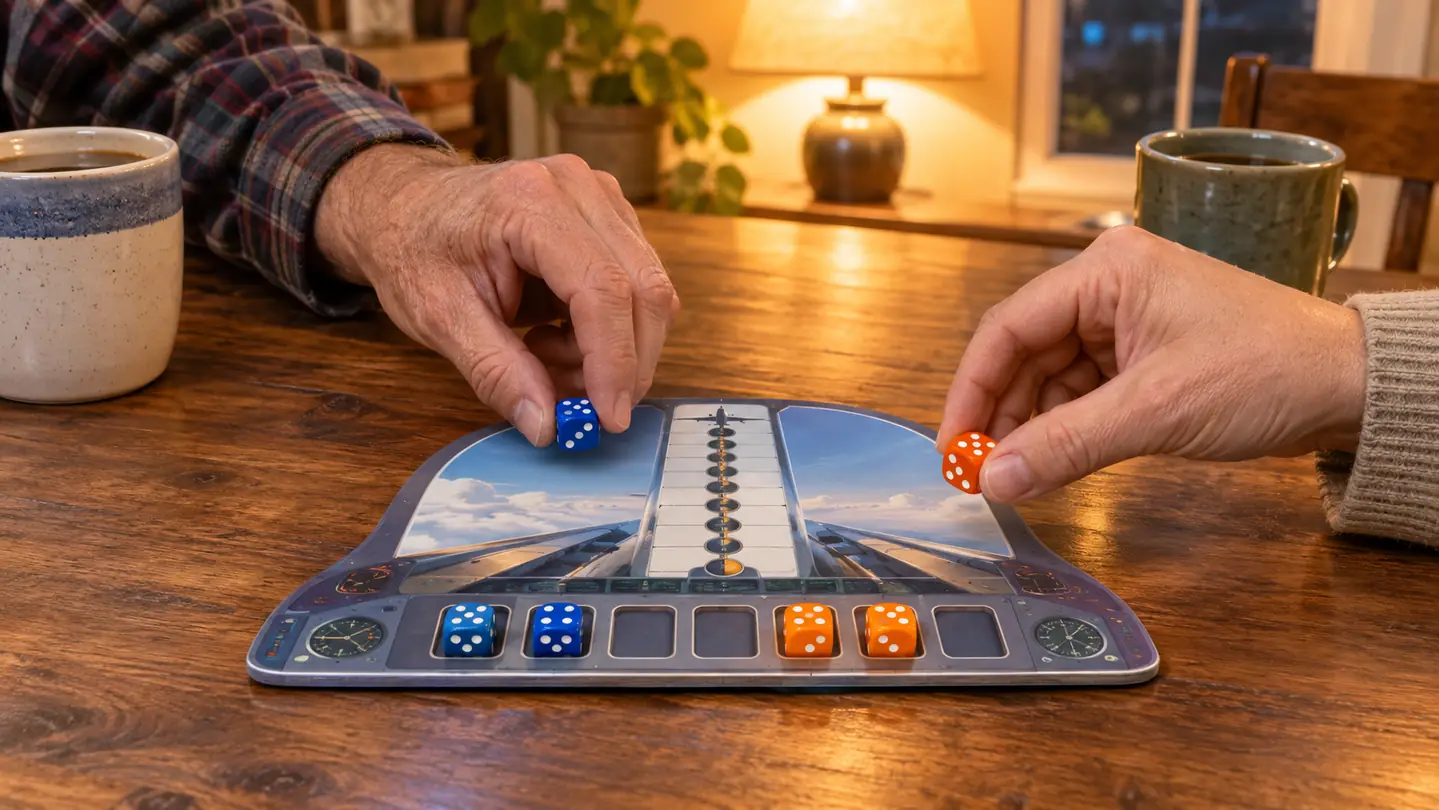
Sky Team is a two-player cooperative game about landing an airplane. One of you is the pilot, one is the co-pilot. The box gives you a control panel, an altitude track, an airplane axis disc, eight dice, and two player aid screens. Each round you roll your own dice behind your screen, then take turns placing them on the panel to handle air traffic, adjust your speed, and level the wings. You can see your own dice and not your partner's, and the rules put real limits on what you are allowed to say out loud. So you place a die and hope. If the plane is still in one piece when the approach is over, you land. The first night, I placed a die where I thought it belonged and Mark turned the airplane axis disc a quarter turn so I could see what that placement had done to us. Nothing was said out loud. The lesson landed anyway, in about four seconds, and I have not made that particular mistake since.
The Scorpion Masqué box ships with twenty airport scenarios, each with its own layout and special rules, which means the same eight dice play differently at a short mountain runway than at a busy hub. Once you can land consistently, you can switch on optional challenge modules: a kerosene leak, ice on the tarmac, a rookie intern who needs extra guidance. The box lists ages 12 and up, and it is small enough to be called travel sized.
Codenames Duet is a word game. You lay out a grid of word cards and look at a key that each of you only half sees. You give a one-word clue plus a number, your partner guesses that many cards, and you have a limited number of turns to find everything you are both looking for. Run out of turns and you lose together, then you flip the key and run it from the other side. There is no score between you. The opponent is the clock and your own vocabulary.
That is the honest difference. Codenames Duet is a game about language. Sky Team is a game about intent. In one, the puzzle is the words. In the other, the puzzle is the person across the table, and the dice are just how you find out whether you read them right.
| Sky Team | Codenames Duet | |
|---|---|---|
| Players | Exactly two, and the whole design assumes it | Two, and more can join in teams |
| Rules on night one | About ten minutes of panel and dice rules | One sheet, and you are playing in two minutes |
| What you talk about | The plane: speed, wings, air traffic | Words, and what your partner meant by one |
| Replayability | Twenty airports with their own layouts and rules, plus challenge modules | The word cards recombine, but familiar words come back around |
| Reading required | Icons and numbers on the panel, so the rulebook does the reading | Every card is a word, so vocabulary is the game |
| Table space | Control panel, altitude track and screens need a real table | A grid of cards and a key fit almost anywhere |
| Packing it for a trip | Travel sized box | A stack of cards, equally easy to pack |
| How you lose | The plane does not land | You run out of turns |
| Conversation it leaves behind | A story about a landing | A debate about a one-word clue |
Where Sky Team Wins
Replayability is the plain one. Twenty airports with different layouts and rules come in the box, and they are not cosmetic variations. We have played the same airport twice in a single night and gotten two different games out of it, because the dice did not fall the same way and because we did not make the same mistakes. Layer the optional modules on top and one box covers a couple of years of Tuesdays. Codenames Duet has word cards that recombine, but the same words come back around and start to feel familiar in a way the airports never do. One airport took us six tries. For five nights we lost in the same place and neither of us could say out loud what we were doing wrong, until we set the dice down and walked through the first three rounds on our fingers. The sixth night we landed it, and the two of us sat there grinning at a piece of cardboard like we had personally flown something.
The other win is who can play it. Codenames Duet requires reading, and more than that it rewards a wide vocabulary and a shared frame of reference. Sky Team runs on icons and numbers on the control panel. Nobody has to be wordy to be good at it. That matters more than it sounds. My husband will not play a game that asks him to put a feeling on a card. He will absolutely play a game where the feeling is, please put that die on speed before we hit the ground.
Where Codenames Duet Wins
It is easier to start. Sky Team asks for maybe ten minutes of rules the first time, and the panel takes a round before it stops looking like the dashboard of a car you have never driven. Codenames Duet is one sheet, and you are playing in two minutes. If you are buying for a couple who are not game people at all, that lower wall matters. The game you can start on the first night is the game that gets played on the second.
It also produces better conversation afterward. Sky Team gives you a shared memory of a landing, which is fun to retell but structurally a story about dice. Codenames Duet gives you a clue your partner gave, the card you guessed instead, and the long, slightly offended conversation about why on earth you would ever say that word. If the point of game night is to end up talking, Codenames Duet walks you to the door of that conversation every single round. The clue that still gets brought up is a single word Mark gave me in February. It seemed obvious to him. It was not obvious to me. I guessed the wrong card, he looked at me like I had failed a test I had not been given, and we lost on the next turn. Then we sat on the sofa for ten minutes afterward still arguing about it, which is either a bug or the entire point.
The One That Got a Skeptic to the Kitchen Table
Two players, eight dice, one airplane, and no prompts to answer out loud. Sky Team is the cooperative game for couples who would rather work a problem together than talk about their feelings on a card. Rated 4.7 from more than 1,100 ratings.
Amazon Check Today's Price on Amazon →
The Weeknight Test
Here is what the ninety-minute window actually looks like. Kids down at 8:30, table cleared, one of us makes tea, and whoever is less tired picks the game. On a night when we are both sharp, Codenames Duet is the better choice, because it wants vocabulary and attention and it punishes sloppiness. On a night when one of us has been in a crawl space since seven in the morning, Sky Team is the one. You can work through an airport in about twenty minutes, land or crash, and then decide whether you have another one in you. A Tuesday in March is my standing example. Mark had been under a house on the east side since eight that morning, came in, ate standing up at the counter, and still sat down at the table because he does not like being the one who cancels. I got the word cards out. He looked at them the way he looks at a service manual printed in the wrong language. We put them away, played two airports back to back instead, and he was asleep by nine forty-five, which is the honest measure of a good Tuesday.
The crash matters more than I expected. Losing together in Sky Team is not abstract. The plane goes down, you look at the dice you both placed, and you can see exactly which decision did it. There is no arguing about who is better at the game, because the game is not measuring either of you. That is a small thing that removes a real source of friction. We have played games where the scoreboard quietly turned into a conversation about something else entirely. This is not one of them.
The guest test is the one I trust most. We taught it to a friend in about ten minutes on a Wednesday. She is not a board game person and said so twice. She asked to play again the next night. Codenames Duet has passed the same test with the same friend, so this is not a knock on it, but the game a non-gamer asks for unprompted is a rare thing and worth noting.
It travels too. The Scorpion Masqué box is listed as travel sized, small enough to go in a bag for a weekend or onto the porch table in the warm months. Ours has been out on the back porch with the light on until the mosquitoes won. Codenames Duet travels just as well, so this is not a tiebreaker for either game, but I did not want anyone picturing Sky Team as a table hog. It is not.
He will not play a game that asks him to put a feeling on a card. He will absolutely play one where the feeling is, please put that die on speed before we hit the ground.
What Neither Game Fixes
Neither of these is a substitute for talking, and I want to be clear about that because the marketing around couples games can get silly. Sky Team does not teach you to communicate. It gives you a low-stakes place to practice being understood, twenty minutes at a time, with a plane as the consequence instead of a mortgage payment. That is a real thing and it is also not therapy, and anyone selling it as therapy is selling you something else.
Codenames Duet has its own trap, which is that a word game measures vocabulary. If one of you reads more, that person gives better clues, knows it, and the other person can feel it by the third round. It has never caused a fight at our table, but I have watched it get quiet. Sky Team has no equivalent gap. You both roll the same number of dice and you both have to place them, and neither of you is better equipped by your reading habits.
Who Should Buy Which
Buy Sky Team, from Scorpion Masqué, if your partner is skeptical of games in general and of couples games in particular. Buy it if you want something that feels like a shared problem rather than a shared prompt, if you have a real table and half an hour, and if twenty airports with different rules sounds like value instead of homework. Buy it if you are the kind of couple who gets along fine until a scoreboard appears, because Sky Team has no scoreboard, only a landing.
Buy Codenames Duet if words are already your thing. If you text each other puns, if you have ever spent a car ride arguing about a crossword answer, if you want a game that starts in two minutes and ends in a conversation, it is the better pick. It is also the better pick for a couple who are not game players yet, and for anyone who wants a box that disappears into a tote bag. Honestly, if you can swing both, they barely overlap. One is a word game, one is a dice game, and the shelf has room.
Start With One Airport, Any Airport
No scoreboard, no prompts, no pressure to share anything you did not volunteer. Just two people, eight dice, and a runway that has to be cleared. Ages 12 and up, exactly two players, and a box that fits in a weekend bag.
Amazon Check Today's Price on Amazon →