
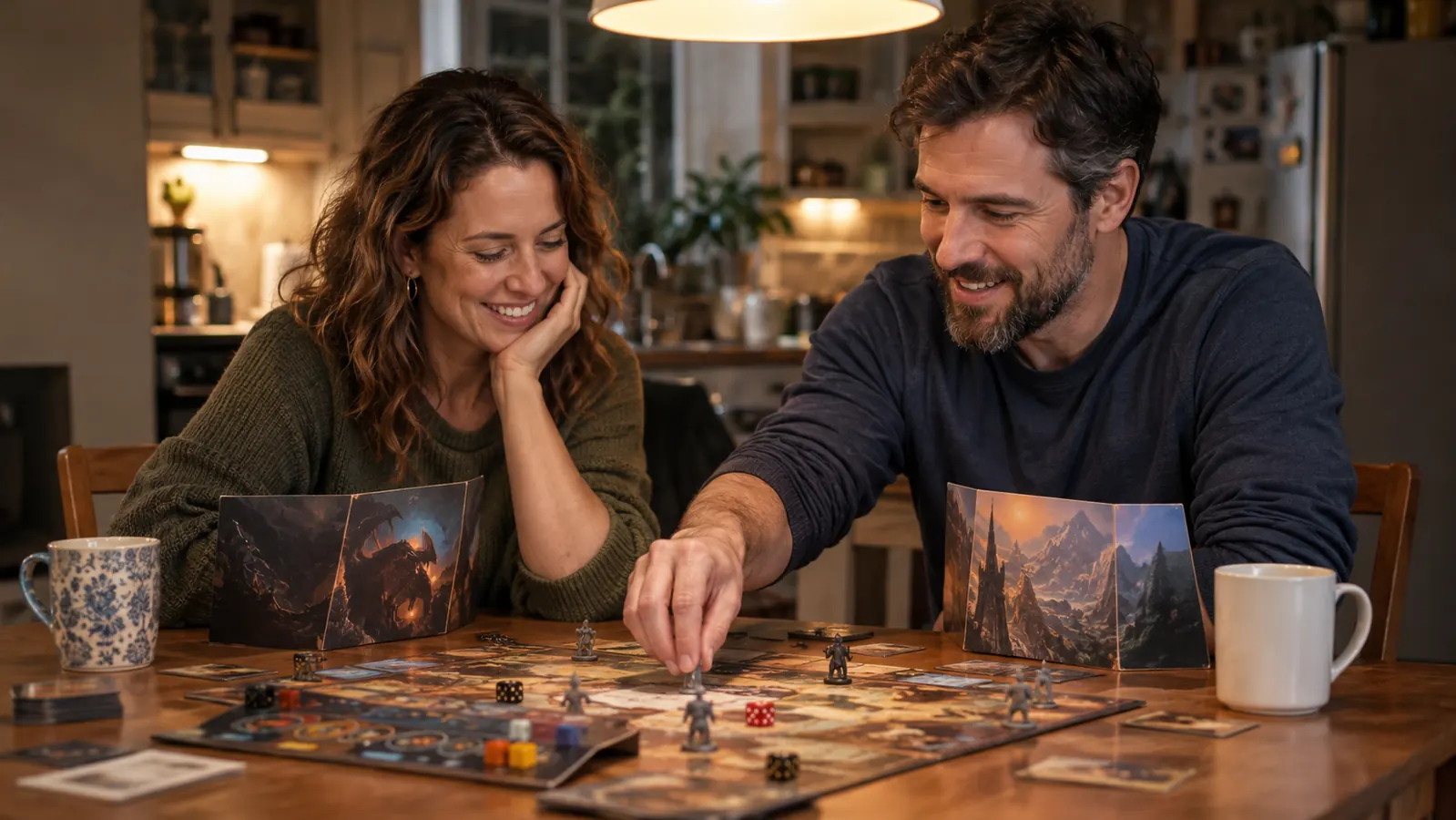
At 8:40 on a Tuesday, both kids are finally down, and my husband Mark and I are sitting at the kitchen table with our phones face up between us. That is the default in our house. Not a fight, not a crisis, just two tired people in Columbus doing parallel scrolling until 10 PM and calling it togetherness. I am a middle-school librarian and I spend whole days watching what screens do to attention spans, and I still could not break the habit at my own table.
We tried the obvious fixes. Conversation cards lasted about four minutes before Mark, who is 41, an HVAC technician, and deeply suspicious of anything sold as a relationship game, started reading the prompts in a fake radio voice. Trivia night turned into him guessing and me correcting, which is not a couples activity, it is a quiz that I win. What finally worked was a two-player cooperative board game called Sky Team from Scorpion Masqué. Two players, ages 12 and up, and the entire job is to land a plane together. Nobody wins alone, and that detail turned out to matter more than I expected.
Two players, one plane, and nobody wins alone
Sky Team is a cooperative game for exactly two players. You and your partner each roll dice, then place them on the control panel to manage your speed, level the wings and clear air traffic as the altitude track counts down. You cannot do it separately. That is the whole design, and it is why it works on a skeptic.
Amazon Check Today's Price on Amazon →Five Steps to a Screen-Free Game Night
Step 1: Read the rulebook out loud, together, before anything leaves the box
The rulebook is thin and that is a trap in the friendliest way. Inside the Scorpion Masqué box you get 8 dice, a control panel, an airplane axis disc, an altitude track, two player aid screens, the approach, and 20 airport scenarios. Read it out loud, both of you, once, before a single die is rolled. Mark reads fast and silently and then gets quietly annoyed when I know a rule he skipped, so out loud solves two problems at the same time.
Keep the two player aid screens upright between you while you read. They do double duty. They tell you what each spot on the control panel does, and they hide the dice you roll from your partner. That hiding is not a gimmick. It is the entire reason the game has anything to talk about.
Budget ten minutes for this and do not skip it because you have played board games since you were nine. Ten minutes of reading is what prevents the first game from ending with someone saying, I assumed you were handling the wings.
One thing worth knowing if you have never played a two-player cooperative game before. There is no table to hide behind. With four people you can be quiet for a round and nobody notices. With two, silence is a decision, and the game punishes it gently. That is a feature if you are trying to talk more, but it helps to know it before you sit down.
Step 2: Put the phones in another room, not face down on the table
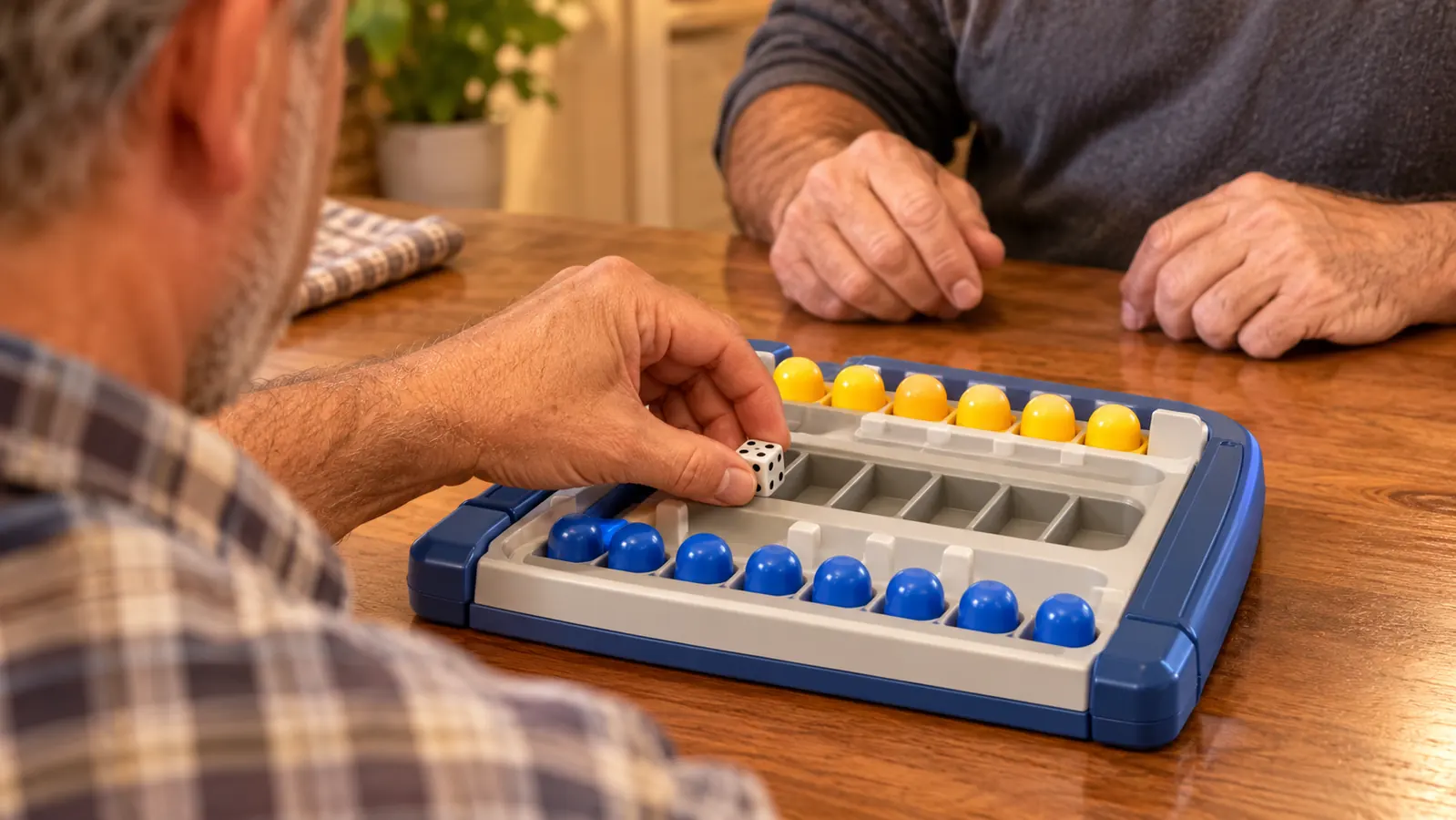
Face down on the table is a negotiation you will lose. Somebody reaches for it during the other person's turn and the whole thing deflates. Ours go in the bedroom, both of them, before the box opens. The first night we did this, Mark reached for a pocket that was empty twice in the first half hour. Then he stopped.
One Thursday I timed it out of curiosity, pencil on the back of a grocery list. Phones away at 8:32. Box open at 8:34. First die rolled at 8:41 after the rulebook refresher. One airport landed and one crashed by 9:25, and we were still at that table talking at 9:50 with nothing playing in the background. That is forty extra minutes we would normally have spent on separate screens in separate rooms.
The other change I made was to stop treating game night as an event. We are not staging a production on a Wednesday. The kids are down at 8:30, we have until roughly 10, and that is the window. A game that fits inside 90 minutes gets played. A game that wants three hours gets dusted twice a year and resented the rest of the time.
If you have one hour instead of two, play a single airport and stop. The box is travel sized and the whole thing packs back up in about a minute, which sounds like a small detail until you are the person who always ends up putting the games away.
A practical note for parents with a narrow window. Setup has to be fast or it does not happen. I keep the dice and the panel in the box lid, and the game is on the table in under two minutes. Anything that takes ten minutes to lay out loses to the couch on a school night, no matter how good it is.
Step 3: Fly the first game at the easiest airport with no optional modules
There are 20 airports in the box, each with its own layout and special rules, and they are not arranged by difficulty for your convenience. Start with the calmest one you can find and leave the modules in the box. The optional pieces, kerosene leaks, ice on the tarmac, and the rookie intern who needs extra guidance, exist to make a game you already understand harder. Adding them on night one just teaches you that the game is unfair.
You will crash. We crashed three times that first night, twice on the approach. Do not reset the entire evening over it. Talk about what went wrong for ninety seconds, set the plane back up, and go again. The second attempt is usually where it clicks, because now you are placing dice with a plan instead of placing dice and hoping.
For context on how much those scenarios change things, a new airport alters the layout and adds its own special rules, so one you have never flown will catch you out even after ten clean landings somewhere else. That is a good thing over months and a bad thing on night one. Give yourself the easy one and let the game earn its difficulty.
Keep the rulebook on the table for the first three games. Not because the rules are complicated, but because arguing about a rule is the fastest way to lose an evening to a search engine. Look it up, agree, move on, roll.
And somebody has to say the plan out loud first. If you are the more talkative partner, that is probably you. Say what you are thinking even when it is only half formed. Your co-pilot is looking at the same panel with half the information you have.
Step 4: Learn the one sentence that makes cooperation work
The rule that holds this game together is simple. You can talk as much as you want, but you cannot say what number is on your die. That single restriction turns a normal board game into an actual conversation, because now you have to describe what you can do instead of just announcing it.
The restriction feels clumsy for about three rounds and then it becomes the best part of the night. You start listening for what your partner is not saying. When Mark goes quiet on his turn, I already know the wings are a problem, because that is the spot he handles without thinking. A number on a die would have told me that in one second. His silence tells me the same thing and makes me pay attention.
So the helpful sentences sound like, I can cover the wings this round. Or, I need you on the axis, I am stuck on speed. Vagueness is the enemy here. If you say, I am fine, your partner hears nothing and places a die badly. If you say, I can do one of two spots and neither one is air traffic, they can work with that.
This is the part that surprised me about Mark. He is the quiet one, the guy who answers questions with a nod. Four rounds into our second game he was narrating his whole thought process, because the game quietly requires it. It is not a talking exercise dressed up as a game. It simply does not work if you stay silent, and he is a person who will do things that work.
Step 5: Land the same airport twice before you open a new one
Once you clear an airport without crashing, fly it again. A clean landing on the second try feels different from a lucky one, and you will know which is which. Then work up. A harder airport, then one module, not both at once. The difficulty curve is generous if you let it be, and miserable if you skip ahead because you want to see the ice on the tarmac.
We have now flown the same airport three weeks apart and landed it the second time without wasting a single die. That is not some abstract leap in skill. It is two people building a shared vocabulary, which is the thing I actually wanted out of a game night and did not expect a box of dice to hand me on a Wednesday.
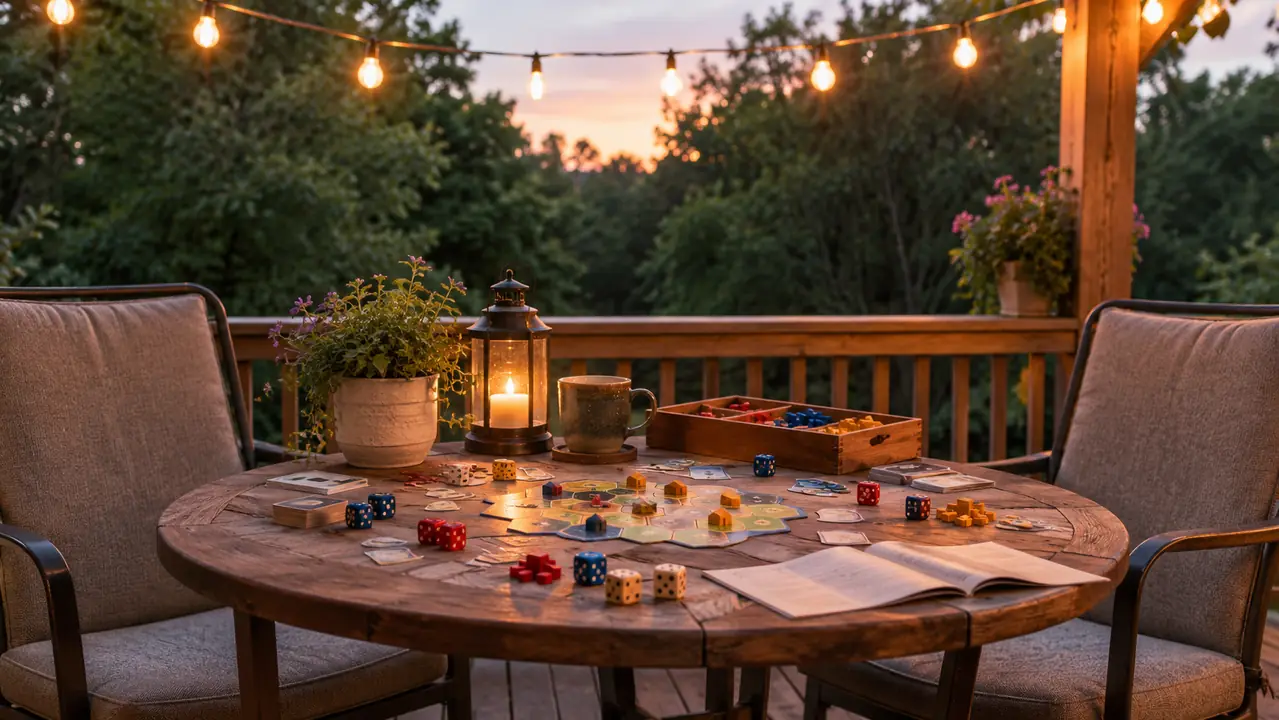
We have a short list we cycle through now. One airport in warm weather, sitting on the back porch with the box on the little table between us, and two or three more at the kitchen table in winter. The Scorpion Masqué box is travel sized, so it goes in a bag for a weekend away, which is more than I can say for the big-box games taking up shelf space in our basement.
The reason I keep coming back to it, and the reason it has stayed on our table for months, is that it is a shared problem instead of a competition. There is no winner at our house. There is a plane that landed or a plane that did not, and either way we are both responsible for the result.
We crashed three times that first night and talked for an hour and a half straight. Nobody reached for a phone.
What Else Helps
Sit side by side instead of across from each other. The control panel is one board you both read, and shoulder to shoulder makes it feel like a shared cockpit instead of a face off. It also means you both see the altitude track at the same moment, which prevents the specific argument where one of you realizes the plane is much lower than the other one thought.
Keep the box somewhere visible. Ours lives on the end of the counter for a week at a time, which is the only reason it gets played on a random Tuesday. Games in the basement do not get played. Games within reach do. If you want a screen-free hour, drop the friction to about zero and let laziness work in your favor for once.
Have something to do with your hands that is not a phone. A mug of tea, a bowl of something, whatever gets you there. The point is not the tea. The point is that the space where the phone used to be needs filling, and a board game fills it well enough that nobody notices the phone is gone.
If after three or four nights it turns out one of you genuinely dislikes it, that is useful information too. This is a cooperative game for two from Scorpion Masqué and it will not suit every pair. What it did for us was replace a default hour of scrolling with an hour of solving something together, which is closer to how we were at 28 than anything else we have tried since.
One airport, one evening, both phones in the other room
Sky Team is a two-player cooperative game for ages 12 and up, with 20 airports and optional modules for the nights when the base game gets too easy. If you want a weeknight that does not end with two people scrolling in silence, start here.
Amazon Check Today's Price on Amazon →