

Mark and I have been married for eleven years, and for most of them our date nights followed the same script. One of us would say we should do something Friday. Friday would arrive. Nobody had planned anything, so we would put the kids to bed, split a plate of nachos, and watch a movie one of us had already seen twice. It was fine. Fine is a trap.
I am a middle school librarian, which means I spend my days around people who plan things for a living, and I still could not get a two-person evening onto a calendar. What finally changed it was not a burst of discipline. It was a book on the kitchen counter. The Adventure Challenge Couples Edition hides fifty date ideas behind scratch-off panels, so the decision is already made for you and all you supply is the evening.
Fifty Date Nights You Have Not Had to Argue About Yet
Each page hides one date idea under a scratch-off panel, with time and cost guidance printed alongside, so you can say yes or not this month without wrecking the surprise. Two players. No planning session required.
Amazon Check Today's Price on Amazon →Why Date Night Planning Falls Apart
Most couples do not fail at date night because they do not want one. They fail at the decision. Deciding what to do requires three things at once: energy, childcare, and agreement. On a Tuesday at 8:30 at night, after the nine year old has finally stopped asking for water, I have maybe one of those three.
The usual fixes do not survive contact with a real week. A restaurant needs a sitter. A weekend away needs a spreadsheet. A list of ideas saved on your phone needs the enthusiasm to scroll past forty of them while someone waits for an answer. What actually works is a decision that has already been made, in a format that takes ten seconds to reveal. That is the entire pitch. It is also why The Adventure Challenge is the only one of these things that has stayed on our counter while three different meal planning apps have come and gone.
There is a subtler problem too, which is that planning becomes a job that somebody owns. In most couples one person ends up as the cruise director and the other person shows up. That imbalance is survivable for a while and then it is not. A scratch-off book splits it evenly, because neither of you knows what is under the panel until you are both sitting there with a coin.
Step 1: Pick a Night You Will Actually Protect
We started with Thursday. Not Friday. Friday is where good intentions go to die in our house, because Friday is also the night the laundry gets folded and somebody remembers a school form. Thursday is boring, and boring is exactly what you want for a standing plan. Nothing competes with it.
Then put it on the calendar as a real event with a name, set to repeat. Ours says Date Night and it shows up every week whether we are ready or not. If the plan lives only in your head, it is a wish. Mark was the one who pointed this out, which tells you how far we had drifted, because he is not the calendar person in this marriage.
One rule made the rest of it easier: the night protects the date, not the other way around. If something genuinely urgent comes up, you move the night. You do not cancel it and promise to reschedule, because later is where date nights go to become a thing you used to do. We moved ours twice in the first two months and have not missed one since.
Step 2: Put the Book Where You Cannot Miss It
The first month we owned it, the book lived in the drawer of the coffee table. We forgot it existed. The second month it moved to the counter next to the fruit bowl, and suddenly it was a thing we saw forty times a day and reached for without thinking.
It is small enough to leave out, about 9.8 inches by 7.1 inches, and the listing calls it portable, which it earns. Ours has been out to the back porch in warm weather, to a hotel room on our anniversary, and to a cabin we rented with another couple who spent the whole weekend asking what was under the panels.
Do not make it precious. Do not shelve it with the wedding album and handle it with two hands. It is a paper book in a plastic shell, it is built to get scratched, and a book with fifty unscratched pages is just a nice gift you never used. That goes double if you bought it for someone else and then set it down somewhere.
Step 3: Scratch Together, Never Alone
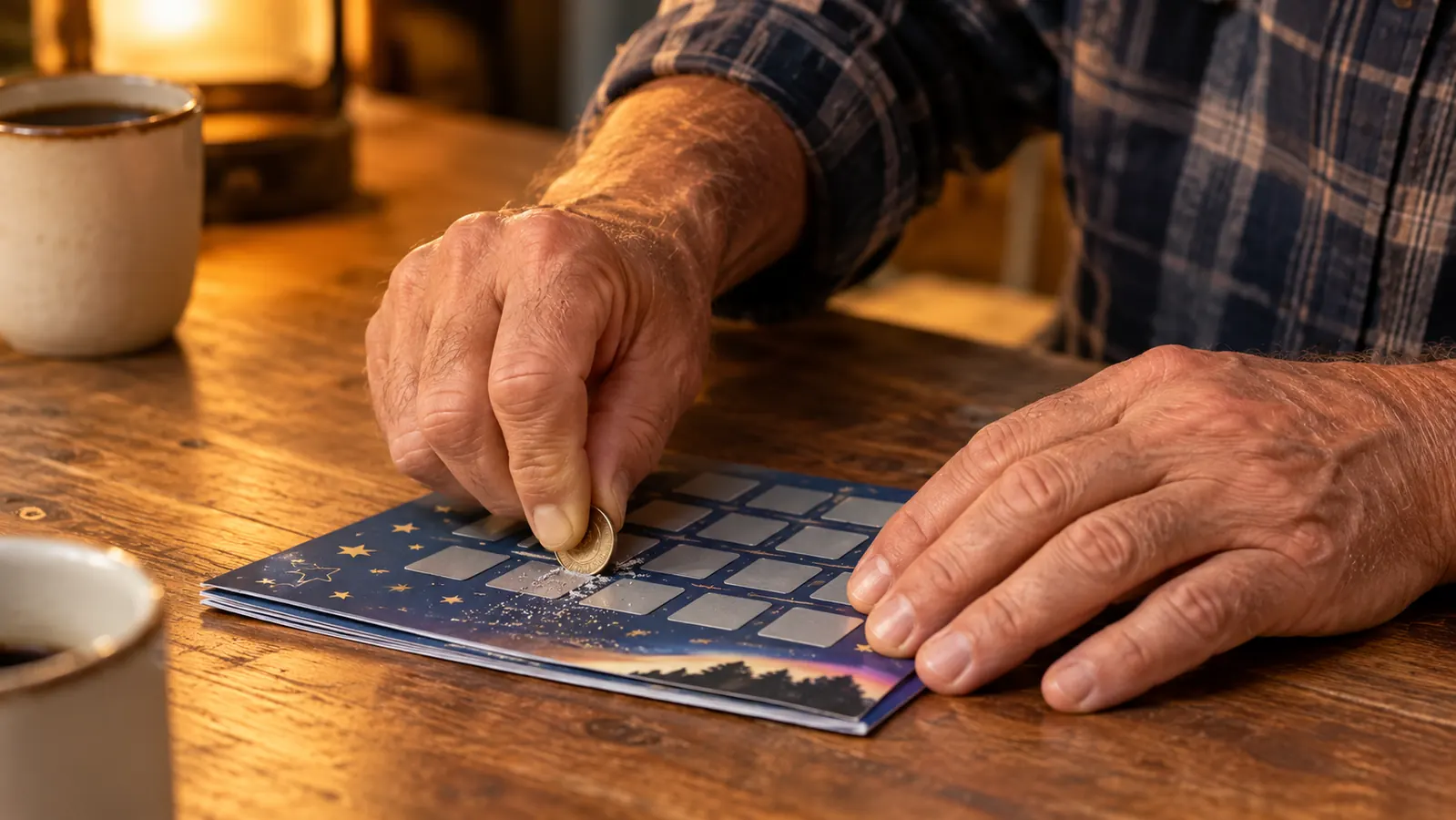
This is the one rule I would fight for. Nobody scratches ahead. Not out of curiosity, not to check whether the idea is any good, not to see whether it works with the weather. The reveal is the entertainment. Scratch it on your own and you have stolen the only part of the evening that costs nothing.
We do ours at the table with a coin, and the reveal is genuinely funny. There is a half second where neither of you knows what is under there, and then you both react at the same time. Mark is a quiet man and openly skeptical of anything with the word couples on the cover, and he has made an actual noise at a scratched panel more than once.
The other useful thing is that each idea comes with time and cost guidance printed alongside it, which means nobody has to play the bad guy. The night we scratched one that needed a full Saturday, we could say not this month and pick another, instead of having a long tired conversation about why one of us never wants to do anything.
We have scratched nineteen panels in eleven months. Two of them landed flat. The other seventeen are the reason I stopped dreading the question of what do you want to do Friday.
Step 4: Handle the Boring Parts Before They Kill the Night
A scratched idea is a small promise, and promises need logistics. We handle the three things that reliably end an evening early: the kids, the food, and whoever forgot to charge their phone. Sitter, grandparent, or the deal we have with our neighbors where they take ours on Thursday and we take theirs on Saturday. Food gets decided that afternoon, not at 8:45.
If an idea needs daylight or a reservation, book it within two weeks or it will not happen. Add it to the calendar the same night you scratch it. This sounds obvious and it is the step most people skip, and it is also the step that turns a cute book into a habit that survives a busy month.
Worth knowing before you buy: the recommended age on the listing is 18 and up, and the ideas assume exactly two players. Our nine year old has tried to dig through the book twice already, so ours lives on the high part of the counter where a curious kid cannot reach it.
Step 5: Write Down What You Did
Inside the back cover we keep a running list in pencil. Date, one line about the idea, one line about how it went. Nineteen entries so far, and it is surprising how much of it I would have lost otherwise.
The log does two jobs. It lets you skip with confidence, because if you scratch something you have already done you know immediately instead of arguing about whether it was the one with the thing at the place. And it is the most honest evidence of the whole experiment. When a friend asks whether the book is worth it, I do not have to describe a feeling. I read her four lines.
Keep it short, keep it in pencil, and do not let it become a journal. The moment the log starts to feel like homework, the whole thing starts to feel like a project instead of a night off.
The First Month Is the Hard Part
The habit does not form on the first scratch. It forms around the fourth, when the night is already on the calendar, the kids go down without a fight, and nobody has to negotiate anything. Our first month was clumsy. We scratched two ideas and only did one of them, because the other needed a Saturday we did not have. That is normal and it is not a sign that the book does not work.
By month three, Thursday had stopped being an event we arranged and become a thing that simply happened. That is the only measure that matters with a system like this, and it is worth giving it eight or ten weeks before you decide it is not for you. One more thing: do not save the good ideas for a special occasion. The occasion is that you are both in the same room and neither of you is holding a phone.

What This Book Does Not Do
It does not fix anything. If the two of you are barely speaking, fifty scratch-off panels will not get you talking, and The Adventure Challenge would be the wrong purchase at the wrong time. It works on couples who already like each other and have simply run out of ideas, which is a much more common problem than people admit.
It also is not a concierge. Some ideas need a Saturday, some need a car, and a couple need both, which is exactly why the time and cost guidance is printed there before you commit. Read that line before you scratch, not after. And it will not plan the sitter for you, because no book can.
What Else Helps
Phones in a bowl before the panel gets scratched. Not as a grand statement about presence. Just because the first thing everyone does after a reveal is look down, and the moment goes flat when you do.
Keep a coin and a pencil in the same drawer, and keep one easy idea in reserve for the weeks when somebody has had a rough one. The book does not mind being used out of order. If a scratched idea needs planning, bank it and scratch another.
Expect a small number of duds. In nineteen entries we have hit two that landed flat, and both were about our own energy more than the idea. The honest framing is that you are buying fifty shots at a good evening, not fifty guaranteed ones. That math is still better than nachos and a movie eleven times in a row.
And if you are buying this for someone else, the couples who get the most out of it are the ones who already enjoy each other and have run out of things to try. The Adventure Challenge built the format around teamwork and spontaneity, and it works because every idea assumes two willing people rather than two people who need a referee.
Your Next Free Thursday Is Already on the Calendar
Fifty date ideas hidden behind scratch panels, each one with time and cost guidance printed alongside. Put it on the counter. Pick a night. Scratch together and find out what is under there.
Amazon Check Today's Price on Amazon →