

Mark is the guy who groans when I bring home anything with the word couples printed on the box. He is 41, he fixes furnaces for a living, and his idea of a perfect Tuesday night is a documentary and a bowl of popcorn. So when I set The Adventure Challenge Couples Edition on the kitchen table, he picked it up, turned it over, and asked whether we were really going to scratch off a card and let a book decide our Friday. Yes. That is the entire premise. Fifty scratch-off dates in a bound book, and you do not know what you have picked until the coating is gone.
That is the pitch. The question I actually cared about is whether a book of scratch-off dates beats a smaller deck of scratch-off cards, the kind sold under names like It's a Date!, and after a few months of using both I think they solve two different problems. Short answer: The Adventure Challenge is for couples who want dates that feel like events, the kind you plan for and then talk about on Sunday. It's a Date! is for couples who want something small enough to keep in a bag and light enough to do on a Wednesday when nobody has any energy left. One of them lives on our shelf. The other lives in my glovebox.
| The Adventure Challenge Couples Edition | It's a Date! scratch-off cards | |
|---|---|---|
| Format | A bound book, 9.8 by 7.1 inches, holding 50 scratch-off date pages | Individual scratch-off cards that come in a small box |
| Range of dates | Fifty dates running from an evening at home to a full day out | Short dates built around a single evening |
| Planning help | Every page lists time and cost guidance before you scratch | No planning notes, you scratch and work out the details after |
| Portability | Book sized, so it stays on a shelf or in a drawer at home | Small enough for a purse, a glovebox, or a carry-on |
| Lift required | Some dates want a sitter, a Saturday, and a real budget | Most cards are doable on a weeknight with almost no setup |
| Keepsake value | Scratched pages stay in the book and become a record of what you did | Used cards end up loose, and usually in a drawer |
Where The Adventure Challenge Wins
What separates the book from a plain deck is that the dates have range and the pages warn you what you are getting into. Before you scratch, each page lists time and cost guidance, so you know whether this is a two hour thing or a whole Saturday. That sounds like a small design choice. In practice it is the difference between a plan and an ambush. With a bare deck you scratch and then discover you need a pottery studio, a reservation, and a babysitter, and by then it is nine at night on a Thursday and nobody is going anywhere. The book lets us pick a card that fits the week we are actually having.
The second thing, and I did not expect to care about this, is that it is a book. It measures 9.8 by 7.1 inches and weighs about a pound, so it sits on the shelf next to the cookbooks where both of us can see it. Visibility is underrated. A deck in a drawer becomes a thing you remember at midnight. A book you walk past every day is a nudge. Twice this year one of us has pulled it down on an ordinary Thursday, and both times we ended up doing something we would not have thought of on our own. It also helps that the listing is backed by a 4.7 star average across more than 6,700 reviews, which is not nothing when you are buying a gift for someone else's marriage.
The scratch itself does real work. Neither of us chooses the date, so neither of us can be the one who picked the boring one. My husband is a quiet man who will happily spend an entire evening discussing air handlers, and he cannot veto a card he has not seen yet. That small loss of control is the whole mechanism, and it is the reason this works on a skeptic. If I had handed him a list of fifty date ideas, he would have found fifteen polite reasons to stay home.
Where It's a Date! Wins
Here is what the smaller deck does better, and I am not going to pretend otherwise. It travels. A box of cards goes in a purse, a glovebox, a carry-on, a hotel nightstand. If you are long distance, or you take a lot of weekend trips, or you want something in the car for the odd hour when you are both free, the deck wins on logistics without a contest. Our book has never left the house. It cannot, really, unless we dedicate a tote bag to it, and I am not that person.
The deck also asks less of you, and sometimes that is the whole game. There is no planning page to read first, no budget conversation to have, no sitter to arrange. You scratch a card, you do the thing, you are done in an hour. For couples in the first year or two, or couples with a newborn, or couples who are simply worn out, the smaller ask is the one that actually happens. A date you can do at 8:45 on a Tuesday beats a nicer date you keep postponing until the calendar opens up. I have lived that math for eleven years.
It takes up no shelf real estate either, which matters more than you would think in a three bedroom house with two kids and an unreasonable number of board games. And it is easier to give. A small box slips into a care package or a padded envelope for a friend who is doing long distance. The book is a heavier gift, in every sense of the word.
The scratch is the whole trick. Neither of us picked the card, so neither of us can be the one who chose the boring one.
Fifty dates, one book, zero vetoes
If the problem is that your Fridays all look the same, the Couples Edition is the version that pushes you out of the rut. Fifty scratch-off dates, each one labeled with time and cost guidance before you commit.
Amazon See the Couples Edition on Amazon →What Both of Them Get Right
Both are analog, and in a house where the default evening is two phones face down on the couch, that is most of the value. There is a physical act involved. You hold something, you scratch something, you put the thing on the table between you. Neither one needs an app, a subscription, or a charged battery. The barrier between deciding to do something and doing it is roughly the width of a coin.
They are also both prompt based rather than question based, which is a meaningful difference from a conversation card deck. A conversation deck asks you to talk about your feelings. These ask you to go do something together, and the talking happens on its own in the car afterward. For my husband especially, doing beats discussing every single time. He will not answer a card that asks him to describe my best quality. He will absolutely drive forty minutes to look at something strange with me.

What a Weeknight Actually Looks Like
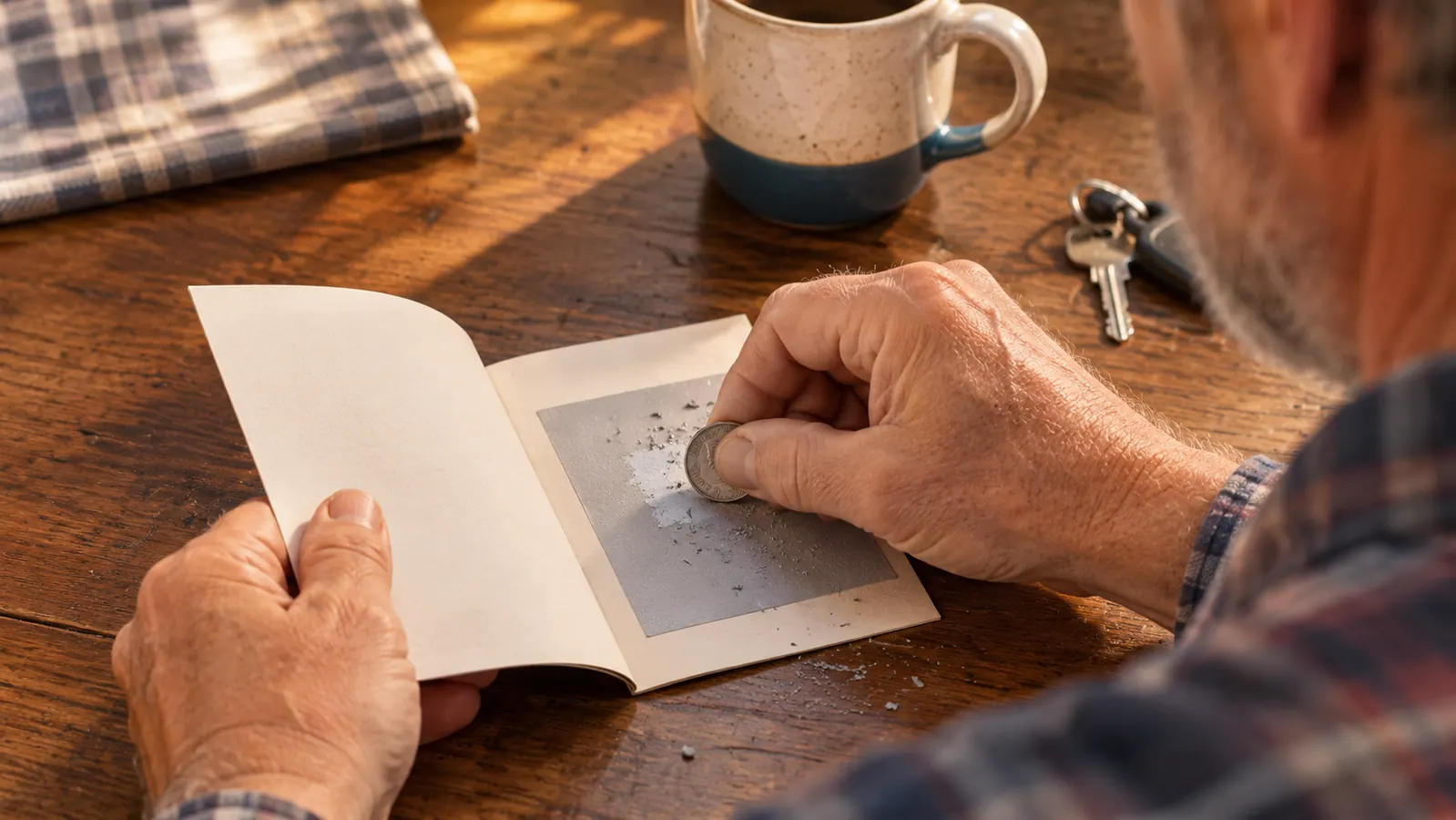
In our house the window is roughly 8:30 to 10 PM. The nine year old and the six year old are down, the kitchen table is clear, and there is a cup of tea going cold next to my elbow. That is the window the book has to work in, and it mostly does. We keep a coin tucked in the front cover because scratching with a fingernail is a mistake you make exactly once. Some cards are a kitchen table thing and we finish them before ten. Others we read, laugh at, write on the calendar, and wait for a Saturday. Both outcomes are fine. The book does not insist.
I am not going to describe specific cards, because the surprise is the product. What I will say is that the split has landed close to half and half for us. About half the cards are evening sized, and half want a day, a drive, or a sitter. The time and cost guidance on each page is what makes that workable rather than annoying, and it is also what makes the book a better gift than it looks, because the person receiving it can see that someone thought about the reality of a couple with children in the house.
One more thing about the format. The scratched pages stay in the book. Ours now holds a handful of opened cards and a few penciled notes in the margins, and it has turned into a log of the past year in a way I genuinely did not expect. A deck of loose cards does not do that. They get used, they get scattered, and eventually one turns up under a car seat.
The Fine Print Nobody Mentions
Two honest complaints. First, the size. At 9.8 by 7.1 inches it is not something you toss in a handbag, and it is not something you bring to a restaurant to fill twenty minutes while you wait for a table. It is furniture, more or less. Second, the scratching. It leaves a small pile of silver shavings, so put a napkin down or do it over the sink. The book is paper, and a wet glass ring on a scratch-off page is a genuinely sad sight.
The listing says 18 and up and two players, which is accurate on both counts. Some of the dates are clearly written for adults, and this is not a family game you play with the kids at the table. That is worth knowing before you buy it as a gift for a couple with young children who might assume it is a family activity. It is a date night book, not a board game, and it will be a strange evening if you get that wrong.
Third, and this one surprised me, not every card fits every couple. We are homebodies with a small back porch and a limited tolerance for crowds. There is at least one card in that book that would be a wonderful time for a couple who loves a crowd and a mildly stressful time for us. That is a feature of a fifty card book rather than a flaw. You are not going to love all fifty. You are going to do fifteen of them and remember eight.
What I Liked
- Fifty dates in one place, from a night at home to a full day out
- Every page lists time and cost guidance before you commit
- The bound book stays visible on a shelf, which is half the battle
- The scratch format removes the veto, which is what gets skeptics moving
- Opened pages turn the book into a record of the year
Where It Falls Short
- Too big to carry, so it never leaves the house
- Some dates need a sitter, a Saturday, and a real budget
- Scratching leaves a small mess of paper shavings
- Written for adults, so it is not a family activity
- A few cards will not suit every couple's taste
Who Should Buy Which
Buy The Adventure Challenge if you have been together long enough that your default Friday is dinner and a movie, if you have kids and need an actual nudge to plan something, and if you like the idea of a book that accumulates as you go. It is the better anniversary gift of the two, because it looks like something and it lasts. And if your partner is a skeptic about anything labeled a relationship game, this is the one I would hand him. The scratch does the persuading for you.
Buy It's a Date! if you are dating, long distance, traveling a lot, or short on both time and shelf space, and if the honest obstacle is that you never plan anything at all. A small deck you can use tonight beats an elaborate book you keep meaning to open. It is also the easier gift to mail and the easier thing to keep in a bag for an unexpected free hour.
Buying both is not ridiculous if you have the shelf, because they cover different nights. The book is for the Saturday you planned. The deck is for the Wednesday you did not. What I would not do is buy either one as a fix for something bigger. A scratch-off card is a prompt, not a counselor. If the two of you are not talking at all, a book of dates will not change that. It works best on couples who are fine and simply bored, which is most of us most of the time.
Start with the one you will actually do this month
If your version of stuck is that every Friday looks identical, take the book. Fifty scratch-off dates, each with time and cost guidance, and a shelf presence that keeps reminding you both.
Amazon Check today's price on Amazon →