

Our Tuesday nights used to end the same way. The kids go down around eight thirty, and by nine Mark and I are on the couch, one of us scrolling, the other pretending to care about whatever is on the screen. Nobody is angry. It is just the same evening on repeat. I am a middle-school librarian in Columbus, so I know the difference between a book people actually want to read and a book that sits there looking responsible. When I brought home The Adventure Challenge Couples Edition, I figured it would sit there too. Mark is an HVAC technician and a genuine skeptic of anything sold as a relationship activity. It did not sit there, and I want to be clear about why, because the box itself is a very simple thing.
Here is what it actually is: a book of 50 scratch-off date cards. You pick one, clear the panel, and find out what the date is. Each card prints its own time and cost guidance alongside, so you know before you commit whether it fits a Wednesday or needs a Saturday. Two players, ages 18 and up, and portable enough to take to the porch or a hotel room. No app, nothing to charge, no rules to learn. It measures about 9.8 by 7.1 inches and weighs roughly a pound, so it lives on the shelf next to the cookbooks instead of disappearing into a drawer.
Fifty dates you do not have to plan or talk each other into
Scratch one card, get one evening sorted. The book waits on the shelf until you need it, and the decision is already made for you.
Amazon See the Couples Edition on Amazon →It ends the what-do-you-want-to-do loop in about ten seconds
The worst twenty minutes of any date night happen before it starts. One of you suggests something, the other hesitates, and now you are negotiating. Nobody wants to be the person who picks, because the picker is responsible for whether it is fun. The scratch-off removes the committee meeting entirely. You both look at the panel at the same time and the decision arrives already finished. Nobody has to lobby, and nobody has to be a good sport about a plan they did not choose. Small thing. It changes the temperature of the whole evening.
It works on the partner who rolls his eyes at relationship games
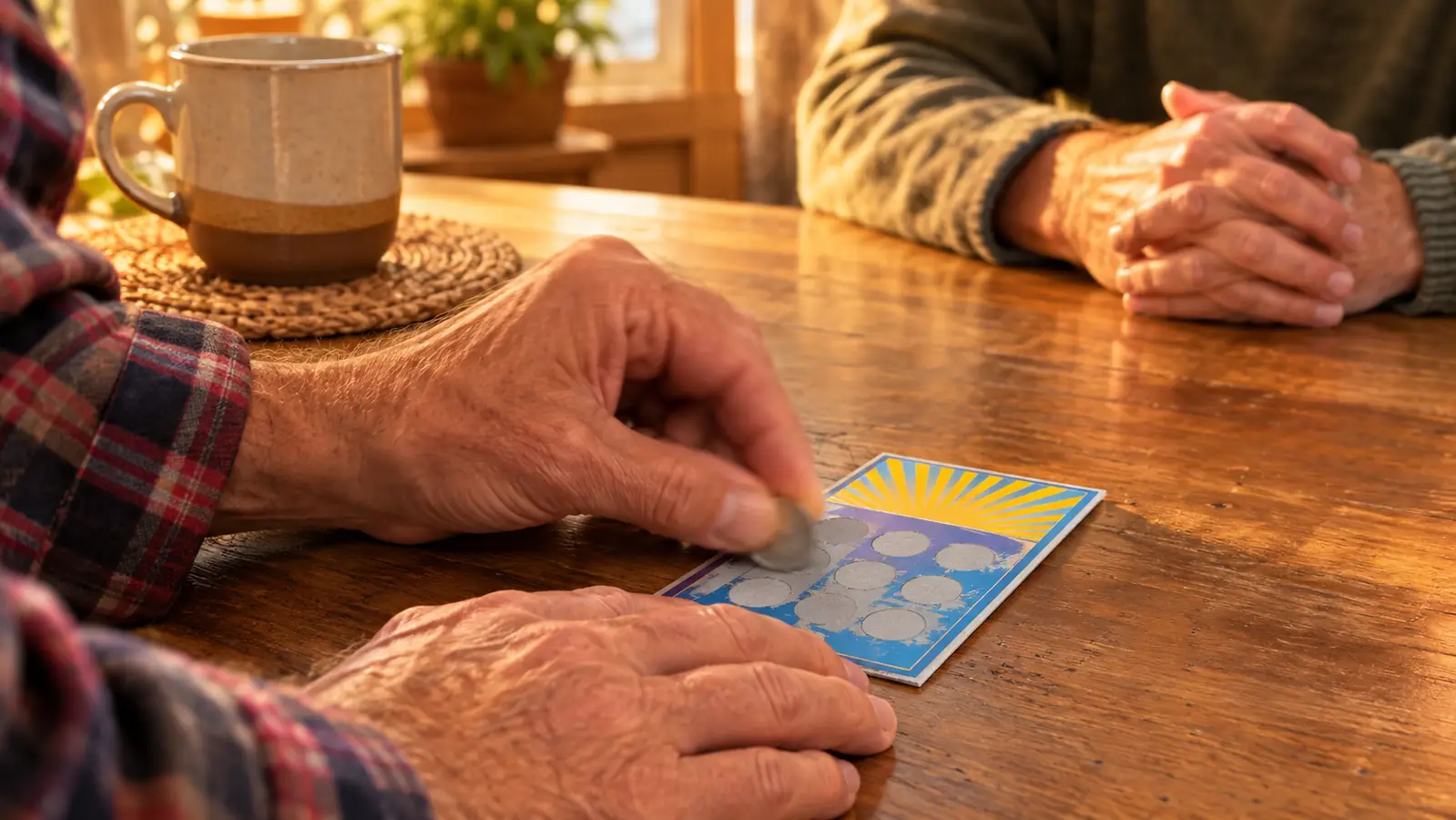
Mark's first question was, 'Is this homework?' He has a low tolerance for anything that feels like a worksheet about feelings. What got him past it is that a scratch-off card is not a conversation prompt. It is an activity with a hidden answer. He was not being asked to open up on command. He was being handed something to figure out. By the second card he was the one pulling the book off the shelf, which in eleven years I have never seen him do with a board game.
Each card shows the time and cost before you commit to it
Every card prints its own time and cost guidance, and I did not expect that to matter as much as it does. Some evenings you have two hours and whatever is already in the account. Other weeks you could do something bigger. Because the guidance sits right on the card, you can pick one that fits the night you are actually having instead of the night you wish you were having. With a nine year old and a six year old, that distinction is usually the difference between a date happening and a date not happening.
It fits the weeknight window, not just a Saturday
Most date night products assume you have a Saturday and a sitter. We get maybe one of those a month. Most of our scratching happens between 8:30 and 10 on a weeknight, at the kitchen table, with the monitor on. The book mixes small cards in with the bigger ones, which is the only reason the habit survived. A box of nothing but grand gestures becomes a guilt object on the shelf by February. The small cards are what keep you showing up.
There is nothing to set up, charge or update
No app, no account, no charging cable, no rules to teach. That sounds like faint praise until it is 8:45 on a Tuesday and neither of you has the energy for a tutorial. Board games need twenty minutes of setup and one person willing to be the rules lawyer. This is a book you open. The Adventure Challenge lists it as portable and manual, and both of those words are doing real work in a house where every other screen already wants our attention.

It gives you something to do instead of something to discuss
Here is the trouble with sitting down to have a meaningful conversation: you can feel it failing in real time. A shared activity gives you a subject. You are doing a thing together, and the talking grows out of the doing instead of being the assignment. Some of the best conversations Mark and I have had in years happened in the car on the way home from a scratched card, not at the table trying to be profound. The activity is the icebreaker. The conversation just turns up.
The mystery does the work willpower cannot
Knowing you should plan a date night and actually planning one are two different skills, and I only have the first one. The scratch-off panel fixes that with a small piece of theater. You genuinely do not know what is under it until you clear it, and that little bit of not-knowing is why we do the thing instead of talking about doing the thing. Willpower has failed me on this for eleven years. Curiosity has not failed me once.
It travels, which matters more than you would think
It went in a tote to a rental cabin last fall, and it has been out on our back porch more times than I can count. It is small enough for a bag and light enough to forget it is in there. For a couple who is long distance, this is probably the strongest argument on the list. You can each keep a copy, or work through a card together during a visit, and it needs no equipment, no screen and no reliable internet. Paper works in a cabin with bad Wi-Fi.
The used pages turn into a record of your year
We keep ours on the shelf next to the cookbooks, and the panels we have cleared stay cleared. Flipping back through them is a strange little pleasure. You can see that February was mostly kitchen-table cards and that August had two that ate a whole afternoon. It is a record of a year that nobody had to journal. I have started plenty of notebooks and finished none of them. This is the only one I have kept up with, and it is because I never had to write a word.
It solves the gift problem for the couple who has everything
I have bought a lot of wedding gifts that were really for me. This one comes with a built-in reason to get used, which is the usual failure point for gifts aimed at couples. You are handing someone fifty evenings instead of a vase. For an engaged pair it works as low-stakes practice at making plans together. For a couple married eleven years, like us, it is a nudge back toward the version of yourselves that used to go out and do things. The Adventure Challenge Couples Edition is the version I would give.
What I'd Skip
Two honest caveats. Some cards need a sitter and a real budget, and if your months are thin you will keep skipping those, which can turn the book into a running list of things you cannot currently do. If that is your season, scratch the small ones and do not feel bad about it. Also, if you genuinely hate surprises, the format fights you. You can peek at a panel, but peeking turns fifty mysteries into a to-do list and the whole thing goes flat. And the panels take a little work to clear, so this is not a thing to do in a hurry. It will not fix a relationship that is in real trouble. What it does is make a decent one less repetitive, which is the problem most of us actually have.
He asked if it was homework at 8:40. By 9:30 he was the one holding the card.
Fifty evenings instead of another Tuesday on the couch
Ours lives on the shelf next to the cookbooks and gets pulled down more than any board game we own. Two players, nothing to charge, and the decision is already made.
Amazon See today's price on Amazon →