

I bought The Adventure Challenge Couples Edition on a Tuesday night in February, mostly because Mark and I had run out of things to say that were not about the furnace or the school pickup line. Eleven years married, two kids, one nine and one six, both in bed by eight thirty. What is left of the evening after that is about ninety minutes and not much fuel in the tank. Our default was dinner and a movie, which in practice meant dinner and Mark asleep on the couch by ten. So I ordered the book and I did not tell him, because I knew exactly what his face would do.
The face, for the record, is the one he makes when I bring home a board game. Mark is forty one, he fixes heating and cooling systems for a living, and he is deeply suspicious of anything that arrives with instructions about how to feel. He calls them homework. So this is not a review written by someone who loves relationship products. It is a review written by someone married to the least persuadable man in Columbus, Ohio, who has now scratched off eleven panels with him and can tell you which parts landed and which parts we quietly skipped.
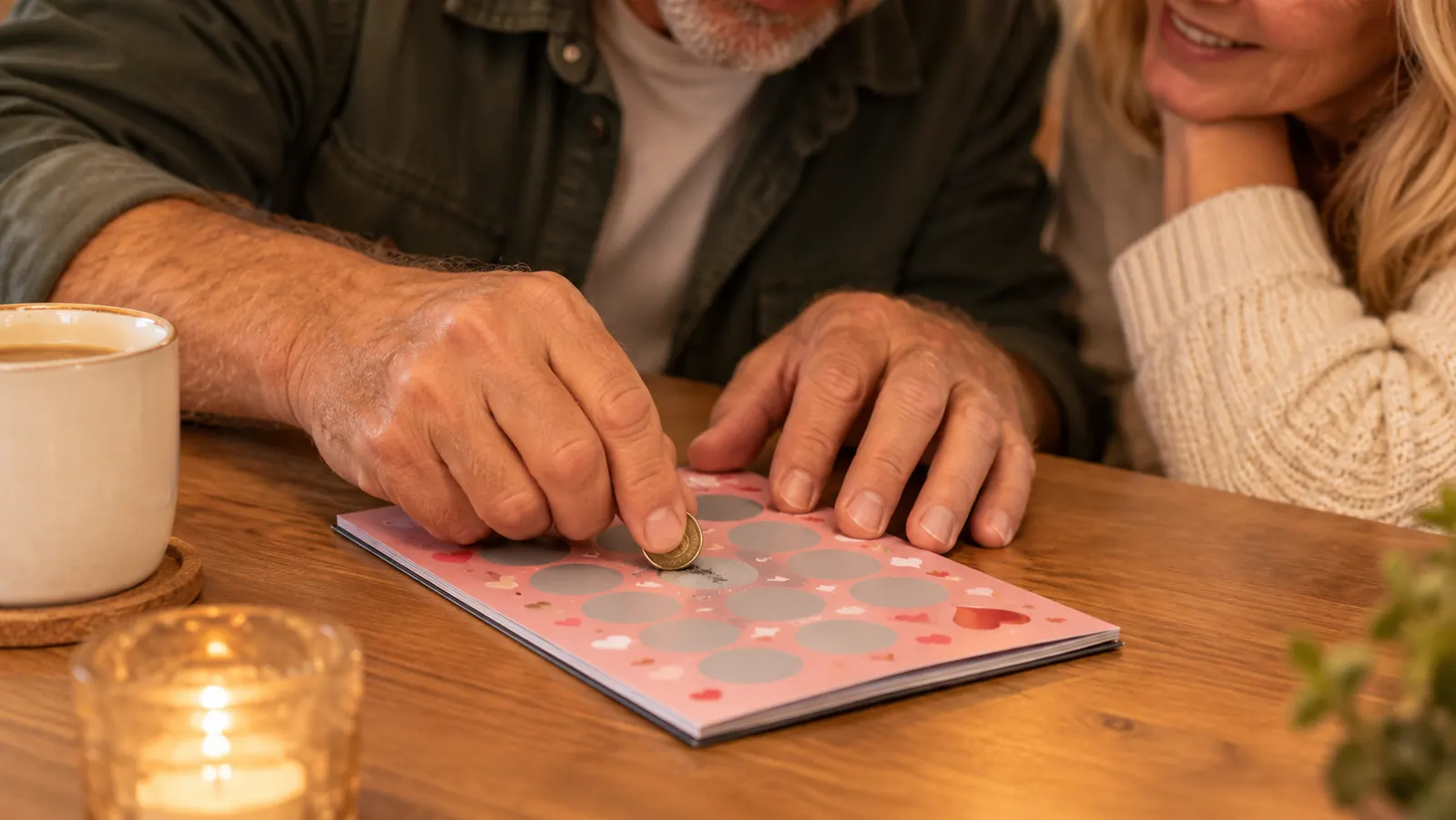
Here is what the thing actually is, because the photos make it look like a box of surprises and it is really a book. Fifty scratch-off panels, each hiding one date idea. The material is paper, it measures roughly nine and three quarter inches by seven, it weighs about a pound, and it sits on a shelf next to the cookbooks without anyone asking questions. Two players, eighteen and up, no batteries, no app, no subscription. You scratch, you find out, you go do it. That is the whole mechanism, and it works better than I expected for reasons that have almost nothing to do with the dates themselves.
The Quick Verdict
A book of 50 hidden dates that earns its place by removing the planning argument. It is a doing product, not a talking product, and it is not for couples who need to see the plan before they commit.
Amazon Check Today's Price →Scratch off the next date instead of arguing about what to do
Fifty hidden date ideas, each with rough time and cost guidance so you can say yes or not this week without a committee meeting. Two people, paper, no charging cable.
Amazon Check Today's Price on Amazon →How We Actually Use It
We do not scratch one on a whim. That was the first thing I got wrong. The very first time, I scratched a panel on a Wednesday afternoon while the kids were at school, read it, and then spent the rest of the day trying to work out how to pull it off by Friday. It needed an evening out and a sitter, and neither of those was happening on two days notice. Lesson learned. Now we scratch on Sunday night, after the kitchen is clean, and we treat it as choosing the plan for the following weekend. That single change turned this from a novelty into something we actually use.
Here is the part nobody puts in the listing photos. The scratch-off moment is fun for about four seconds, and then it becomes a logistics conversation. Each panel gives you a rough time commitment and a rough cost level, which genuinely helps, but you only see those after you have already uncovered that panel. So sometimes you scratch something wonderful that needs a Saturday, and it is a Tuesday, and you have to decide whether to shelve it or move your week around. We have a strict rule now. If the panel we scratched is not workable this month, we write it on the whiteboard on the fridge and pick another. It sounds bureaucratic. It has saved the whole thing.
The other thing I did not expect: Mark likes the scratching. He does not like the planning. He does not like talking about the planning. He will not read a page of anything that resembles a worksheet. But he genuinely enjoys being the one who takes a coin to the panel and reveals the thing. That is now his job and he takes it seriously, in the way he takes grilling seriously. It is the only part of the process where he is fully engaged without me having to sell it, and I will take that trade every time.
Eleven panels in, we have had two dates we would never have chosen ourselves, one we abandoned halfway, and zero Tuesday nights where we just watched television.
What Nobody Tells You About the Format
First honest note: not every date in the book is for you. That is by design and it is also the main complaint I would make. Fifty ideas across one marriage means the hit rate depends entirely on how adventurous you actually are, not how adventurous you think you are. Some panels require leaving the house and finding a sitter. Some require nothing but an hour and a willingness to be a bit ridiculous. Some are built around being flirtatious, which is either the entire point or the reason you should not buy this, depending on your marriage.
Second honest note: the scratch-off panel means you cannot browse. You cannot flip through and pick the one that sounds best, because they are all hidden. For some couples that is the whole thrill. For planners it is genuinely uncomfortable, and I am about half a planner. My compromise is the whiteboard rule, plus one wildcard panel a month that we are not allowed to swap out. The wildcard has produced our two best evenings so far, and also one that ended with us driving home early and getting tacos. I will not tell you which.
Third: this is not a conversation card deck. I own two of those and they are a different product with a different job. Cards are for staying at the table and talking. The Adventure Challenge is for doing. If your problem is that you have stopped talking, a card deck is the more direct tool. If your problem is that you have stopped doing anything other than managing a house and two children, this is the closer match. I have heard people describe this book as a conversation starter and it is not that, and I think that mismatch sits behind a good chunk of the disappointed reviews out there.
The Parts That Annoyed Us
The paper is sturdy and the scratching works, but the panels do not always come off cleanly. Use a coin that is too sharp, or dig at it, and you can tear the surface and end up reading a partial sentence. Mark did exactly this on panel four. We pieced it together from context, but it was irritating, and there is no second copy of that panel. Use something blunt and go slow. That sounds like a small thing. In practice it is the single most common way to lose a date from the book.
The cost guidance is helpful and it is also incomplete. It tells you roughly what a given date will run you, which is more budgeting than most books offer, but it cannot account for the sitter. With two kids under ten, the real cost of an evening out is the date plus the sitter plus the drive, and nothing on the panel is going to tell you that. We started weighting the at-home panels higher for that reason, not because we prefer them, but because the math works better on a Thursday.
There is also no organization system worth the name. The panels are loosely themed, but there is no index, no checklist, and no way to mark what you have done other than the fact that the panel is scratched. If you are the kind of person who wants to track it, you will build your own system. I put a sticky note on the inside cover. Mark says that is the most librarian thing I have ever done. He is not wrong.
What the Dates Are Actually Like
There is a wide range. Some are essentially an errand you have been given permission to enjoy, which sounds faintly insulting until you have done one and realized you have not done anything playful in a year. Some are full evenings out that need real planning. A few are the sort of thing that would make a shy person quietly perish, and I say that with affection, because Mark is that shy person and he survived. No, I am not going to spoil them. That is the entire product.
What surprised me is that the quality of the evening did not track with how elaborate the date was. Our best one so far required no spending at all, happened on the back porch in September, and lasted about forty minutes. Our worst one was the most effortful, involved a drive, and was fine. Fine is not nothing when the alternative was television, but it is not the story we tell people at parties.
The dates also have a way of surfacing things. Not in a therapy way, in a practical way. We learned on one of them that we disagree about what counts as a good time, which we did not know after eleven years, which is either funny or alarming. We laughed about it afterward in the car. I would not trade that hour.

How It Holds Up Over Months
Eleven panels in, the book looks fine. The scratched panels are obvious, which is exactly what you want, and the binding has not cracked. It lives on the shelf between the cookbooks and a stack of library books and it gets picked up maybe twice a month. That is the honest cadence. Twice a month, not twice a week. The couples who burn through all fifty in a single summer are the ones who will be reselling it by fall, and I think that is a mistake, because the long shelf life is the point. Fifty panels at two a month is roughly two years.
Where it gets sticky is year two. Once you have scratched a good number of them, the remaining options feel less varied and the novelty has worn thin. We are not there yet but I can see it from here. My plan is to slow down rather than speed up, keep the wildcard rule, and be honest with myself that this is a tool for a season when we needed it, not a permanent fixture of the marriage.
What I Liked
- No planning required on the night itself, the decision is made the moment the panel comes off
- Each panel carries rough time and cost guidance, so you can veto a date before committing a weekend
- Works on a skeptical partner because it is doing rather than talking about feelings
- Small enough to shelve with the cookbooks, portable enough to pack for a trip
- Fifty panels at twice a month is roughly two years of use
Where It Falls Short
- You cannot browse or choose, which is the point and also the friction
- Some dates need a sitter or a full evening, and the panel cannot warn you before you scratch
- Panels can tear if you use something sharp
- No index or tracking beyond the scratched surface
- Marked 18 and up, and some ideas are flirtatious, which will not suit every couple
The Gift Question
A lot of people arrive at this product as a gift, and I understand why. It looks like a present, it photographs well, and it solves the problem of what to buy a couple who already own a toaster. My advice is to buy it for a couple who are visibly playful, not for a couple you are quietly worried about. A book of hidden dates handed to a marriage in trouble reads as a hint, and nobody wants to receive a hint in a box.
It also carries an eighteen and up marking, which matters if you are shopping for a nephew or a coworker. The dates are not explicit, but some are flirtatious, and the whole premise assumes two adults with their own place and their own schedule. I gave one to my sister and her husband for their anniversary and it landed well. I would not bring it to a work gift exchange.
Who This Is For
Couples who have drifted into logistics. If your conversations are ninety percent schedules and house maintenance and you cannot remember the last time you did something together that did not have a purpose, this is a low effort way to break the pattern. It is also good for the couple where one person plans everything and resents it, because the book takes the planning off both of you and puts it on the panel. And it is a strong gift for an engaged couple or a couple with young kids, because it does not require them to share a hobby.
It also works for long distance, with a caveat. Some panels are do-together-in-person and will simply have to wait. Others can be done over a call if you are both willing to be ridiculous. I would not buy it as a primary long distance tool. The Adventure Challenge is the thing you keep for the visits, not the thing that carries you between them.
Who Should Skip It
Skip it if the two of you are genuinely struggling to communicate and neither of you wants to sit down and talk. This is not a substitute for that conversation, and I would be doing you a disservice to pretend otherwise. Skip it if you have already bought a date night subscription or a card deck and it is sitting in a drawer, because a new format will not rescue an old habit. And skip it if you are private about being playful out in the world, since several of the dates happen in public.
Skip it, too, if you need to know what you are getting before you commit. The entire product is the not knowing. If that reads as stressful rather than fun, you are the person who will scratch one panel, feel mildly annoyed, and put the book back on the shelf. I have a friend exactly like this and I told her not to buy it. She thanked me.
If your weeknights have turned into logistics, start with one panel
Two people, paper, no batteries and no subscription. Scratch it on Sunday, do it on Friday, and find out whether the two of you still like being ridiculous together.
Amazon Check Today's Price on Amazon →