
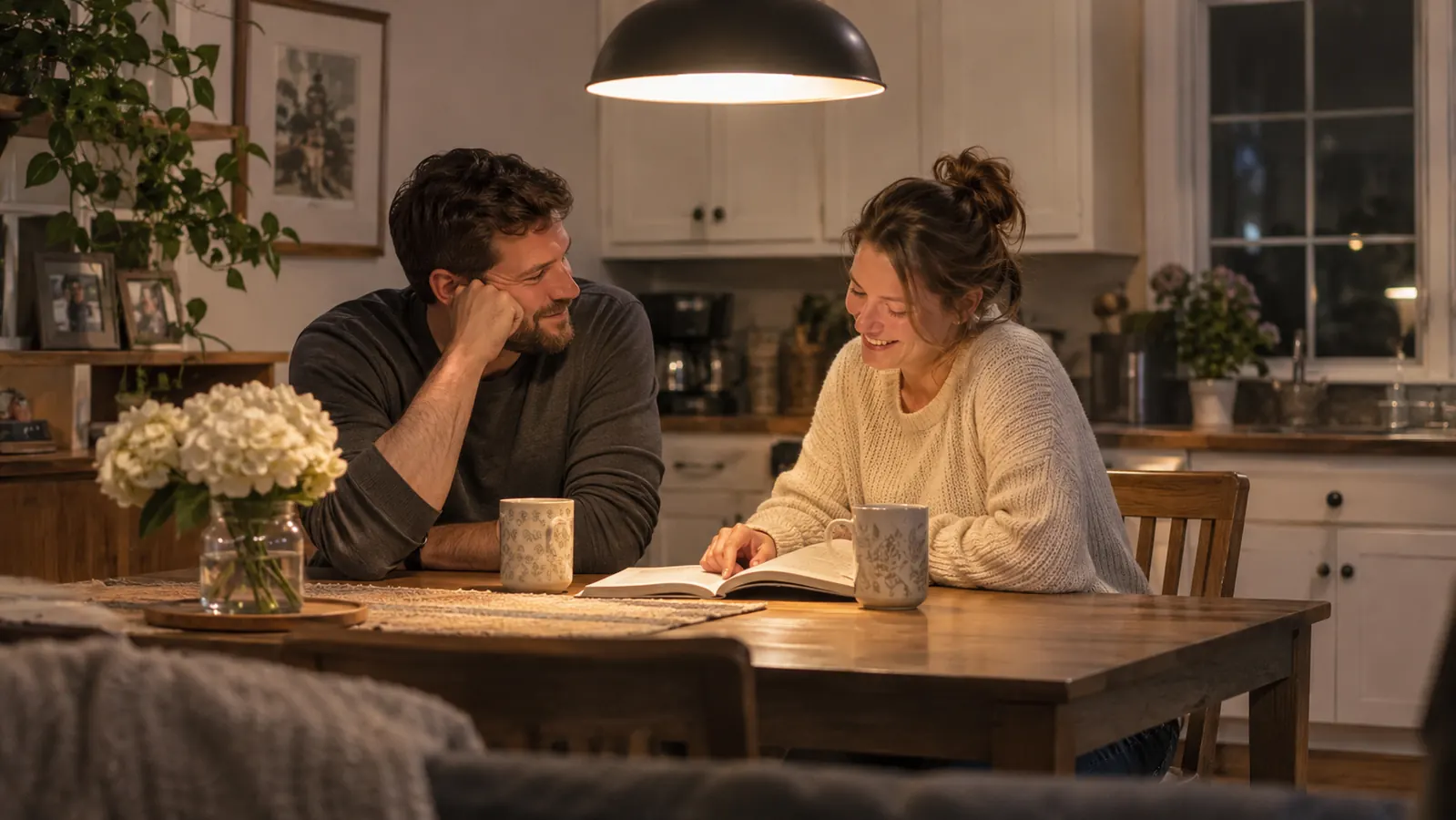
At 8:40 on a Tuesday night, both kids finally down, Mark sat at the kitchen table with his phone and I set a book between us. He looked at it the way he looks at a furnace that is making a noise: suspicion first, diagnosis second. He asked whether this was one of those relationship games. It was not a question. It was a ruling. I told him it was one question, one page, maybe ninety seconds, and if he hated it we would stop. That was the deal that got the cover open.
We have been married eleven years. Mark is an HVAC technician, so he spends his days on problems with actual answers, and a prompt about feelings makes him twitchy. I am a middle-school librarian, so I spend my days asking questions of people who would rather be anywhere else on earth. The book was A Year of Us, a couples journal from Callisto (Alicia Muñoz): 196 pages, one question a day, about the size of a paperback novel. I bought it half for us and half because I wanted to know whether a book could get him talking without me pulling.
The Quick Verdict
A daily question book that got my skeptical husband talking inside the first week. It works if you already have ten quiet minutes at night. It will not do the work for you.
Amazon Check Today's Price →The questions that got a skeptic talking, one page at a time
A year of daily questions, 196 pages, no app and no scoreboard. Check today's price and read the sample pages on Amazon.
Amazon Check Today's Price on Amazon →How I've Used It
Here is the mechanic, because it matters more than any description of the book. One question a day. We keep it on the kitchen table next to the napkin holder. Whoever sits down first after bedtime opens it and reads the question out loud, and then both of us answer. I write mine down. Mark does not write his, which is its own small piece of information about us and one I did not need a book to learn.
We have run it in stretches. Some weeks we hit five nights. Some weeks we hit one. In July the air conditioning died and the house sat at 88 degrees for four days and we did not open the book once, and nothing bad happened. That is the part I did not expect to appreciate. It does not nag. No notifications, no streak to break, no monthly recap telling me how connected we are. It sits on the table being a book, and we come back to it.
Ninety seconds to ask, five minutes to answer if the question lands. That is short enough that Mark, who has vetoed every card deck I have ever brought home, has never once said not tonight after the first week. It is also short enough to do while the dishwasher runs and the six-year-old is calling down the stairs for water.
We tried a card deck first, and the failure was structural rather than about the questions themselves. The tin came out of the drawer, we shuffled, one of us read a card, and then someone had to decide what to do with the tin. It was a parlor game with a timer nobody had set. We got through four cards twice and then it went in the junk drawer, and I know it was early spring because I found it again in June while looking for a tape measure. What the book has that the deck never had is a place. The cards live in a drawer. The book lives on the table, in arm's reach, next to the salt. That difference is most of the product.
One night in late September I opened it while Mark was still in the basement and read the question to myself first to see whether it was worth waiting for him. It was not, so I turned one page ahead. I know you are not supposed to do that. Being able to flip ahead quietly is a small advantage of paper that I have used more than once. The next one asked about a habit of his that I had simply gotten used to, which is a question that could go badly, and it went fine, and we ended up laughing about the way I reorganize the spice rack every few months without telling anyone.

How the Book Is Built
The basics, since a gift buyer will want them. It is a physical book, 196 pages, 6 by 9 inches, a bit under half an inch thick, and the listing gives the weight as 2.31 pounds. It was published in June 2019 by Callisto (Alicia Muñoz) in English, and it is part of the Question a Day Couple's Journal series. That is the whole physical description, and honestly it is nearly the whole product. There is nothing to charge, pair or update.
Being a physical object turns out to be the feature. Ours lives on the table where we can see it, which means the decision to use it takes about as long as reaching for a fork. Every app we have tried for this kind of thing lives behind a login and a notification that arrives when I am elbow-deep in something else. The book has no such problem. It also does not die with the Wi-Fi, which in a house with two kids and a full schedule is a genuine consideration.
It is also quiet. That sounds like nothing. It is not nothing at nine at night after a day of two children and a school library full of seventh graders. The book asks for attention and then gives it back.
The pages are matte rather than glossy, which matters if you write with a gel pen like I do. Mine has not bled through once in several months of use. The cover is soft, so it does not lie perfectly flat the way a spiral notebook would, and I have more than once set a mug on it to hold a page while I answered. There is writing room under each question, enough for two people's answers if you both keep it to a few lines, and not so much that a page starts to feel like homework. At 6 by 9 inches it fits in a tote bag, and it went with us on a weekend trip in the fall, which is the only trip we have taken without the kids in four years.
The Questions That Actually Got Him Talking
Some prompts land flat. I am not going to pretend otherwise. A handful are the kind you answer in four words and then reach for your coffee. The pattern is clear after a few months: the specific questions work and the abstract ones do not. Anything that asks me to describe a thing, a day, a version of myself, a decision, gets a real answer. Anything that asks us to characterize the relationship gets a shrug and a joke.
But roughly one night in three, a question does something I did not plan for. Early on, one asked what job he would do if money were not a factor, and Mark talked for eleven minutes. Eleven. He has never talked for eleven minutes about anything that was not a furnace. I learned about a plan he had at nineteen that he had never mentioned in eleven years of marriage, and I learned it sitting eight feet from the refrigerator.
The other thing it does is slow the start of a conversation that would otherwise not happen. Most of our weeknight talk is logistics: who has the nine-year-old at 4:15, whether we are out of milk, which of us is doing the school run. The question interrupts that. It hands us a topic that is not a task, and it does it before we have a chance to default to the calendar.
Another one asked what I would tell my twenty-five-year-old self, and Mark answered before I had finished reading it, which is a thing he does not do. He said he would tell himself not to take a particular promotion years ago, then explained why for a while, and I understood something about the last two years of our marriage that I had been quietly assigning to a different cause entirely. I am not going to repeat the details here. The point is that the information was in him and the question got it out, and eleven years of ordinary conversation had not.
The questions that fail are the ones that ask us to rate something. Rate the week. Rate how connected we feel. Anything with a number attached makes him sound like he is filling out a form at the dentist. Anything that asks for a story gets a story. If you are the sort of couple who likes a rating scale and a place to track a score, this is not the book for that, and there is a separate category of couples journal built entirely around check-ins and numbers.
How It Compares to the Other Journal People Recommend
There is a whole shelf of these now, and the one that comes up most often is Our Q&A a Day. Both are daily question books for couples, and the difference comes down to tone more than structure. This one, the Callisto (Alicia Muñoz) journal, leans warm and conversational, with prompts that read like something a friend would ask over a second glass of wine. That is the register that works on Mark. Drier, more interview-style books get an answer that sounds like a witness statement.
If you are deciding between formats, the practical question is which one your partner will actually open. A journal nobody opens is a paperweight with opinions. Ours gets opened because the prompts are the sort that make a quiet person feel like he has something to say rather than something to perform.

Where It Slips
The honest cons. First, skipping days is easy and the guilt is quiet but real. There is no date pressure in the book itself, so you never feel technically behind, but after a ten-day gap you feel behind in a way that makes opening it harder. Second, one direction is not enough. This only works if both people answer. If one partner gives a two-word reply and checks the phone, you have a very nice book and a very one-sided evening.
Third, it does not fix anything. It is a prompt, not a counselor. If the underlying problem is that you are barely speaking to each other, a question on the table will not bridge that, and it might make the silence more obvious. Fourth, by month four or five the prompts start to rhyme with each other. That is the cost of a full year of questions. Some nights you will read one and think, we did this one in February.
None of those are reasons to skip it. They are reasons to buy it with your eyes open. We still use it, and the nights we use it are better than the nights we do not.
The ten-day gap happened in August, during that heat wave, and when we came back to it the page was exactly where we left it, which is both the mercy and the problem. Nothing catches you up and nothing scolds you. We read the question for that day and skipped the nine we had missed, and it turns out the book does not mind at all, so I had to decide whether I minded. I decided I did not. For a couple with a streak-keeping temperament, that could easily go the other way, and I would rather warn you than have you find out in week three.
One more practical thing: there is no index and no way to search. A question you loved in February is genuinely hard to find again. I have spent a good half hour flipping through pages looking for the one about the job at nineteen. I eventually folded the corner, the only folded corner in the book, and Mark noticed it and asked why, and that turned into its own small conversation on a Wednesday while the dishwasher ran.
What I Liked
- One question a day, short enough to finish on a weeknight after bedtime
- Specific prompts that get a quiet or skeptical partner talking
- No app, no notifications, no streak to break
- 196 pages, so a full year of questions rather than a deck you burn through in a month
- Reads as a real book, which makes it an easy anniversary or wedding gift
Where It Falls Short
- The prompts start to repeat in feel by month four or five
- Only works if both partners answer, it will not carry a one-sided effort
- No structure to catch you up if you fall weeks behind
- Not a substitute for counseling if the silence between you runs deep
He talked for eleven minutes about a question in a book. He has never talked for eleven minutes about anything that was not a furnace.
Who This Is For
Couples who already have ten quiet minutes and want to spend them differently. Married, dating, engaged, long distance, all fine. It is especially good for the pairing where one person is the talker and the other needs a reason to start. New couples get a lot out of it because everything is still new. Long-married couples get something different, which is the occasional surprise, the detail you never thought to ask about after eleven years. It is also a genuinely good anniversary or wedding gift, partly because it looks like a book and not a therapy assignment.
Who Should Skip It
Skip it if nobody in the pair actually wants to do it. Skip it if you are buying it to hand to a partner as a hint, because that lands badly every time. Skip it if you are in a rough patch and hoping a book will do the work of a professional, because it will not, and I would rather say that plainly. And skip it if you know the two of you hate prompts and will feel a small daily failure every time you walk past it on the table. The book is patient. Your guilt is not.
One question a night, starting tonight
196 pages, one question a day, and a partner who has to open it. Check today's price on Amazon and read the first pages before you decide.
Amazon Check Today's Price on Amazon →